India-Vietnam BrahMos Missile Sale Talks
Vietnam secures BrahMos missiles for $629 million.
Model Diplomat8 min readSoutheast Asia

India-Vietnam BrahMos Deal Signed: What Hanoi Actually Bought
India's ~$629 million BrahMos sale to Vietnam was signed months before it was revealed at Shangri-La — and it is Hanoi's first hard capability against China at sea.
India's defence secretary let a rehearsed line slip in Singapore on May 31, 2026: the BrahMos supersonic cruise missile deal with Vietnam "has already been signed, probably not publicly announced, but it's already been signed." That answer, reported by The Diplomat, confirms a roughly $629 million contract quietly closed in the last Indian fiscal year — and it does more than add Hanoi to a customer list. It gives Vietnam its first combat-proven, standoff anti-ship weapon against China at a moment when Hanoi is publicly drifting toward Beijing on rail, trade and diplomacy. The BrahMos is what Vietnam is buying instead of choosing a side.
The deal, as best we know it
Defence Secretary Rajesh Kumar Singh spoke at the Shangri-La Dialogue in response to a Vietnamese delegate, telling reporters the Vietnam contract was inked in FY 2025-26 and kept off the record "given the sensitivities involved," per ThePrint. A Reuters figure, cited by
BBC Vietnamese, values the package at about 60 billion rupees — roughly $629 million — including training and logistics. The Observer Research Foundation's Harsh Pant, writing before signature was confirmed, put the shortlist at five shore-based anti-ship batteries with "techno-commercial details already shared";
ORF and Hong Kong's SCMP have separately estimated the ceiling closer to $700 million.
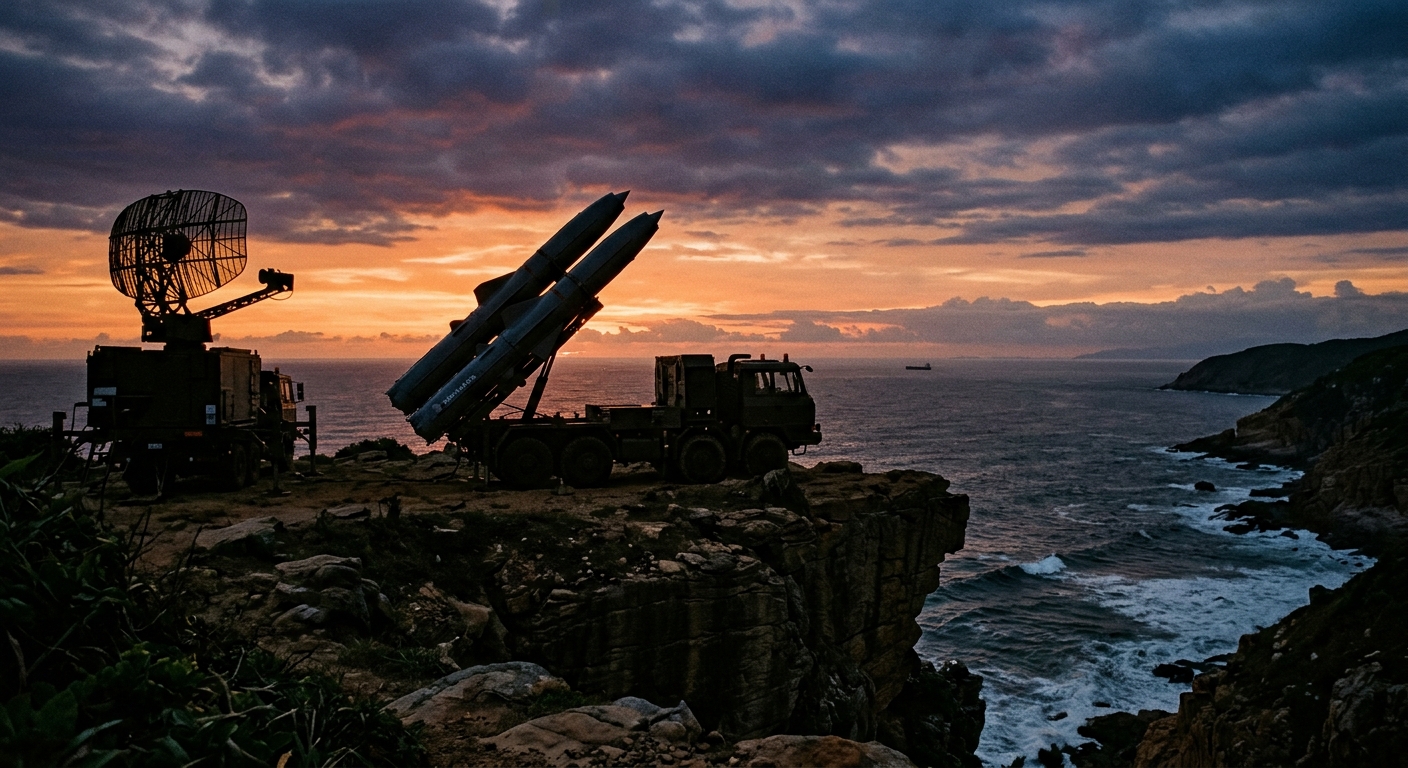
What Hanoi is buying is specific: the shore-based coastal-defence variant of the Indo-Russian ramjet cruise missile, launched from truck-mounted mobile batteries, flying at Mach 2.8 with a 290 km range and a 200–300 kg warhead. Vietnam's Ministry of Foreign Affairs has not confirmed the contract. India's Ministry of External Affairs confirmed, in the joint statement issued during Vietnamese President Tô Lâm's May 5–7, 2026 state visit, that "defence systems procurement" was formally on the table — the closest either side has come, in a public document, to acknowledging BrahMos.
Why now, and why quietly
The timing is not accidental. BrahMos had its combat debut in May 2025 against Pakistan, striking the Nur Khan airbase in Rawalpindi and the Bholari base in Sindh during the four-day war triggered by the Pahalgam attack. Pakistan's Chinese-supplied HQ-9B surface-to-air system, per an Al Jazeera year-on retrospective, "failed to intercept the BrahMos missiles." India's second Chief of Defence Staff, Anil Chauhan, used the same Shangri-La platform in June 2025 to confirm the strikes. The 12 months between the strikes and the Vietnam confirmation are the marketing tailwind. Every Southeast Asian buyer now knows the missile works against a Chinese-built layered air defence — a datapoint no brochure could have supplied.
That is why the sale, and the disclosure, were staged this way. India signed the contract during the fiscal year that closed March 31, 2026 — before Tô Lâm's visit — but withheld announcement to protect Hanoi's parallel diplomacy with Beijing. Vietnam's General Secretary and President spent the same spring signing 32 cooperation documents with Xi Jinping, praising Chinese high-speed rail, and floating partner status in the Shanghai Cooperation Organization, as the Carnegie Endowment documented in an April 2026 essay titled "Why Vietnam Is Swinging in China's Direction." A BrahMos press release in that context would have detonated the choreography.
The New Delhi visit reset the balance. Ties were elevated to an "Enhanced Comprehensive Strategic Partnership," a new 2+2 Strategic Diplomacy-Defence Dialogue was established, and the two sides set a bilateral trade target of $25 billion by 2030, per the official outcomes list from the PMO. On defence lines of credit, ORF's post-visit analysis notes that projects worth $300 million have now been identified under the older $500 million facility — 14 high-speed patrol boats, three to four offshore patrol vessels, submarine battery procurement — with Modi personally offering MRO support for Vietnam's Sukhoi Su-30 fighters and Kilo-class submarines. BrahMos sits on top of that stack, not inside it.
What Hanoi is really buying
The strategic content of the missile is the range ring it draws around the western South China Sea. Deployed on the Vietnamese coastline — plausibly around Da Nang, Cam Ranh, and the Gulf of Tonkin approaches — shore-based BrahMos batteries put every square kilometre of Chinese-claimed water inside the nine-dash line off Vietnam within reach of a Mach-2.8 sea-skimming missile with a two-to-four-minute flight time. That is what Chinese analysts, cited by ORF, describe as a "clamping effect on the South China Sea's western side."
It is also a step Vietnam has ducked for a decade. Bilateral talks on BrahMos have been running since 2011–2012, per ORF's Rajeswari Rajagopalan, and India was ready to move as early as 2016 once Russia formally cleared re-export. What held Hanoi back was its "Four Nos" doctrine — no alliances, no siding against any country, no foreign bases, no use of force — a framework the Australian Institute of International Affairs describes as still binding, but under strain since China's declaration of a new baseline in the Gulf of Tonkin in March 2024. That baseline,
analysts writing for the AIIA argue, both "denied the bilateral agreement that had been agreed and departed considerably from UNCLOS principles." BrahMos is Hanoi's answer that does not require Hanoi to say anything.
The choice of supplier is the second signal. Vietnam already operates Russian-origin Bastion-P coastal batteries with Yakhont missiles. It could have topped them up. Instead it went to the Indo-Russian joint venture — a diversification move away from a Russian defence industry that, per Chatham House, has seen Indian arms imports from Russia fall from 76% in 2009–13 to 36% in 2019–23, with delivery delays on the S-400 and spare-parts backlogs from the Ukraine war eroding buyer confidence. Vietnam, watching that shift, has effectively used the BrahMos programme to Indianise a Russian weapon. New Delhi delivers, trains, and supports — and, as defence analyst Rahul Bedi told
BBC Hindi, India throws in deployment, training and spares "at very low cost, or sometimes free."
Who wins, who pays
The immediate winner is BrahMos Aerospace, whose export book has moved in twenty months from a single $374.96 million Philippine contract, signed January 28, 2022, to three regional buyers with a combined announced value approaching $1.5 billion. India's Ministry of Defence has publicly targeted ₹50,000 crore in annual defence exports by FY 2029-30, up from roughly ₹38,000 crore in FY 2025-26, per figures cited by
BBC Hindi. The Council on Foreign Relations, in a
January 2025 briefing, notes that India's defence exports were about $2.4 billion when the Vietnam pipeline was moving; the Vietnam contract alone approaches a quarter of that base.
The second-order winner is India's naval logistics footprint. The 2022 Mutual Logistics Support MoU signed by Rajnath Singh and Phan Van Giang, per the Press Information Bureau, is "the first such major agreement which Vietnam has signed with any country." That, combined with Modi's May 2026 offer to service Vietnam's Sukhois and Kilos, embeds Indian technicians in Vietnamese maintenance chains — logistical geometry that ORF's analysts, in a
post-visit assessment, call a "node, not a pivot," useful to New Delhi as its navy pushes east.
The loser is not Beijing directly; China's stance on BrahMos exports has softened from active protest to strategic irritation. The loser is Russia. Its own Yakhont/Bastion export franchise in Southeast Asia is now boxed in by a missile that carries its ramjet engineering DNA but flies under Indian export licences and Indian sustainment contracts. The RAND corporation, in a 2023 commentary, flagged this trajectory well before the Vietnam signature: India, it wrote, is quietly "becoming a power in Southeast Asia." The BrahMos order book is the empirical form of that argument.
The China question, honestly
Two objections deserve airtime. The first is that BrahMos gives Vietnam a coastal-defence capability, not a war-winning one; five batteries at 290 km range cannot close the western South China Sea against a PLA Navy that operates three aircraft carriers and the world's largest coast guard. That is true. But coastal-defence missiles are not built to win wars; they are built to raise the cost of a first move. Chinese analysts, per ORF, are less concerned about combat outcomes than about the political signal: that Hanoi has chosen — for the first time — to buy a system whose only credible target is the PLA Navy.
The second objection is that Vietnam's "swing toward China," documented by Carnegie, will overwhelm any Indian deterrent. Here Diplomat readers should watch the divergence, not choose one narrative. Hanoi is doing both: dense economic embrace with Beijing, dense military hedging with New Delhi. The bamboo bends. What Tô Lâm told the Indian Council of World Affairs in May 2026, per ORF, was that defence cooperation should "move beyond frameworks into delivery" — an explicit break with the aspirational tone of every prior India-Vietnam joint statement.
Forward look — what to watch
- The formal announcement. Vietnam has not confirmed the contract; the Ministry of National Defence in Hanoi has said nothing on record. Any public disclosure will likely be tied to a delivery milestone or to a Modi state visit to Hanoi, which the ECSP statement flagged as forthcoming.
- Delivery timeline. The Philippines took just over two years from signature to first battery delivery. A comparable schedule puts Vietnam's first BrahMos hardware ashore in late 2027 or 2028 — before the ASEAN chair rotation and the next Chinese Party Congress cycle.
- The second contract. BrahMos Aerospace CEO Atul Rane has publicly flagged Malaysia and Thailand as next-order candidates; a Malaysian expression of interest at [DSA 2026] would confirm the missile's Southeast Asian pivot.
- The Extended-Range test. India's tested BrahMos-ER (~500 km) is not part of the Vietnam package under MTCR-compliance framing; a follow-on sale of the extended-range variant would be the escalation to watch.
Diplomat View
The Vietnam BrahMos contract is the most consequential arms sale in Southeast Asia this decade — not because $629 million reshapes a regional balance, but because it marks the first time a "Four Nos" state has bought a combat-proven anti-Chinese missile from a supplier who is neither Washington nor Moscow. That is a template. Expect Malaysia, and possibly Thailand, to follow within eighteen months, and expect the Indo-Russian joint venture to press for extended-range and air-launched variants on the same buyer list. Our forecast: by the end of 2027, BrahMos will have overtaken the Russian Yakhont/Bastion family as Southeast Asia's benchmark coastal-defence system. The forecast breaks if Vietnam publicly cancels or freezes the contract in response to a Chinese economic-coercion package — plausible but unlikely, given that Hanoi accepted the price of signing this deal before Tô Lâm's Beijing bullet-train rides. Watch delivery dates, not press releases; the missiles, not the missives, will tell the story.
The Bottom Line
Vietnam has bought India's BrahMos for roughly $629 million because it needs a hard-capability answer to China at sea that does not require it to formally align with the United States, and India has sold it — quietly, in FY 2025-26 — because a combat-tested missile is now its highest-value export and its most credible instrument of Indo-Pacific influence. The disclosure, not the contract, is the news; the delivery, in 2027 or 2028, will be the strategic fact.
Discover more

India
India-South Korea $50B Trade Expansion Plan
India and South Korea target $50 billion in bilateral trade by 2030, focusing on industrial cooperation and strategic alignment amid US pressures.
India
Rajnath Singh's Durga Squad for 2026 Polls
Rajnath Singh's Durga Squad promised women's safety in Bengal but has since disappeared from the agenda, revealing BJP's true priorities.

Global Politics
US Seizes Iranian Ship, Tensions Surge
The US seizure of the Iranian ship Touska highlights a shift in control over the Strait of Hormuz, favoring Iran's strategic position.
Conflict & Security
Guatemala: El Niño 2026–27 becomes regional security test
UNICEF: 25.8M children face El Niño risks in Latin America; Guatemala maps 188 municipalities for drought and food insecurity amid regional security test.