Goma Clinic Shows Trust Containing Ebola
Local credibility, not foreign logistics, decisive in DRC Ebola outbreak.
Model Diplomat5 min readAfrica
Goma's Clinic Shows Trust — Not Aid — Is Containing Congo's Ebola Outbreak
With no vaccine for the Bundibugyo strain and 80% of new cases outside known contact lists, a single Goma clinic's recovery from a 20% patient drop reveals that local credibility — not foreign logistics — is the decisive variable in the DRC's third-largest Ebola outbreak.
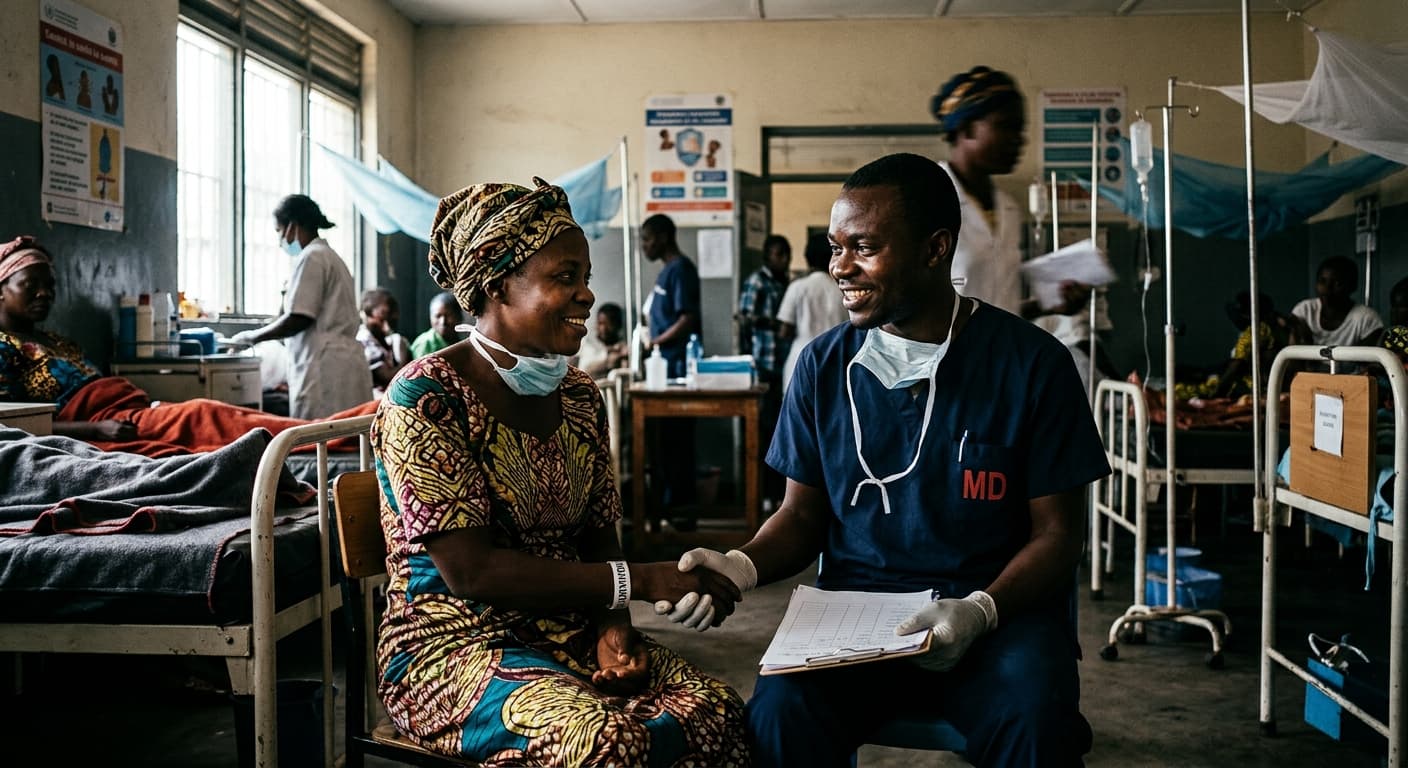
A small clinic in Goma that has never received a confirmed Ebola case has become the clearest illustration of what is actually determining the trajectory of the Democratic Republic of the Congo's 17th Ebola outbreak: local trust, not foreign logistics, is the load-bearing variable. The Wellness Clinic, run by the NGO Jericho Road, saw patient visits fall roughly 20% at the start of the outbreak as fear kept people home, then watched visits return after a single mid-May Ebola patient in Goma was isolated and survived, according to clinic staff Direct Relief via ReliefWeb. That recovery — driven by one visible, local survivor — did more to restore health-seeking behavior than any directive from Kinshasa or Geneva, and it exposes the central flaw in how the international response is built.
The outbreak, caused by the rare Bundibugyo virus species for which no licensed vaccine or treatment exists, has become the third-largest Ebola outbreak on record. As of July 16, 2026, the World Health Organization reported 2,073 cases and 796 deaths, with the outbreak expanding faster in the past month than any previous one WHO. More than 80% of new cases are being detected outside known contact lists, and roughly two-thirds of deaths occur in communities among people who never reach a health facility. The U.S. government, citing the Public Health Service Act, has suspended the introduction of certain travelers from the DRC, Uganda, and South Sudan for 30 days
Federal Register. Yet the factor most correlated with whether transmission chains are broken is not border policy or bed capacity — it is whether communities believe the people standing at their door.
The Trust Deficit Is the Outbreak
Distrust in eastern Congo is not a cultural curiosity; it is a measurable epidemiological driver. During the 2018–20 North Kivu outbreak — the second-largest on record, with 3,481 reported cases and 2,299 deaths — a population-based survey of 961 adults in Beni and Butembo found that only 32% trusted local authorities to represent their interests, and 26% believed the Ebola outbreak was not real PubMed. Low institutional trust was associated with a 78% reduction in the odds of accepting an Ebola vaccine and a 94% reduction in seeking formal health care. A companion mixed-methods study found 72% of respondents were dissatisfied with or mistrustful of the response, and denial of the biomedical explanation of the disease was statistically associated with social resistance — including hiding cases, touching bodies, and refusing official burial teams
PubMed.
The current outbreak is reproducing those dynamics at scale. The slogan "Ebola is a business" — documented extensively in the 2018–20 response as a shorthand for the perception that responders profit from the disease while communities are excluded — has returned Taylor & Francis. A resident of Rwampara told Al Jazeera that when health providers refuse to hand over bodies, "people think they might be trafficking their organs"
Al Jazeera. ActionAid assessed that roughly one-third of respondents in Ituri did not believe Ebola was a real disease, viewing it as a spiritual phenomenon or sorcery
BBC. The result has been physical: at least a dozen documented attacks on treatment facilities, including the torching of a treatment centre in Bafwabango, Ituri, on July 1, and repeated attempts to reclaim bodies for traditional burial
BBC. On May 22, crowds set fire to isolation tents at Rwampara General Hospital after being prevented from taking a body, and police fired warning shots
Al Jazeera.
Dr. Prince Mbuzukongira, a physician at the Wellness Clinic, names the structural cause plainly. "When there is an outbreak, people often come from very far away to organize the response," he told Direct Relief. "They do not use enough local nurses, local doctors, and local people who have influence in the community. They often come from Kinshasa or other places, and they come with funding. That is a problem because some people do not trust medical personnel who come from far away" Direct Relief via ReliefWeb.
"Some people think medical personnel are there because there is money in the outbreak. They worry they will be falsely told they have the disease, or that they will be used as an experiment for a new disease." — Chantal Mandro, nurse and director, Wellness Clinic, Goma
Direct Relief via ReliefWeb
This is not irrational. Eastern Congo has lived through decades of conflict, mass displacement, and outside interference over minerals, with nearly seven million people internally displaced — five million of them in the three provinces now at the outbreak's center UNHCR via CFR. As one academic analysis of the 2018–20 response concluded, declaring Ebola a health disaster "was to reveal the disease's connections with politics, in sharp contrast to the lack of protection provided to those living through daily violent atrocities"
LSE. The response asks communities to trust institutions that have never reliably protected them. The result is a second-order effect the response architecture barely accounts for: routine care collapses. Chantal Mandro described how malaria, respiratory infections, and typhoid become more dangerous when people stay home, and how the line between malaria and Ebola is ambiguous in early presentation
Direct Relief via ReliefWeb. The WHO's emergency director for Africa, Dr. Marie Roseline Belizaire, confirmed that "the disease symptoms are very malaria-like in the community," and that some families attribute deaths to witchcraft or poisoning
UN News. The indirect mortality from delayed routine care may never be fully counted, but the 2018–20 outbreak's legacy suggests it is substantial.
Why One Survivor Mattered More Than a Supply Drop
The Wellness Clinic's experience demonstrates the leverage point. The clinic, which provides primary care, surgery, and a birthing ward, saw visits fall about 20% early in the outbreak as patients avoided the health system entirely. The reversal came not from a messaging campaign but from a single event: an Ebola case in Goma around mid-May was isolated and survived. "After people heard that someone could survive, they began coming back," Dr. Mbuzukongira said Direct Relief via ReliefWeb.
That is consistent with what the WHO has observed across Ituri. At Mongbwalu hospital, after the first patient recovered and returned home, medical director Dr. Richard Lukodu reported "a huge difference in the community" and that "more people are coming here now seeking treatment" BBC. The logic is simple and brutal: the dominant local belief is that treatment centres are where people go to die. A survivor who walks out — visible, local, named — contradicts that belief in a way no poster or radio spot can.
Discover more
US Politics
Washington's Scrutiny of Iran War Prediction
The Iran war prediction market scandal exposes political ties and regulatory challenges in Washington, as insider trading concerns rise.

Global Politics
U.S. Naval Blockade Heightens Iran Tensions
The U.S. naval blockade of Iran collapsed oil exports, creating a new maritime regime in Hormuz that favors Tehran.
Global Politics
US-Iran Tensions Rise
Tensions escalate in the Strait of Hormuz as Iran and the US clash over maritime control, with a ceasefire hinging on a contested MoU paragraph.

Conflict & Security
Drone Warfare Killing Aid Workers at Unprec
Over 1,000 humanitarian workers killed in three years as cheap armed drones collapse legal protections. Gaza, Sudan, Ukraine, and DRC see deliberate targeting of aid convoys and hospitals with zero prosecutions.