Gaza Aid Declines Despite $17 Billion Pledge
Humanitarian aid in Gaza shrinks post-ceasefire as funds remain undisbursed.
Model Diplomat7 min readMiddle East
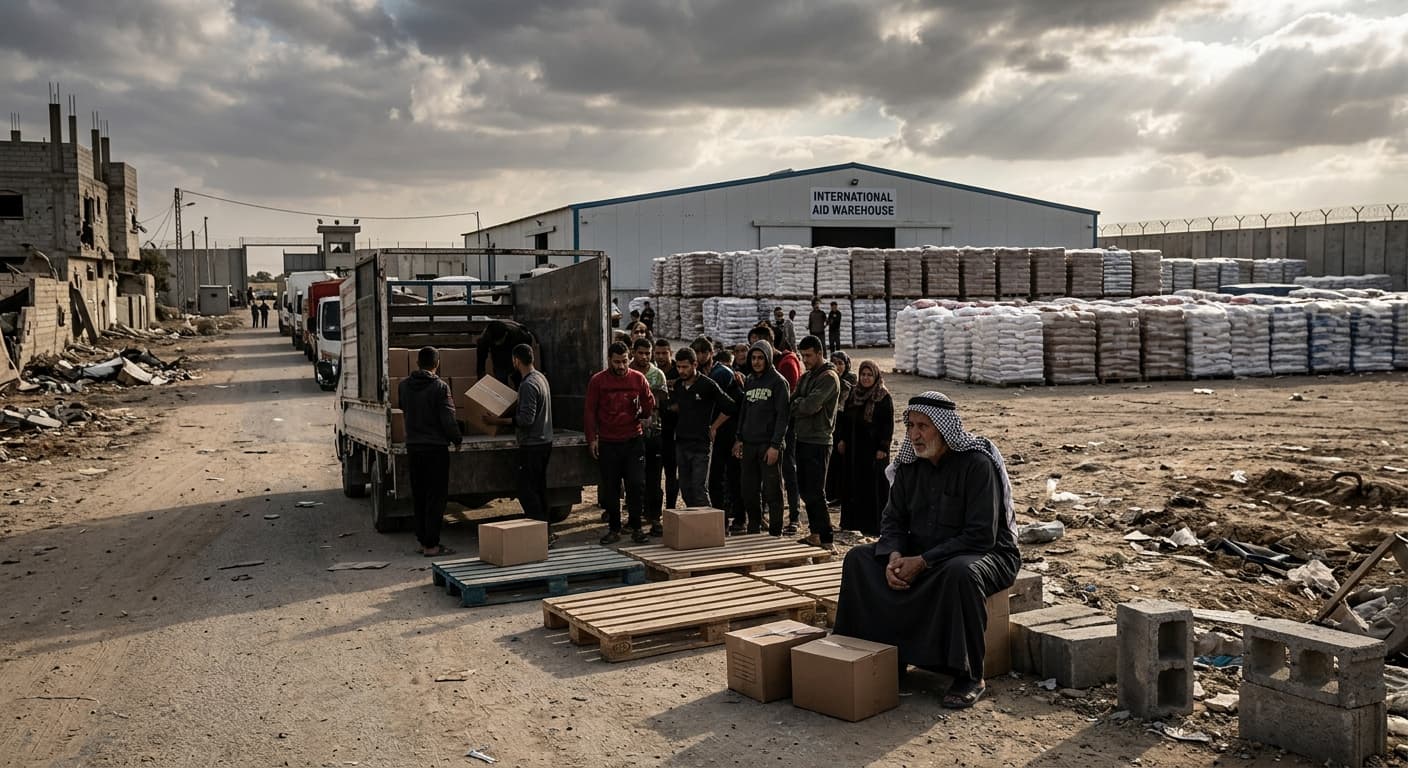
Gaza aid falls even as $17 bn sits pledged — the ceasefire's hidden squeeze
Eight months after Gaza's ceasefire, UN-tracked aid volumes fell in June 2026 and only 42% of Egypt-origin cargo could offload at Kerem Shalom — while $17 billion in reconstruction pledges remain undisbursed.
Eight months after the October 2025 ceasefire took effect, the humanitarian pipeline into Gaza is contracting, not expanding: UN Spokesperson Stéphane Dujarric confirmed on July 6 that under 42,000 pallets of tracked supplies entered Gaza in June, down from 46,600 in May, and that only 42% of aid from Egypt could be offloaded at Kerem Shalom last week, per UN News. The "lifesaving assistance" framing has been quietly inverted: humanitarian aid is now the primary lever in a governance negotiation over Hamas disarmament, and the architecture designed to save Gazans is instead holding food, medicine and reconstruction hostage to a political sequencing Israel and Hamas cannot agree on. That is why $17 billion sits pledged while OCHA's 2026 appeal remains under a quarter funded.
The gap between pledges and pallets
The numbers do not add up in the direction they were meant to. On February 18, 2026, President Donald Trump convened the first meeting of his Board of Peace in Washington and announced $10 billion in US commitments plus $7 billion from nine other member states — Kazakhstan, Azerbaijan, UAE, Morocco, Bahrain, Qatar, Saudi Arabia, Uzbekistan and Kuwait — according to BBC News. Three months later, the Board itself acknowledged the problem in a report to the UN Security Council, document
S/2026/418:
"Funds committed but not yet disbursed represent the difference between a framework that exists on paper and one that delivers on the ground for the people of Gaza."
That is the polite version. Moath al-Amoudi, an expert tracking international aid to Palestinians, told Al Jazeera that "out of the $17bn pledged, the actual liquidity that has reached the ground is zero." The Board disputes the characterisation but has not published disbursement figures. Carnegie Endowment analyst Bhumika Muchhala notes that Saudi Arabia and Kuwait have already signalled their contributions will be disbursed over years, not upfront — a hedging pattern consistent with the Ad Hoc Liaison Committee's cautious April 20 endorsement of parallel channels through the World Bank's Palestine Fund for Reconstruction and Development, per
Carnegie.
The World Bank–UN–EU Rapid Damage and Needs Assessment estimates recovery costs at $71.4 billion over ten years. The pledged sum is not even a quarter of that ceiling, and none of it is moving.
The ceasefire that shrank the pipe
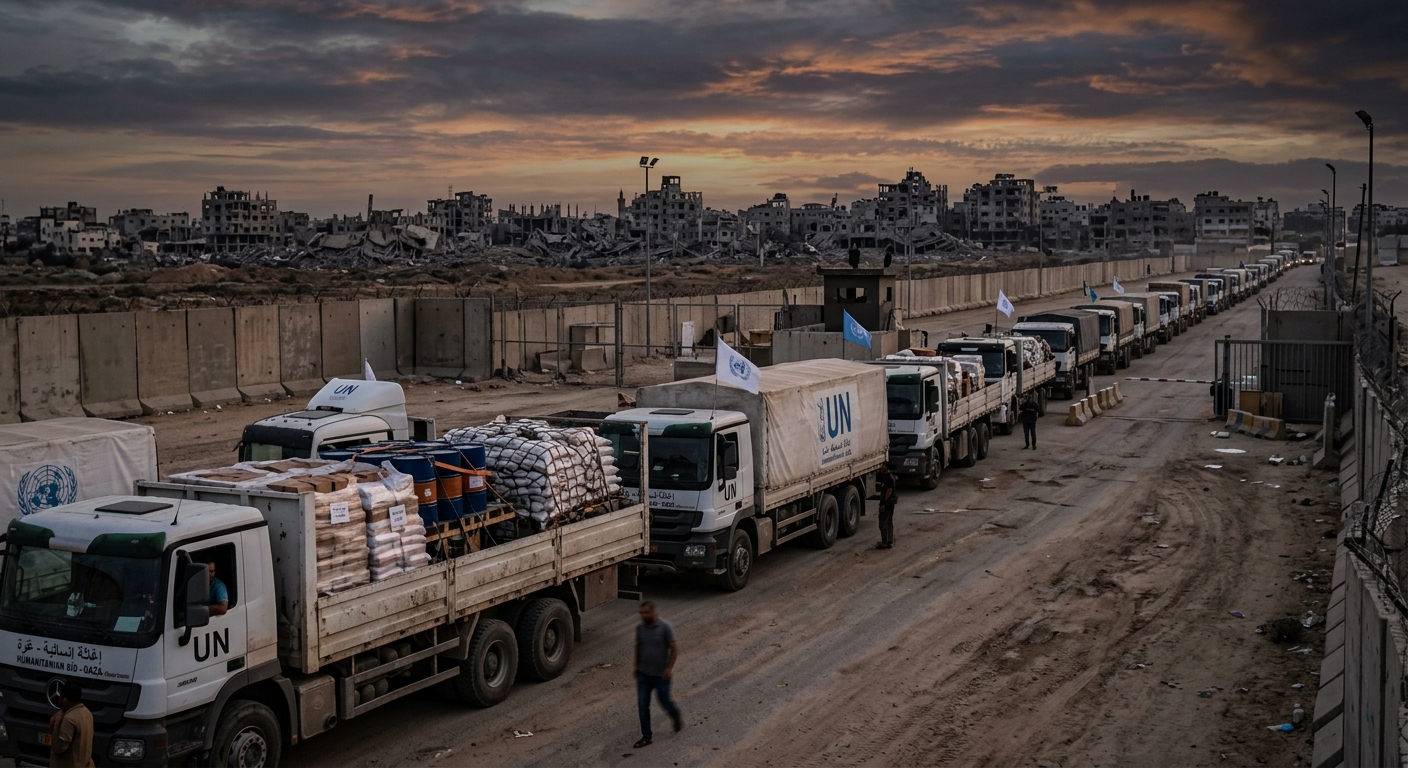
Under Trump's 20-point plan, "full aid" meant 600 trucks per day, per the Council on Foreign Relations. Only a third of that committed daily figure is actually entering, according to reporting by
Al Jazeera marking the war's 1,000-day threshold on July 2. And the fixed choke-point is physical: Kerem Shalom remains the sole cargo crossing, with Zikim reopened for northern flow but restricted. OCHA's
26 June situation report records that access-restricted areas now cover 65% of Gaza's land, that "less than 25 per cent of the requirements for this year are covered so far," and that Israeli forces continued to advance the "Yellow Line" — the ceasefire's internal boundary — westward with fresh yellow cement markers laid near Beit Lahia.
The macro numbers on Gaza's condition remain grim. According to the IPC's December 2025 assessment, 1.6 million people — 77% of the analysed population — were in IPC Phase 3 or worse between mid-October and end-November 2025, including 571,000 in Emergency (Phase 4) projected through April 2026. Al Jazeera reported nearly 400,000 Gazans surviving on one meal a day; 62% of primary healthcare medications are out of stock; life expectancy has collapsed to 40.
The Rafah patient bottleneck
The single starkest number in the humanitarian file is medical evacuation. The World Health Organization estimates around 20,000 patients in Gaza require urgent treatment abroad. When Rafah reopened on February 3, 2026 for the movement of people — BBC reports Israeli protocols capped exits at roughly 50 patients per day, each with only one or two companions. Five patients crossed that first day.
At that ceiling, evacuating the 20,000-patient backlog would take more than a year even if every seat were filled — and the BBC's July 2 investigation documents families receiving evacuation calls weeks after the patient had died. WHO, which manages the "Yellow Line" bus transfers into Israeli-controlled territory before onward passage to Egypt, has resumed operations after multiple suspensions, per ReliefWeb.
The GHF experiment ended — the deaths did not
The single most consequential humanitarian decision of the past year was the shuttering of the Gaza Humanitarian Foundation. The US- and Israel-backed group, which ran four militarised food-distribution points inside Israeli military zones between May 26, 2025 and the ceasefire, wound down operations in November 2025 after distributing what it claimed were 187 million meals, according to BBC.
The UN's own count of the model's cost is the datum that matters. The Office of the UN High Commissioner for Human Rights recorded the killing of at least 859 Palestinians in the vicinity of GHF sites and 514 near UN or other aid convoys between May 26 and July 31, 2025 — most, per OHCHR, by Israeli military fire. Antonio Guterres, addressing the Security Council mid-crisis, framed it as reported by BBC:
"We are seeing the last gasp of a humanitarian system built on humanitarian principles. This system is being denied the conditions to function, denied the space to deliver, denied the safety to save lives."
The successor architecture — the Board of Peace's Gaza Reconstruction and Development trust fund (GRAD), a UN Multi-Donor Trust Fund, and the World Bank's PFRD — was designed to restore principled delivery. It is doing so partially. OCHA reported that in the first two weeks of June 2026, nearly 420,000 people received food parcels, high-energy biscuits and flour covering roughly 75% of minimum daily caloric needs, per its UNISPAL update. WFP reached 1.4 million people with assistance in May, including cash-for-work programmes reactivating carpentry and sewing. But the June downturn confirms this is a plateau, not a ramp.
The regional stability angle: what the aid squeeze is really doing
The Board of Peace's own report to the UNSC states the mechanism plainly: "full reconstruction cannot be unlocked until… demilitarization proceeds." Board director-general Nickolay Mladenov extended that condition beyond Hamas, telling donors it applies to "all factions in Gaza." Israeli Prime Minister Benjamin Netanyahu, at the February Washington meeting, restated the same principle: no reconstruction before demilitarisation.
That is a policy. It is also a fiscal architecture that converts food, fuel and cement into leverage. The regional consequences are already visible in three moves:
- Arab donor caution. UAE, Qatar, Kuwait and Saudi Arabia are each in for a billion or more but staggering disbursements. They are hedging against a scenario in which infrastructure they fund is later bombed — the pattern of the 2014 reconstruction cycle, where only 46% of $2.7 billion pledged was disbursed within three years.
- European abstention. The UK, France, Germany and Canada refused to join the Board, per the
BBC, and are routing what they will give through parallel World Bank channels. That fragments donor coordination and undermines the Board's claim to be the single coordinating framework.
- Cairo and Cyprus tracks. Al Jazeera reported on July 1 that "secretive Gaza meetings" were under way in Ayia Napa in parallel to Cairo mediation, as the plan to isolate Hamas from Gaza's next administrative phase accelerated. This is the political process the aid squeeze is designed to force.
The second-order effect: Egypt and Jordan, which agreed only to train police for the future Palestinian Authority force, now sit between a starving neighbour and a US-led framework their populations distrust. Cairo's leverage in the Rafah bottleneck (patient movement, embassy registrations of 30,000 Palestinians hoping to return) has become a live diplomatic currency.
The bottom line
The bottom line: Gaza's humanitarian pipeline is not shrinking by accident. It is the mechanical result of a peace plan that made aid volumes and reconstruction cash conditional on a Hamas disarmament sequence no mediator has yet delivered — while Israel's Yellow Line advances quietly convert "access-restricted" into permanent control. Until that sequencing breaks, the $17 billion is a headline, not a lifeline. Gaza's 2.1 million residents remain the collateral of a governance dispute dressed as a relief operation. The ceasefire's humanitarian dividend has already peaked.
What to watch
- UNSC deliberations on Resolution 2803 renewal. The Board of Peace's mandate under UNSC Resolution 2803 (2025) sunsets in under two years; the next quarterly report to the Council is expected in mid-August 2026 and will disclose disbursement figures the May 15 report withheld.
- Cairo track on the Roadmap. Hamas delegations resumed talks in Cairo in early July 2026 on the "Roadmap for full implementation," including decommissioning. A concrete disarmament schedule — or its absence — will determine whether GRAD funds flow in Q4 2026.
- Rafah medical throughput. WHO publishes weekly evacuation counts; sustained movement above 50 patients per day would signal Israeli protocol easing. Anything below that keeps the 20,000-patient backlog structural.
- August IPC update. The next Integrated Food Security Phase Classification report for Gaza is due in late summer; a re-escalation of Phase 5 catastrophe caseload above the 1,900 projected for mid-April 2026 would confirm the June downturn is trend, not noise.
Discover more

US Politics
White House Pressures Congress for Crypto Leg
The Trump administration's push for the CLARITY Act aims to reshape crypto regulation, impacting trillions in market value and the Trump family's wealth.
Global Politics
US-Iran Tensions Rise
Tensions escalate in the Strait of Hormuz as Iran and the US clash over maritime control, with a ceasefire hinging on a contested MoU paragraph.

Global Politics
US Proposes Pakistan for Iran Talks Amid Ties
The US-Iran negotiations are now mediated by Pakistan, highlighting Islamabad's strategic role and the implications for regional diplomacy.

Conflict & Security
Drone Warfare Killing Aid Workers at Unprec
Over 1,000 humanitarian workers killed in three years as cheap armed drones collapse legal protections. Gaza, Sudan, Ukraine, and DRC see deliberate targeting of aid convoys and hospitals with zero prosecutions.