Fujimori Wins Peru by 49,641 Votes
Sánchez vows to lead Congress opposition after election loss
Model Diplomat6 min readSouth America
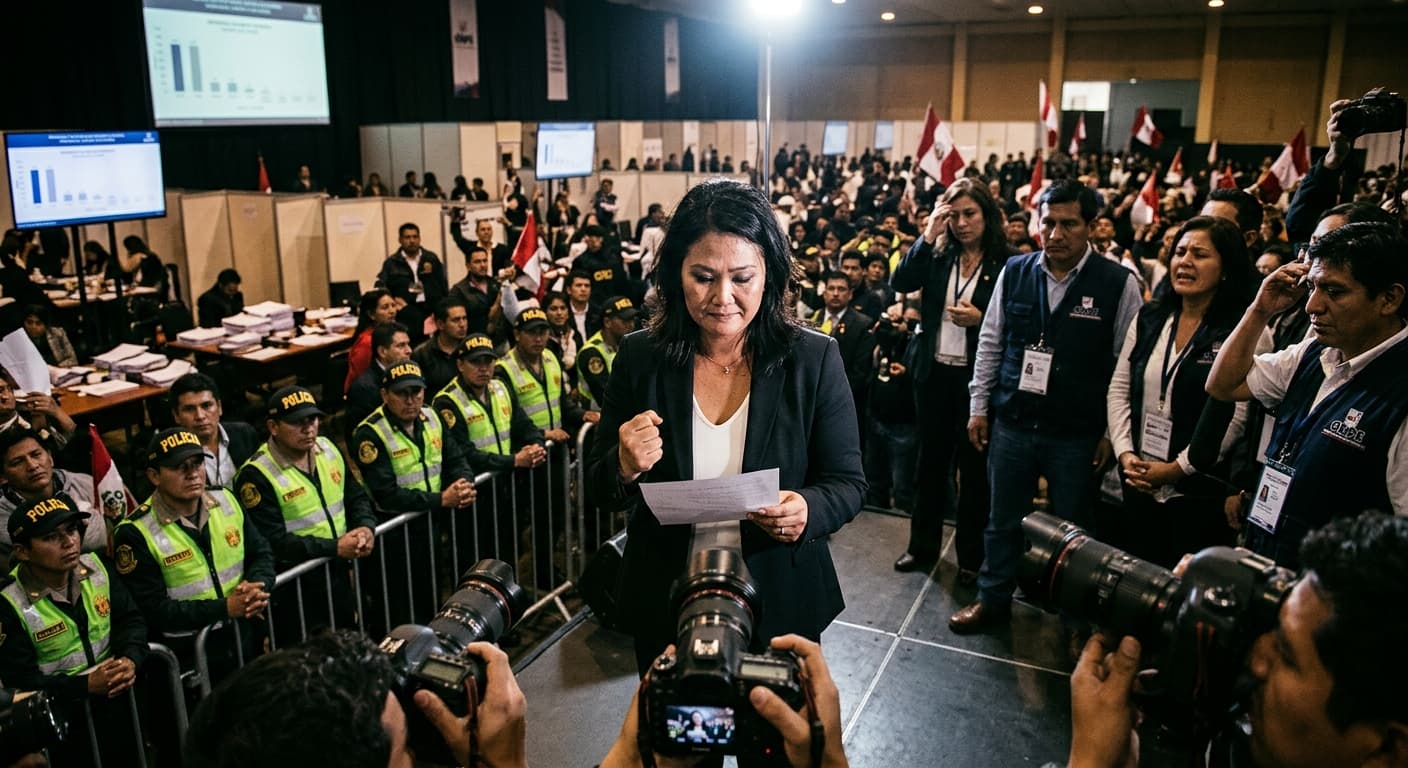
Fujimori Wins Peru by 49,641 Votes; Sánchez Vows Congress Fight
Peru's National Jury of Elections certified Keiko Fujimori's 50.135% runoff win on July 3, 2026. Roberto Sánchez conceded July 6 and pledged a "vigilant" Congress opposition bloc.
Roberto Sánchez's July 6 concession did not end Peru's political crisis — it moved it into a bicameral Congress designed, in part, by Keiko Fujimori's own party, and it hands the Fujimorismo movement its first executive win since 1990 with a mandate 49,641 votes wide and a legislature it does not fully control. According to the National Jury of Elections (JNE), Fujimori took 50.135% to Sánchez's 49.865% in the June 7 runoff. Sánchez, the Juntos por el Perú candidate and a former trade minister under jailed ex-president Pedro Castillo, will now lead a self-described "firm, vigilant and responsible" opposition, per a joint statement carried by
Anadolu Agency. The mechanism he intends to wield — congressional oversight of the presidency — is the same one his own coalition's ally, Castillo, tried to dismantle in 2022, and the same one Fuerza Popular has used to sink four of Peru's last eight presidents.
A concession that isn't a truce
The wording matters. In the joint text signed with Ahora Nación and Obra Cívica, Sánchez accepted the JNE proclamation while explicitly reserving the right "to point out and denounce the irregularities that occurred during the electoral process," per Anadolu Agency. That formulation — recognise the institution, dispute the process — is a template for four years of grievance politics, not a concession in the Al Gore 2000 sense.
Sánchez had spent the previous month escalating. He had called the runoff "fraudulent," refused to recognise a Fujimori presidency, filed a formal complaint with the Inter-American Commission on Human Rights, and organised weekend street protests, Al Jazeera reported. The pivot came only after the European Union Election Observation Mission head, Annalisa Corrado, told reporters observers had "not found objective elements to support the narrative of fraud," according to
Al Jazeera's coverage of the count.
What Sánchez lost in the streets he intends to relitigate in the chamber. His stated legislative priority is not an economic platform — it is the release of Castillo, who was sentenced on November 27, 2025 to 11 years, 5 months and 15 days in prison for his December 2022 attempt to dissolve Congress, per Al Jazeera. Framing the release as "national reconciliation" gives the left a permanent mobilising cause and yokes the Sánchez bloc to a convicted would-be autocrat — a trade the Fujimoristas will happily take.
The arithmetic Fujimori has to solve
Fujimori's party, Fuerza Popular, will be the largest bloc in both chambers of the new Congress that convenes with her July 28 inauguration — but nowhere near a majority. BBC Mundo, citing ONPE preliminary counts, put Fuerza Popular at 22 of 60 Senate seats and 40 of 130 lower-house seats. Impeaching a president under the Constitution's "permanent moral incapacity" clause requires 87 deputies — two-thirds of the chamber. On the raw math, Fujimori is impeachment-proof only if her right-wing allies, chiefly Rafael López Aliaga's Popular Renewal and Alianza para el Progreso, do not defect en masse.
The Atlantic Council read the ceiling correctly on June 10: "Fujimori's party holds enough Senate and Congress seats to avoid impeachment, but effective governing will require compromises," wrote analysts for the Atlantic Council. That is the ceiling and the floor — she can survive, but she cannot legislate alone.
This is the first legislature elected under the bicameral system restored by the 2024 constitutional reform, ending 34 years of unicameralism imposed by her father's 1992 self-coup, according to the Congressional Research Service–adjacent CSIS briefing. Fernando Tuesta and other analysts quoted by
Al Jazeera have warned the new Senate will not accept a subordinate role, meaning Fujimori faces a three-way institutional contest — presidency, Senate, deputies — where previous presidents faced only two.
The historical inversion Sánchez is banking on
The subtext of Sánchez's "vigilant congressional opposition" pledge is that Fuerza Popular wrote the playbook he intends to run. Between 2016 and 2022, the party's congressional bloc used the "moral incapacity" clause and impeachment threats to force out Pedro Pablo Kuczynski, block Martín Vizcarra, and destabilise Castillo — a pattern the Council on Foreign Relations documented as the proximate driver of Peru's "impeachment trap." An Observer Research Foundation analysis noted that only 52 votes are required to begin impeachment proceedings and that the clause has been invoked against every Peruvian president since 2016, per
ORF.
Now the roles reverse. Fujimori is the president; Sánchez's minority bloc — likely somewhere between 20 and 27 deputies once left-aligned regional parties are counted — will attempt the same asymmetric harassment. The bloc lacks the numbers to remove Fujimori, but it has more than enough to trigger interpelaciones (formal questioning of ministers), block emergency decrees in the Senate, and force the government into constant procedural defence.
There is a second, quieter inversion. Fuerza Popular spent three decades opposing the return of a Senate on the grounds that the elder Fujimori dismantled it. The party now inherits, as governing force, an institution designed to slow it down. As Al Jazeera reported, political scientist Alberto Vilca told the outlet the new Senate will likely be "in conflict" with both the Chamber of Deputies and the president, per Al Jazeera — a "crisis of three" rather than of two. The instrument Sánchez needs to be effective was, by accident of timing, built for him.
Who benefits from a hostile Congress — and who loses
The immediate beneficiary is not Sánchez. It is the Peruvian judiciary and, in particular, the Constitutional Tribunal, which under Fujimorista influence archived Keiko's own money-laundering case tied to Odebrecht and thereby permitted her candidacy, BBC Mundo noted. A weak, harassed executive gives judicial and prosecutorial actors — and the congressional committees that control appointments — outsized policy leverage.
The loser is macroeconomic policy. Peru's fragmented Congress has, over the past four years, approved a run of populist spending measures that, per BBC Mundo, analysts warn could threaten the country's fiscal balance — one of Latin America's most orthodox for three decades. Fujimori campaigned as the guardian of that model. A working coalition with López Aliaga's Popular Renewal and centrist Alianza para el Progreso will demand its own spending price, and Sánchez's opposition will oppose fiscal tightening from the left. The market-friendly "Fujimori restoration" narrative is likely to survive contact with Congress only in diluted form.
The second, less visible loser is the presidency itself as an institution. Peru will swear in its ninth president in a decade on July 28 — a data point BBC News placed at the centre of its result coverage. Each impeachment cycle has ratcheted congressional power upward and executive authority downward. Vilca's "secondary power" description of the presidency, cited by
Al Jazeera, applies to Fujimori too, regardless of the name recognition.
What to watch
- July 28, 2026 — inauguration. Fujimori's cabinet composition will signal whether she attempts a broad right-wing coalition (Popular Renewal, APP) or governs from a Fuerza Popular core. The first names, especially at Interior and Economy, are the tell.
- First 90 days — interpelaciones. Watch for Sánchez's bloc to file its first ministerial censure motion. Under Peruvian practice, this is the earliest procedural test of the opposition's coordination and the government's Senate support.
- Castillo release bill. Any Juntos por el Perú-authored bill to reduce Castillo's sentence or grant amnesty will force centrist parties to take a public position — and will function as Sánchez's litmus test for coalition-building on the left.
- The Constitutional Tribunal docket. Pending challenges to the 2024 party-registration thresholds (5% of votes plus five seats) could either entrench Fuerza Popular's grip on the party system or open the field for 2031. The
Al Jazeera analysis flagged this rule as Fuerza Popular's most consequential structural win.
- IACHR complaint. Sánchez's pre-concession filing with the Inter-American Commission on Human Rights remains active. A finding of procedural irregularity — even non-binding — would give the opposition a permanent legitimacy weapon.
The Bottom Line
The bottom line: Peru did not elect Keiko Fujimori to govern — it elected her, by 49,641 votes, to be the least destabilising option in a system where Congress has become the real seat of power. Sánchez's "vigilant opposition" is a bet that the same impeachment machinery Fujimorismo perfected against four presidents can now be turned on its architect. Whether he has the numbers for that is unclear; whether the country's institutions can survive the attempt is not — Peru has already burned through eight presidencies proving they barely can.
Discover more
US Politics
Congress Targets AI Chatbot Access for Terror
The House passed the Generative AI Terrorism Risk Assessment Act, focusing on AI's role in terrorism and potential surveillance implications.
India
Rajnath Singh's Durga Squad for 2026 Polls
Rajnath Singh's Durga Squad promised women's safety in Bengal but has since disappeared from the agenda, revealing BJP's true priorities.

US Politics
SNAP Food Assistance Faces Legal Challenges
In 2026, SNAP faces stricter eligibility rules and mounting legal challenges, threatening food assistance for the millions of Americans who rely on the program.

Economics
Fed's Amex AML order puts correspondent banking on notice
Federal Reserve's Amex AML order requires board-level controls and a 90-day plan; OCC fined the bank $350 million over enterprise-wide deficiencies.