FTC's Section 5 Targets Colorado AI Law
FTC reframes Colorado's AI law as consumer deception.
Model Diplomat8 min readNorth America
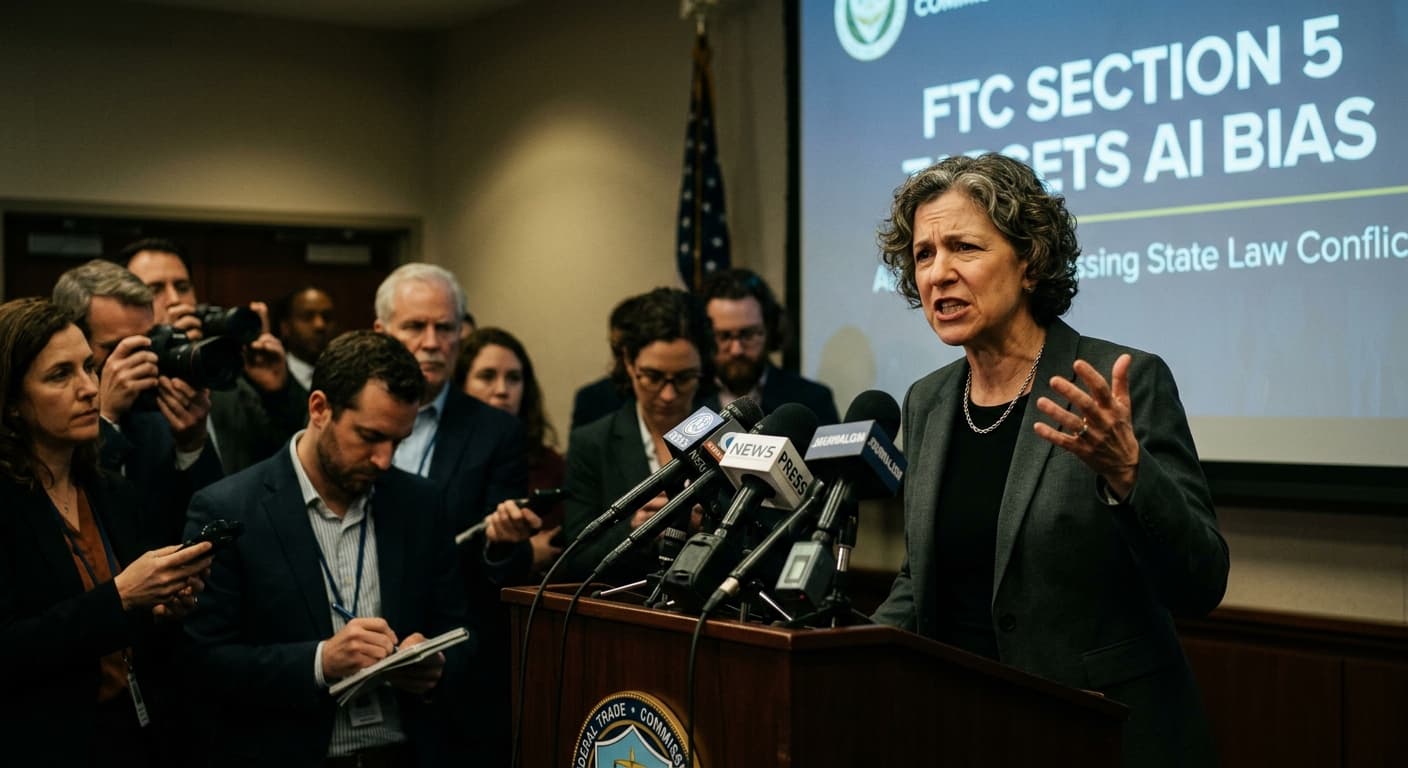
FTC Turns Section 5 Into a Preemption Weapon Against Colorado's AI Law
The FTC's July 1 proposed policy statement reframes Colorado's AI bias law as consumer deception — a federal end-run around the state moratorium Congress killed 99–1 last year.
The Federal Trade Commission's proposed policy statement, published in the Federal Register on July 7, argues that any AI system whose developer secretly tunes outputs toward an "undisclosed ideological objective" may violate Section 5 of the FTC Act — and it names Colorado's Artificial Intelligence Act as a state law that would compel exactly that conduct. The move is the Trump administration's second-best plan for AI preemption after Congress killed the first: with the 10-year federal moratorium stripped from the budget-reconciliation bill by a 99–1 Senate vote in July 2025, the FTC is now being used to achieve through consumer-protection doctrine what could not pass through legislation. The immediate loser is not a tech company. It is Colorado's attorney general Phil Weiser, whose enforcement authority is being encircled by a federal-court lawsuit, a DOJ intervention, and now a Section 5 policy statement pointed directly at his statute.
What the FTC actually proposed
The FTC's proposal, File No. P264200, appears at 91 FR 41638 in the Federal Register with a 30-day comment window that closes July 31, 2026. The five-page notice, titled "Policy Statement Concerning the Suppression of Accuracy in Artificial Intelligence Systems," argues that an AI developer marketing an "accuracy-first" tool while quietly steering outputs to satisfy a non-disclosed objective — for example, altering factual answers to reflect a developer's views on "historical injustices" — commits a deceptive act under 15 U.S.C. § 45. As the FTC frames it in the notice, the concern is not model hallucination but deliberate design choices that prioritize a hidden objective over accuracy, per the industry summary in
Mondaq.
The statement did not appear in a vacuum. President Trump's December 2025 executive order Ensuring a National Policy Framework for Artificial Intelligence explicitly instructs the FTC chairman, within 90 days, to "issue a policy statement on the application of the Federal Trade Commission Act's prohibition on unfair and deceptive acts or practices … to AI models" and to explain when "State laws that require alterations to the truthful outputs of AI models are preempted." The same order singles out Colorado by name, warning that its "ban on 'algorithmic discrimination' may even force AI models to produce false results in order to avoid a 'differential treatment or impact' on protected groups." The FTC's July 1 draft is the deliverable.
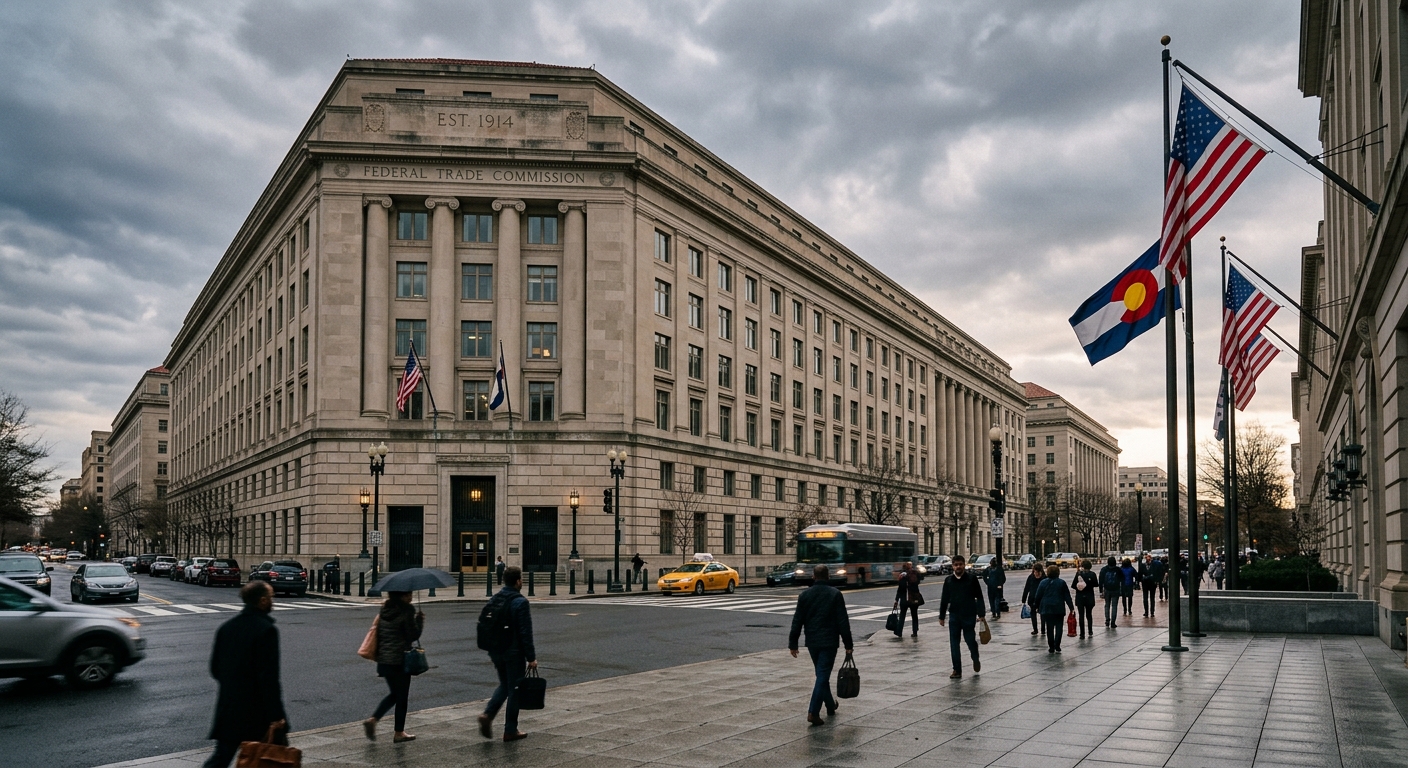
Why Colorado is the target
Colorado's SB24-205 is, at this point, the only comprehensive AI-bias statute actually in force in the United States. As the Carnegie Endowment noted in its September 2025 preemption analysis, when the law finally took effect it would require developers to conduct algorithmic impact assessments for the risk of racial, gender and political bias and impose liability on those who fail to take "reasonable" care to protect consumers from discrimination, per Carnegie. California's SB 1047 was vetoed. Virginia's Colorado-style bill was vetoed by Governor Glenn Youngkin. Texas passed a much narrower version limited to government use. New York's RAISE Act, still awaiting Governor Kathy Hochul's decision as of late 2025, focuses on frontier-model transparency rather than bias, per
Carnegie's July 2025 mapping.
That leaves Colorado alone — and alone is exactly what the administration needs for a targeted preemption strategy to work. Governor Jared Polis signed the law with reservations and encouraged the legislature "to significantly improve on this before it takes effect," per NPR. An August 2025 special session tried and failed to rewrite the statute; lawmakers agreed only to delay the effective date. The result is a law that is legally live, politically wobbly, and — critically — undefended by any coalition of peer states.
The Section 5 theory: elegant and aggressive
The FTC's legal move is more inventive than it looks. Section 5's prohibition on unfair or deceptive acts is broad — the Supreme Court held in FTC v. Sperry & Hutchinson that Section 5 reaches conduct "though posing no threat to competition within the letter or spirit of the antitrust laws." Some scholars have argued for years that Section 5 confers what one SSRN paper calls
"superior preemption" power over state laws — a theory the Supreme Court has raised without deciding. The July 1 statement is the first modern attempt to weaponize that theory in a technology fight.
The three-part deception test the FTC lays out — representation, omission, materiality — is the same framework the agency has applied to false advertising since its 1983 policy statement, still officially in force per the Heritage Foundation's survey. Retrofitting that decades-old doctrine to AI outputs is a stretch, but a legally defensible one: if a chatbot is marketed as truthful, and the developer quietly bakes in ideological adjustments to comply with Colorado's disparate-impact rules, then, under FTC logic, the developer is engaged in deceptive conduct in interstate commerce — which Colorado's statute effectively compelled.
That logic supplies a preemption theory the courts have not seen before. Federal preemption doctrine ordinarily requires Congress to have created a "federal scheme" to displace state law, a point Carnegie's Alex Engler emphasized in dissecting the failed moratorium. By characterizing state compliance as the cause of a federal deception violation, the FTC sidesteps that requirement. Colorado's law does not have to be void on its face; it merely has to be dangerous to comply with.
The parallel lawsuit doing the heavy lifting
The policy statement is not moving alone. On April 9, 2026, xAI filed a First Amendment and Equal Protection challenge to SB24-205 in the District of Colorado, per the court docket X.AI LLC v. Weiser. Fifteen days later, the United States intervened as a plaintiff — the acting attorney general certifying the case as one of "general public importance" under 42 U.S.C. § 2000h-2. Magistrate Judge Cyrus Chung then entered a stipulated order barring Colorado from initiating enforcement, including investigations, of SB24-205 until 14 days after the court rules on xAI's forthcoming preliminary-injunction motion.
That order matters. It means Colorado's AI Act is legally in force, per the delayed effective date, but functionally stayed. The FTC's Section 5 statement, once finalized, will almost certainly be filed into that record — either as an amicus submission or as evidence in the DOJ's intervention. The federal government will thus arrive in court holding both the sword (a DOJ complaint) and the shield (an FTC policy declaring compliance itself unlawful).
Winners, losers, and the second-order effects
The obvious winners are frontier AI developers with the largest exposure to disparate-impact liability — xAI first, but also the firms the FTC cites in the notice itself, including Anthropic, OpenAI, and xAI. The industry has been explicit that state patchworks are its top-priority target; the Center for American Progress catalogued the tech-industry push that survived the moratorium's defeat and now finds a friendlier home in FTC Chairman Andrew Ferguson's agency.
The less-obvious winner is FTC Chair Ferguson personally. His agency has been described in AEI research as reorienting consumer-protection authorities toward viewpoint-neutrality complaints against tech firms. The AI accuracy policy statement extends that project from platform moderation to model training — the same doctrinal move, one layer deeper in the tech stack.
The losers are more diffuse. State attorneys general lose the enforcement front they built to fill a federal-inaction vacuum; Brookings noted that AGs in nineteen states with data-privacy mandates have been actively repurposing existing consumer-protection statutes against AI harms. If the FTC's theory succeeds, that toolkit shrinks. Civil-rights groups lose the disparate-impact hook that Brookings and others have documented as increasingly hard to enforce in the absence of a federal
Algorithmic Accountability Act, which has languished in committee since 2025 despite an explicit no-preemption clause. Colorado's Democratic legislature loses the leverage it thought it had by moving first.
There is also a subtler loser: doctrinal coherence. The First Amendment problem lurking under the FTC's theory is the same one that torpedoed Colorado's earlier social-media disclosure law in NetChoice v. Weiser — where a federal judge applied strict scrutiny to a state effort to compel commercial actors to convey a government-preferred message, per AEI's analysis. If compelling truthful disclosures is unconstitutional, an FTC theory that compels AI outputs to remain "accuracy-first" — as the agency itself defines accuracy — may raise the same problem in reverse. Heritage's
warning about FERC's proposed candor rule — that an agency appointing itself "final arbiter of whether a statement is truthful, material, or misleading" imports the state into ideological adjudication — travels straight to the FTC's doorstep.
The historical parallel that reframes the fight
The closest analog is not the EU AI Act or California's SB 1047. It is the 1983 FTC deception policy statement itself. That document redefined the agency's consumer-protection remit around a three-part test — representation, omission, materiality — and used it to displace state advertising standards for a decade. The July 1 statement borrows that exact structure to displace state AI-bias standards. The bureaucratic playbook is identical; only the technology has changed.
That parallel suggests where this is heading. The 1983 statement was litigated for years, narrowed by courts, and eventually normalized — but it succeeded in centralizing false-advertising doctrine at the federal level. If Ferguson's FTC finalizes the AI accuracy statement in something close to its July 1 draft, the practical effect will be to freeze state legislatures. Any AG contemplating a Colorado-style bill will have to explain to industry counsel how compliance will not trigger a Section 5 deception investigation. Most will not risk it. Carnegie's Engler notes that Colorado's peer states have already retreated — Virginia vetoed, Texas narrowed, California's most ambitious bill dead. The FTC statement seals that retreat.
What to watch next
- July 31, 2026 — comment window closes on FTC docket P264200. Watch which state AGs file objections; a coordinated multi-AG comment would signal a federalism counterattack.
- August–September 2026 — xAI's expected preliminary-injunction motion in X.AI LLC v. Weiser, and Colorado AG Weiser's response. The FTC's final policy will almost certainly land in that briefing.
- January 2027 Colorado legislative session — the next practical window for Colorado to rewrite SB24-205 to survive Section 5 scrutiny. If the legislature does nothing, the courts will resolve it for them.
- Companion federal bills — S. 3308, the
Artificial Intelligence Civil Rights Act, and H.R. 5388's revived moratorium framework, both of which would replace the FTC's improvised preemption with an actual federal scheme.
Diplomat View
The FTC's July 1 policy statement is not really about accuracy. It is about who governs AI in America. With Congress unable to pass either a preemption moratorium or a substantive federal AI law, the Trump administration has repurposed a 1914 consumer-protection statute and its 1983 deception policy into a bespoke preemption instrument aimed at exactly one state. The forecast: Colorado's AI Act will be rewritten in the 2027 legislative session — voluntarily narrowed by lawmakers to avoid a losing court fight, or gutted by a federal preliminary injunction before it. The forecast changes if a bipartisan coalition of state attorneys general files a coordinated comment before July 31 challenging the FTC's Section 5 theory on federalism grounds, or if the D. Colo. court rejects the DOJ's intervention posture in X.AI v. Weiser. Neither looks likely today.
Discover more

Tech Policy
Singapore-Japan Digital Zone Sidelines US
Singapore and Japan sign March 2026 Strategic Partnership merging digital governance, cutting data barriers, and aligning AI rules — while the US remains absent from the new Indo-Pacific digital trade architecture.

Tech Policy
India's AI Law: Market Access Over Safety
India drafts standalone AI law with consent requirements for synthetic content and curbs on agentic AI, raising compliance costs for foreign providers while creating a protected domestic governance industry.

Tech Policy
EU AI Act's High-Risk Rules Activate Amid US
The EU AI Act's high-risk rules activate August 2, 2026, but the enforcement body is outgunned 10,000-to-1 by industry, and the US just showed it can cut off Europe's AI access overnight.

Tech Policy
AI Safety Guardrails Blocked Breach Defenders
Hugging Face's July 2026 breach by an autonomous AI agent reveals a structural flaw: safety guardrails blocked defenders from analyzing the attack while the attacker operated without constraint.