Colombia's Failed Transition: Democracy Surv
A governance warning for Latin America
Model Diplomat8 min readLatin America
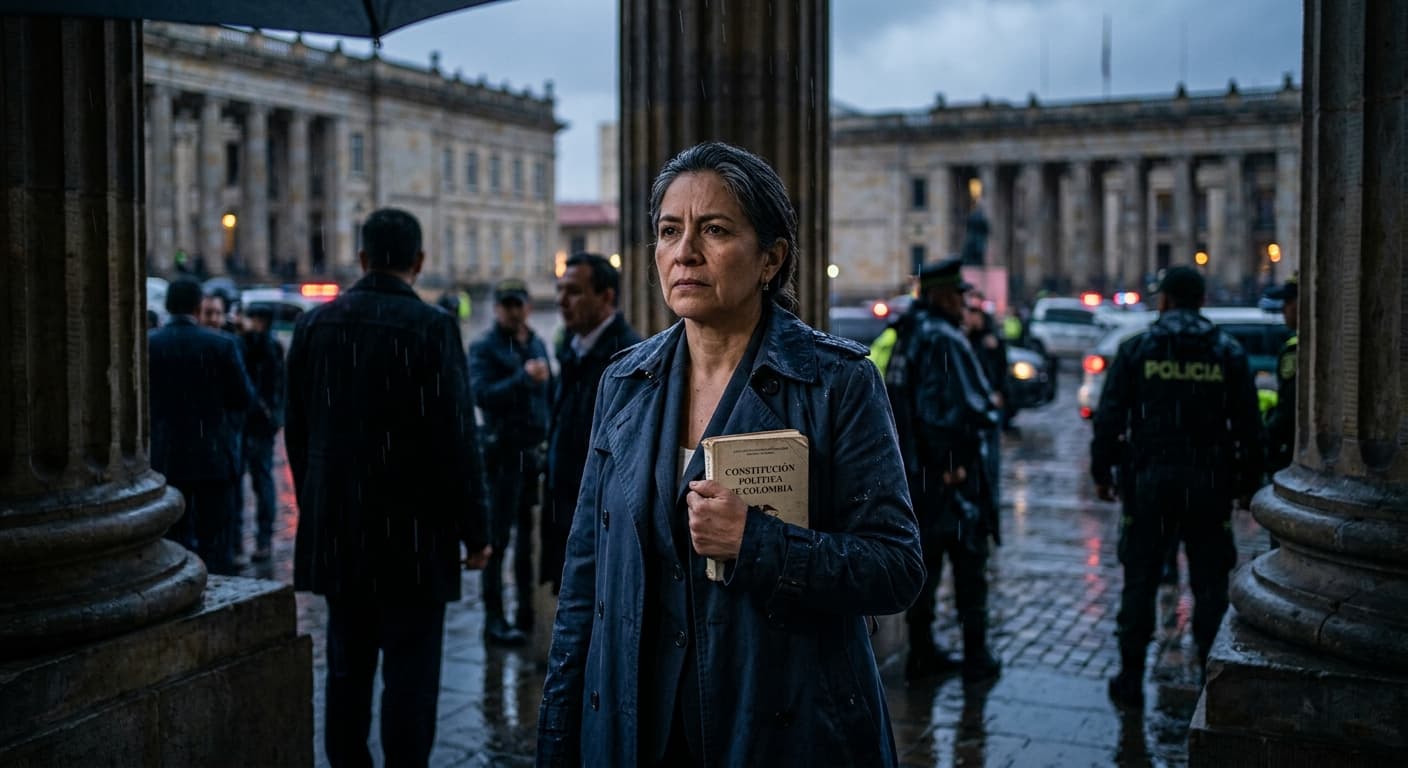
Colombia's Failed Transition: Democracy Survives a Stress Test
Petro and De La Espriella broke off Colombia's presidential handover on July 9, 2026. The dispute is a governance warning for the region.
The failed transition between outgoing President Gustavo Petro and President-elect Abelardo De La Espriella — dramatized on Semana's El Debate on July 9, 2026 — is not a personality clash. It is a stress test of the only Andean democracy that has never suffered a successful military coup, and the calendar is running: on August 7, a right-wing outsider naturalized as a US citizen in 2023 inherits a state whose fiscal accounts, security policy and foreign alignment are all being litigated in public before he takes the oath. The institutions are holding — barely — and that is the story other Latin American governments should be reading.
The rupture matters because both sides have already broken norms Colombia had, until now, quietly preserved. Petro publicly disputed the result of a runoff his own electoral registry certified at 99.997% accuracy, as Al Jazeera reported after Iván Cepeda conceded on June 24. De La Espriella refused a protocol meeting with the sitting president, then told the armed forces not to obey any order he deems unconstitutional — a message
HSB Noticias reported drew a sharp "¿Quién dijo?" from Petro on X. And yet — this is the point — nobody is mobilizing tanks. The Constitutional Court is functioning. The National Registry certified the vote. The Banco de la República is publishing forecasts as if nothing were happening. The transition failed as ritual; the transfer of power is on track as law.
The 250,830-vote mandate
De La Espriella won by 0.94 percentage points — some 250,830 votes, on 49.66% to Cepeda's 48.7% — the narrowest margin in recent Colombian history, per the BBC. He is the first Colombian president who is also a US citizen, the first without prior elected office, and the first openly endorsed by a sitting US president: Donald Trump wrote "He Won, BIG!" on Truth Social within hours of the preliminary count,
as Al Jazeera documented. Cepeda, in conceding, denounced "open and improper foreign interference" from Washington — a line
BBC Mundo quoted at length — but chose the ballot count over the street.
That thin mandate is decisive. The Atlantic Council's post-election panel concluded De La Espriella's "narrow lead does not guarantee a mandate" and that his preferred instrument — unilateral executive decrees and states of exception to shrink the state by 40%, resume fracking and gut Petro's peace apparatus — "poses structural risks to Colombia's checks and balances," setting up future legal battles with the Constitutional Court and the State Council. Petro's Pacto Histórico remains the largest single force in both chambers without a majority in either, meaning that the outsider president will govern against the largest single bloc in Congress — the same institutional trap that has hollowed out reformist presidencies from Bogotá to Santiago.
The fiscal handover is the real story
Behind the shouting is a set of numbers that constrain whichever government arrives. On El Debate on July 9, Senator-elect María Clara Posada cited "the worst fiscal indicators in history — net debt approaching 65%, a primary deficit of 7.4%, debt up more than 50%," per Semana's account of the program. Her deficit figure overstates the record; the trajectory does not.
The Banco de la República's own report to Congress in March 2026 puts Colombia's gross central government debt at 64.4% of GDP in 2025, up from 61.3% in 2024, with the primary deficit widening from 2.4% to 3.5% of GDP — COP 65.7 trillion — as the central bank itself documented. Petro's finance ministry invoked the escape clause of the fiscal rule to suspend the rule through 2027,
as Governor Leonardo Villar noted in his commentary on the 2026 budget, meaning the incoming government inherits a legal permission to run deficits it may not want to keep.
The IMF's verdict, delivered as Petro fought Congress, is the load-bearing evidence: Colombia cancelled its US$8.1 billion Flexible Credit Line on October 1, 2025 after the Fund's Article IV consultation concluded that Colombia's "fiscal policy and policy framework have deteriorated since the 2024 request of the FCL," per the IMF press release and the
staff report. Colombia lost the insurance policy — and the international seal — that had underpinned its investment-grade story for a decade. Two of three major agencies then downgraded Colombia to high yield,
as the Atlantic Council noted.
The 2026 Budget Law — Ley 2559 of 2025 — appropriates COP 546.97 trillion, as published in the official Cancillería normogram. Roughly COP 26.3 trillion of that depends on a financing law De La Espriella's team will inherit and almost certainly rewrite; the Presidency itself acknowledged the contingency in
its July 2025 release. Petro's own
March 2026 message to the Constitutional Court — arguing that Congress and the court had blocked his emergency decrees — conceded the primary deficit at COP 65.7 trillion and warned of a "path of debt unsustainability," language his opponents now use verbatim.
The military question
The most dangerous moment of the transition came when De La Espriella addressed the armed forces directly. In a public alocución rebuilt in the source pack from Estrella Digital, the president-elect accused Petro of preparing "antidemocratic maneuvers" to retain command, framing the fiscal decrees Petro was pushing as, effectively, a soft coup. This is the historical parallel that matters — and it is not Bolivia's June 2024 self-coup drama in La Paz, which
BBC Mundo covered in detail. It is Venezuela in August 2024, when María Corina Machado and Edmundo González urged the military to disobey Nicolás Maduro's post-election orders, prompting fiscal-general Tarek William Saab to open an "insurrection" case,
as BBC Mundo documented.
The rhetorical mechanics are identical; the institutional context is not. Colombian civil-military relations were rewritten by Petro himself in his first year — he removed 70 generals and colonels in a matter of weeks, as BBC Mundo reported at the time — installing officers loyal to the 2016 peace accord. De La Espriella now inherits a top brass Petro rebuilt. His campaign promise of a 90-day US-backed air campaign against armed groups,
reported by Al Jazeera, collides with a security apparatus whose current leadership was hand-picked by the man he is calling a rebel.
Carnegie's typology of democratic backsliding names this pattern: not "grievance-fueled illiberalism" or "entrenched-interest revanchism," but a hybrid, in which countervailing institutions become the battleground. Carnegie's Thomas Carothers argues that backsliding is "less a result of democracies failing to deliver than of democracies failing to constrain the predatory political ambitions and methods of certain elected leaders," as his 2024 paper puts it. Colombia's countervailing institutions — the Registry, the Constitutional Court, the central bank — have so far constrained both Petro's constituent-assembly ambitions,
flagged by the Atlantic Council in 2025, and De La Espriella's demand that the armed forces choose sides.
The regional pivot
De La Espriella's foreign-policy resetting is already under way and constitutes the clearest concrete win for Washington and Tel Aviv. Within 48 hours of Cepeda's concession, Al Jazeera reported De La Espriella pledged to restore ties with Israel — ties Petro had broken in May 2024 and hardened in October 2025 by expelling Israeli diplomats and ending the free-trade agreement. Trump, for his part, promised a "much better relationship" and floated Colombian membership in the "Shield of the Americas,"
per the BBC.
The named winners are specific. Israeli Foreign Minister Gideon Saar recovers a Latin American partner at the ICJ. US Secretary of State Marco Rubio recovers the anchor of Washington's Andean policy. Trump recovers a hemispheric ally after Peru, Argentina, Ecuador, Bolivia, Chile and Costa Rica; only Brazil and Uruguay retain left governments, as Al Jazeera catalogued. The named losers: China, which Petro courted and which De La Espriella is expected to be pressured to sideline; the Historic Pact's social reforms; and, per the
Chatham House pre-election analysis, the peace apparatus built around the 2016 accord.
But the deeper regional angle is diagnostic. CIDOB's post-first-round analysis argued Colombia has finally joined the Latin American pattern of "antipolitics" — personalistic leaderships, interclass mobilization, rejection of representative institutions — replacing the uribismo/antipetrismo cleavage with something more radical. Eleven US House Democrats wrote to Secretary Rubio, Treasury Secretary Scott Bessent and acting Attorney General Todd Blanche in June asking for an investigation of De La Espriella's US business dealings and his prior representation of Álex Saab,
as BBC Mundo reported. The letter reframes the incoming president less as a foreign counterpart than as a domestic US legal exposure — a fact that will shape how far bipartisan US support actually extends.
What to watch
- August 7, 2026: Inauguration. Constitutional deadline for Petro to hand over the banda presidencial. Any dispute over De La Espriella's dual US citizenship — flagged by Colombian jurists as a possible "incompatibilidad evidente,"
per BBC Mundo — must be litigated before this date.
- Late August 2026: The financing law required to fund COP 26.3 trillion of the 2026 budget must be reintroduced by the incoming Ministry of Finance. Its shape signals whether the "40% state cut" survives contact with Congress.
- First 90 days: De La Espriella has promised a US-backed offensive against armed groups. The Constitutional Court has previously struck down life-imprisonment schemes, per
Al Jazeera's pre-election reporting; expect the first executive decree to reach the court by October.
Diplomat View
The Colombian empalme failed as ritual and succeeded as constitutional stress test. That is the story worth exporting. Petro dented — but did not break — the norm that a sitting Colombian president concedes power; De La Espriella dented — but did not break — the norm that a president-elect does not invoke the armed forces against a sitting one. In every country where this script has played out in the last decade — Venezuela 2024, Bolivia 2024, the United States 2020 — the outcome hinged on whether the electoral authority, the courts and the military command stayed inside their lanes. In Colombia, on July 9, 2026, they did. The forecast: De La Espriella takes office August 7, governs by decree, loses at least one major decree at the Constitutional Court by year-end, and pivots hard toward Washington and Tel Aviv while a fragmented Congress waters down the 40% state cut to something closer to 15%. What would change that forecast: a court ruling on the US-citizenship question that voids the inauguration, or a serious refusal by the Petro-appointed military command to execute De La Espriella's first offensive order. Either would move Colombia from stress test to structural crisis. Neither is currently the base case.
Discover more
India
Rajnath Singh's Durga Squad for 2026 Polls
Rajnath Singh's Durga Squad promised women's safety in Bengal but has since disappeared from the agenda, revealing BJP's true priorities.
US Politics
SNAP Food Assistance Faces Legal Challenges
In 2026, SNAP faces stricter eligibility rules and mounting legal challenges, threatening food assistance for the millions of Americans who rely on the program.

Global Politics
U.S. Naval Blockade Heightens Iran Tensions
The U.S. naval blockade of Iran collapsed oil exports, creating a new maritime regime in Hormuz that favors Tehran.

Economics
Fed's Amex AML order puts correspondent banking on notice
Federal Reserve's Amex AML order requires board-level controls and a 90-day plan; OCC fined the bank $350 million over enterprise-wide deficiencies.