Colombia's Election Legitimacy Crisis
Civil observers endorse De la Espriella's win amid political turmoil.
Model Diplomat7 min readLatin America
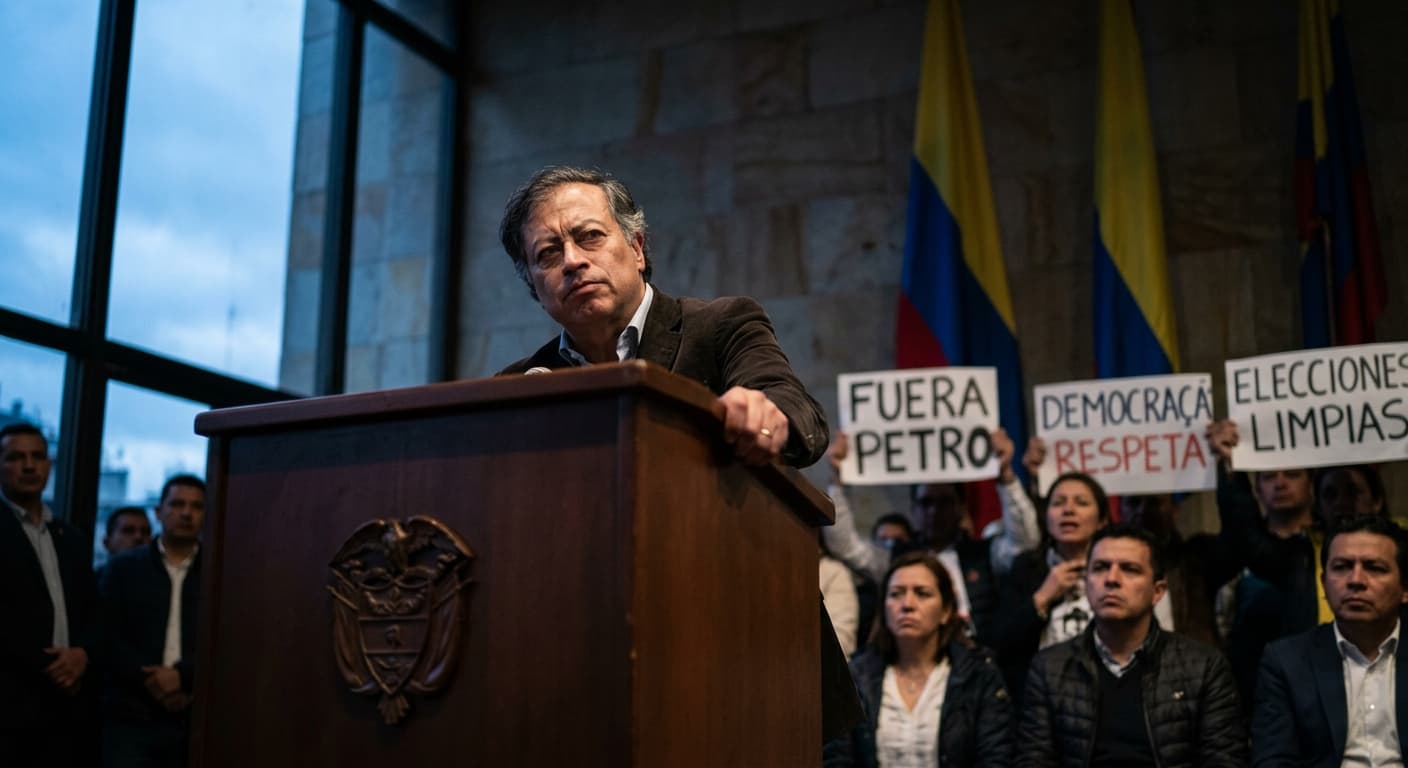
Colombia's civil-observer stamp on De la Espriella win exposes a Latin American backsliding pattern
Corporación DemocraTIA Global's July 8 endorsement of Colombia's 2026 vote is less about fraud than about a sitting president refusing to concede — the region's new normal.
Corporación DemocraTIA Global's July 8, 2026 declaration that Colombia's presidential election met every constitutional and legal standard is not routine paperwork — it is a civil-society intervention against a sitting president who, two weeks after losing power, still refuses to recognise his successor. The finding, signed by board president Abdón Espinosa Fenwarth and chief executive René Mauricio Rojas Tapias, arrives at a moment when the losing camp is not challenging ballots in court but disputing legitimacy on X. That inversion — where the electoral machinery works and the political class does not — is now the defining feature of democratic stress across Latin America, and Colombia's transition to Abelardo de la Espriella has become its clearest test case.
What the observers actually said
The Bogotá-based corporation deployed roughly 8,000 accredited citizen observers in the first round and 9,000 in the runoff, one of the largest domestic monitoring efforts in Colombian history, according to the outlet La Noticias. Its technical report, described in
El Tiempo, concludes that the pre-electoral, electoral and post-electoral phases offered "verifiable conditions of integrity, transparency, security and traceability," and that any electoral controversy in a constitutional democracy must move through courts, not communiqués.
That echoes what international monitors already said. On June 2, the head of the EU Election Observation Mission, Esteban González Pons, called the first round "transparent, orderly, and smooth" after his 143 observers covered 591 polling stations, Al Jazeera reported. Real Instituto Elcano observer Nadina Roncancio, invited by Colombia's Consejo Nacional Electoral, described the three 2026 votes as marked by "absolute normality" and found no evidence of systemic fraud in
her post-election assessment. The Registraduría Nacional's own numbers do the closing argument: the preliminary count matched the final judicial scrutiny at 99.997%, per
BBC Mundo.
Against that evidentiary wall, Petro's June 21 post — "as president I do not accept the results of the preliminary count" — reads less as a fraud claim than as political theatre.
The numbers, and why the loser conceded anyway
The June 21 runoff was the closest presidential election in modern Colombian history. According to the Registraduría, De la Espriella took 12,959,542 votes (49.66%) against Iván Cepeda's 12,708,712 (48.70%), a margin of about 250,000 votes or 0.96 percentage points, on a record 63.6% turnout, BBC Mundo documented. The right-wing outsider — an attorney who launched his candidacy only in July 2025 — was proclaimed president-elect by the Consejo Nacional Electoral on June 24, notes the
CIDOB profile, and will be inaugurated on August 7.
Cepeda challenged more than 50,000 tables, then folded three days later. His June 24 concession is the document that matters here:
"Acepto el resultado… Abelardo de la Espriella es el nuevo presidente de la República. Lo hago como un acto de responsabilidad democrática."
He paired the concession with a denunciation of Donald Trump's "open and improper foreign interference" — Trump had endorsed De la Espriella on Truth Social on June 2, calling Cepeda "a radical left Marxist," per BBC Mundo — and warned of AI-driven manipulation and vote-buying, without evidence. He then pledged "civil disobedience and peaceful resistance" as opposition leader. Petro did not follow him. The president kept challenging the vote and, per multiple domestic ex-presidents grouped in the Grupo Libertad y Democracia,
called on Colombians toward civil disobedience against the incoming administration.
Why a domestic NGO is doing the work states used to do
The rush of pro-legitimacy statements is unusual. In the last three weeks, at least four Colombian civil-society bodies — DemocraTIA Global, the Grupo Libertad y Democracia, the coalition Aliadas and the Fundación Colombia 2050 — have issued declarations defending the result. The regional daily
El Diario editorialised on the same theme, arguing that democratic strength is measured by the losers' willingness to accept the count.
That mobilisation matters because the historical script has flipped. Latin America's classical fraud crisis featured a ruling party manipulating the count while the opposition and international monitors called it out — Bolivia 2019 being the textbook case, when the OAS found "manipulations and irregularities" in Evo Morales' vote count, BBC Mundo reported. In Colombia 2026, the count is intact and the outgoing incumbent is contesting the outcome, mirroring dynamics seen after the US 2020 and Brazil 2022 elections. Carnegie Endowment researchers write in an April 2026 study that democratic backsliding is "the gradual and piecemeal erosion of democracy under elected governments," and that of 25 countries that entered backsliding since 1990, only four have durably reversed course, per the
Carnegie Endowment.
Colombia is not yet on that list. But the mechanism the Carnegie authors flag — an elected leader treating institutions as adversaries when they deliver unwanted results — is exactly what DemocraTIA Global's declaration is trying to defuse. The V-Dem Institute's Democracy Report 2024 catalogues the same trend as the dominant global pattern, with autocratization advancing on multiple continents, per the V-Dem SSRN paper. CIDOB analyst Rafael Grasa argues in a June 2026 opinion piece that Colombia is now converging with regional peers: a "radical new right, presenting itself as anti-system, anti-political and anti-establishment," is displacing traditional conservatism, per the
CIDOB brief.
The domestic observers' bet is that piling on evidence of clean process will raise the political cost of Petro's stance before it hardens into something structural. The Elcano analysis warns that even flawless electoral administration cannot substitute for institutional trust; if citizens no longer believe verdicts they can verify, "all the progress made by electoral institutions may end up partial."
Who benefits from the legitimacy war
Three actors are extracting leverage from the current stand-off.
De la Espriella himself. Every declaration from a Colombian civil-society body affirming his election strengthens his hand before he takes office on August 7. He inherits a fragmented Congress in which the Pacto Histórico remains the largest single force — BBC Mundo noted the left dominated the March 2026 legislative vote — and no majority for his promised 40% cut to the size of the state or his security-first agenda. The louder the endorsement of his mandate, the harder it will be for Cepeda's caucus to portray his reforms as illegitimate.
Donald Trump's White House. Trump's June 2 endorsement, followed by his blunt post-election reaction — "he won, big" — signals that Washington will treat De la Espriella as an ally against Caracas and Havana and against Petro's "paz total" policy. That reverses more than a year of open confrontation, during which Trump threatened Colombia with tariffs, decertified it in the anti-drug fight, and revoked Petro's US visa, per BBC Mundo's regional analysis.
Petro's political brand. Losing without conceding is not a loss — it is a positioning play. By staying inside the legitimacy fight, Petro pre-empts a lame-duck month and positions himself as the leader of a resistance movement rather than a defeated incumbent. That is why his refusal is not accompanied by any legal filing: the audience is his own base, not the CNE.
The losers are more diffuse. Colombia's constitutional order absorbs another stress test at a moment when Latinobarómetro data cited by International IDEA already show a 12-point drop in regional support for democracy over the last decade. Cepeda inherits an opposition role from a president who is undermining the peaceful-transfer template his own left tradition spent forty years demanding. And the OAS, absent so far from the 2026 Colombian discussion, quietly loses relevance: the credibility work is being done by domestic NGOs, an EU mission and a Spanish think-tank observer, not the inter-American system.
The regional read-across
This is where the DemocraTIA Global report matters beyond Bogotá. Latin America is entering an 18-month cycle in which every close vote could produce a Colombia-style dispute. Honduras is still adjudicating its November 30, 2025 election, with the OAS mission publicly criticising "a marked lack of expertise" in the tech rollout, BBC Mundo reports. Chile, Brazil and Peru vote in 2026–2027. Ecuador's Daniel Noboa has already been accused of extraterritorial interference in Colombia's race, drawing a formal protest from Bogotá's foreign ministry.
The pattern the Colombian case establishes: when the count itself is unimpeachable, contestation migrates from ballots to narratives, and the burden of defending institutions falls on organised civil society rather than on the party system or international bodies. Whether that arrangement holds, or whether Petro-style rejection becomes a template for other losing incumbents in the region, is the open question.
Diplomat View
The DemocraTIA Global report is the most consequential civil-society intervention in Colombia in a decade — not because it proved anything the Registraduría's 99.997% scrutiny match hadn't already proved, but because it forces Petro to choose between soft delegitimation and open confrontation with an institution he cannot easily attack. Our call: De la Espriella will be inaugurated on August 7, 2026 without meaningful institutional disruption, but Petro will retain the "unrecognised result" line as a mobilisation tool through the 2027–2028 territorial elections, converting a lost presidency into a permanent opposition posture. We would revise if either the Consejo de Estado admits any Pacto Histórico challenge to the CNE proclamation, or if street mobilisations after August 7 exceed the 2021 estallido social in scale and duration. Neither is likely on current evidence; both are testable. What is not testable is the deeper thesis: Latin America's next democratic emergency will not look like Bolivia 2019 or Venezuela 2018. It will look like a clean election that the loser refuses to lose.
What to watch next
- August 7, 2026 — De la Espriella's inauguration in Bogotá. Whether Petro attends the transfer of the presidential sash is the single most concrete signal of how far the delegitimation posture will go.
- Before August 7 — any Consejo de Estado ruling on Pacto Histórico's outstanding challenges to the 33,000-plus impugned tables; a rejection would close the last legal avenue and force a purely political fight.
- October 2027 — regional and municipal elections. The first test of whether Petro's "not my president" framing translates into left-bloc mobilisation or fractures the Pacto Histórico coalition ahead of a Cepeda-led opposition project.
Discover more
US Politics
Congress Targets AI Chatbot Access for Terror
The House passed the Generative AI Terrorism Risk Assessment Act, focusing on AI's role in terrorism and potential surveillance implications.

India
India-South Korea $50B Trade Expansion Plan
India and South Korea target $50 billion in bilateral trade by 2030, focusing on industrial cooperation and strategic alignment amid US pressures.
India
Congress Accuses Modi of Stalling Women's Law
Congress accuses Modi of stalling women's reservation law by linking it to delimitation, revealing a deeper electoral strategy.

Economics
Fed's Amex AML order puts correspondent banking on notice
Federal Reserve's Amex AML order requires board-level controls and a 90-day plan; OCC fined the bank $350 million over enterprise-wide deficiencies.