Colombia Criminal Complaint vs. President-Eld
A criminal complaint filed 23 days before inauguration tests Colombia's peace accord protections.
Model Diplomat6 min readLatin America
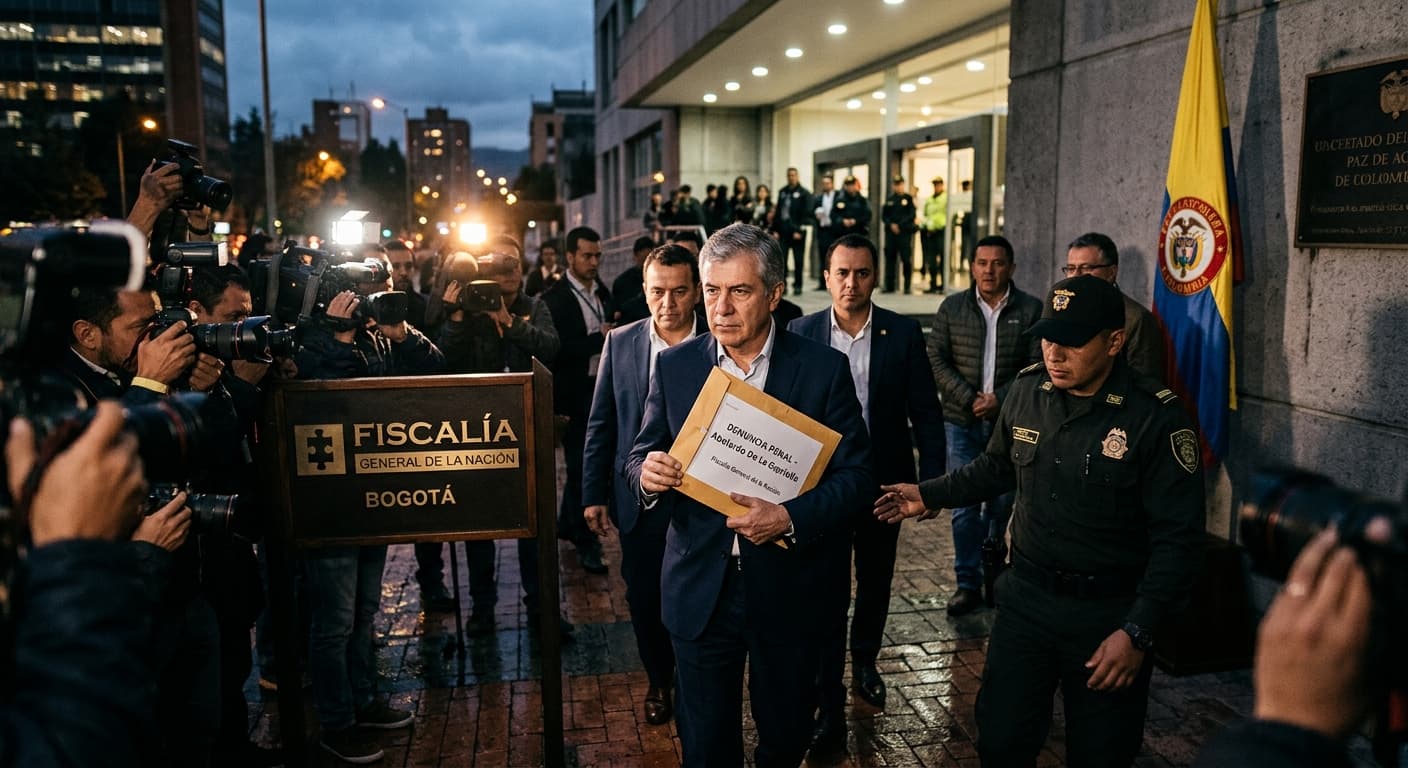
Criminal Complaint vs. Colombia's President-Elect Is a Race Against the August 7 Immunity Clock
Gloria Cuartas, director of the Peace Agreement Implementation Unit, filed criminal charges against president-elect Abelardo De La Espriella on July 15, 2026 for alleged aggravated harassment of peace signatories — a legal maneuver timed to beat the constitutional immunity that shields a sitting president once sworn in.
The criminal complaint that Gloria Cuartas filed with Colombia's Fiscalía on Wednesday, July 15, 2026 is less a prosecution than a race against a clock: once Abelardo De La Espriella is sworn in on August 7, the constitutional fuero channels any criminal case against him through a fragmented Congress — and the institutional architecture built by the 2016 peace accord to protect its signatories will depend on the man elected to dismantle it. The complaint's leverage is timing, not law, and that is the whole point. The filing creates a documentary record that survives regardless of whether the Fiscalía acts, locks the incoming presidency into a legally catalogued pattern of rhetoric against protected persons, and hands the UN Verification Mission a citable reference point for its next Security Council report. The 23-day window between complaint and inauguration is the entire battlefield.
What the complaint alleges
Cuartas, director of the Unidad para la Implementación del Acuerdo de Paz, accuses the president-elect of three offenses: hostigamiento agravado (aggravated harassment), injuria (defamation), and instigación a delinquir (incitement to crime), directed at ex-FARC commander Rodrigo Londoño — alias Timochenko — and the more than 13,000 signatories of the 2016 accord, according to El Tiempo.
The trigger was De La Espriella's announcement on Monday, July 13, that upon taking office he would eliminate the post of Alto Comisionado para la Paz, dismantle what he called a "perverso sistema de impunidad," and target the Jurisdicción Especial para la Paz (JEP), the transitional justice tribunal created by the accord. He also said Londoño "merece estar preso de por vida" — deserves to be imprisoned for life — and criticized the JEP for authorizing the former guerrilla chief's travel to Spain, El Tiempo reported. Cuartas additionally asked the Fiscalía to investigate the president-elect's comments about Pilar Rueda Jiménez, a JEP official and wife of Senator Iván Cepeda, De La Espriella's runoff rival, as possible violencia política de género — gender-based political violence.
The legal theory maps onto Article 134A of Colombia's Criminal Code, which criminalizes aggravated harassment of protected persons including peace signatories, per the Colombian Criminal Code, Ley 599 of 2000 as amended. The complaint's argument is that public statements by the incoming president "incrementan el riesgo" — increase the risk — for ex-combatants in reincorporation, a framing that connects rhetorical stigmatization to the documented pattern of killings that has drawn Security Council alarms for years.
The political calculus of a lame-duck charge
This is the leverage point. The complaint forces the Fiscalía — an independent prosecutor's office, not the executive — to open a file on the incoming president while he is still a private citizen. If the investigation advances, it carries into the presidency; if it stalls, the record of the filing itself becomes a legal and political marker that civil-society organizations and the international verification mission can cite.
Cuartas is no neutral bureaucrat. Her appointment by outgoing President Gustavo Petro and her public posture make the complaint as much a political instrument as a legal one — a bid to constrain an incoming government that campaigned on dismantling the peace architecture she oversees. De La Espriella won the June 21 runoff with 49.7% against Cepeda's 48.7%, a margin of roughly 250,000 votes out of a record near-13 million turnout, according to BBC Mundo. He built that coalition on a Bukele-style "mano de hierro" security platform — ten megaprisons, aerial fumigation of coca, and explicit promises to dismantle the JEP and the High Commissioner for Peace,
BBC Mundo profiled. Donald Trump publicly endorsed him on Truth Social after the first round, calling Cepeda "a marxist of the radical left."
The named winners and losers are already visible. The winner if the complaint stalls is De La Espriella's coalition — Defensores de la Patria, Centro Democrático, and the uribismo security establishment — which gains a free hand to legislate the peace architecture into obsolescence. The loser is the population of more than 11,000 ex-combatants still in the government's reintegration programme, whose security guarantees depend on institutions the incoming president has pledged to eliminate. The secondary loser is the JEP itself, which loses its political shield the moment Petro leaves office on August 7.

The historical parallel: Patriotic Union
The stigmatization-to-killing pipeline that Cuartas invokes has a Colombian precedent that cost more than 3,000 lives. In the 1980s, the FARC's earlier attempt to form a legal political party — the Unión Patriótica, or Patriotic Union — ended in the systematic assassination of its members by right-wing paramilitaries and others, a pattern documented in US congressional research, the Congressional Research Service reported. That history is the ghost in the room: every time a Colombian leader with executive authority calls peace signatories criminals deserving imprisonment, the ex-combatant population hears the preamble to a repeat.
The parallel is not exact. The UP killings occurred in a pre-accord era with no JEP, no UN Verification Mission, and no Security Council mandate. The 2016 accord created institutions specifically designed to prevent recurrence — the JEP, the Unidad de Búsqueda de Personas Desaparecidas, the Comisión de la Verdad — and embedded them in international verification architecture. But De La Espriella's rhetoric targets precisely those institutions. His promise to eliminate the High Commissioner for Peace and frame the JEP as a "system of impunity" removes the institutional buffers that distinguish 2026 from 1986.
Why the numbers make the complaint credible as a threat
The weight of the complaint rests on a documented pattern of killings that the UN has tracked for nearly a decade. As of January 2026, 487 former FARC combatants had been killed since the 2016 signing, the UN Verification Mission reported to the Security Council, UN News documented. The OHCHR verified 33 killings in 2024, bringing its confirmed total to 441, and noted that only 71 convictions had been secured in over 400 homicide cases since the accord was signed — a near-total impunity rate,
the UN Human Rights Council reported. In the first quarter of 2025 alone, 23 ex-combatants were killed,
UN News reported in April 2025.
The UN's independent expert on Colombia has explicitly connected stigmatization to physical risk, noting that peace signatories "are falling victim to homicides, attacks, disappearances, forced displacement and threats" and that "structural impunity enjoyed by the perpetrators, in particular the instigators" is a principal cause, the UN expert's report to the Human Rights Council stated. Cuartas's complaint is, in effect, an attempt to apply that international finding domestically — to test whether Colombian criminal law can reach the stigmatizer-in-chief before he takes office.
The timing is not incidental. The complaint was filed 23 days before De La Espriella assumes the presidency, at which point he gains the fuero constitucional that protects the head of state. Under Colombia's 1991 Constitution, a sitting president can only be criminally prosecuted after being formally accused by a congressional process — a gauntlet in which the largest single bloc belongs to Pacto Histórico, the party of outgoing President Petro and of Cepeda, BBC Mundo reported on the cabinet formation. The filing on July 15 locks in an investigation that the Fiscalía can pursue now, before the shield drops.
Discover more
India
Rajnath Singh's Durga Squad for 2026 Polls
Rajnath Singh's Durga Squad promised women's safety in Bengal but has since disappeared from the agenda, revealing BJP's true priorities.

US Politics
Virginia GOP Rallies Rural Voters Against Red
Virginia Republicans are mobilizing rural voters against a Democratic-led redistricting referendum, a fight seen as pivotal to control in the 2026 midterms.

International Relations
Economist Impact Sustainability Week 2026
Economist Impact Sustainability Week 2026 spotlights the energy transition, AI in clean technology, and supply chain resilience as themes for global leaders.

Economics
Fed's Amex AML order puts correspondent banking on notice
Federal Reserve's Amex AML order requires board-level controls and a 90-day plan; OCC fined the bank $350 million over enterprise-wide deficiencies.