China's Sea-Based ICBM Test Rattles Indo-Pac
China's missile launch signals a shift in nuclear strategy.
Model Diplomat7 min readIndo-Pacific
China's First Sea-Based ICBM Test Rattles the Indo-Pacific
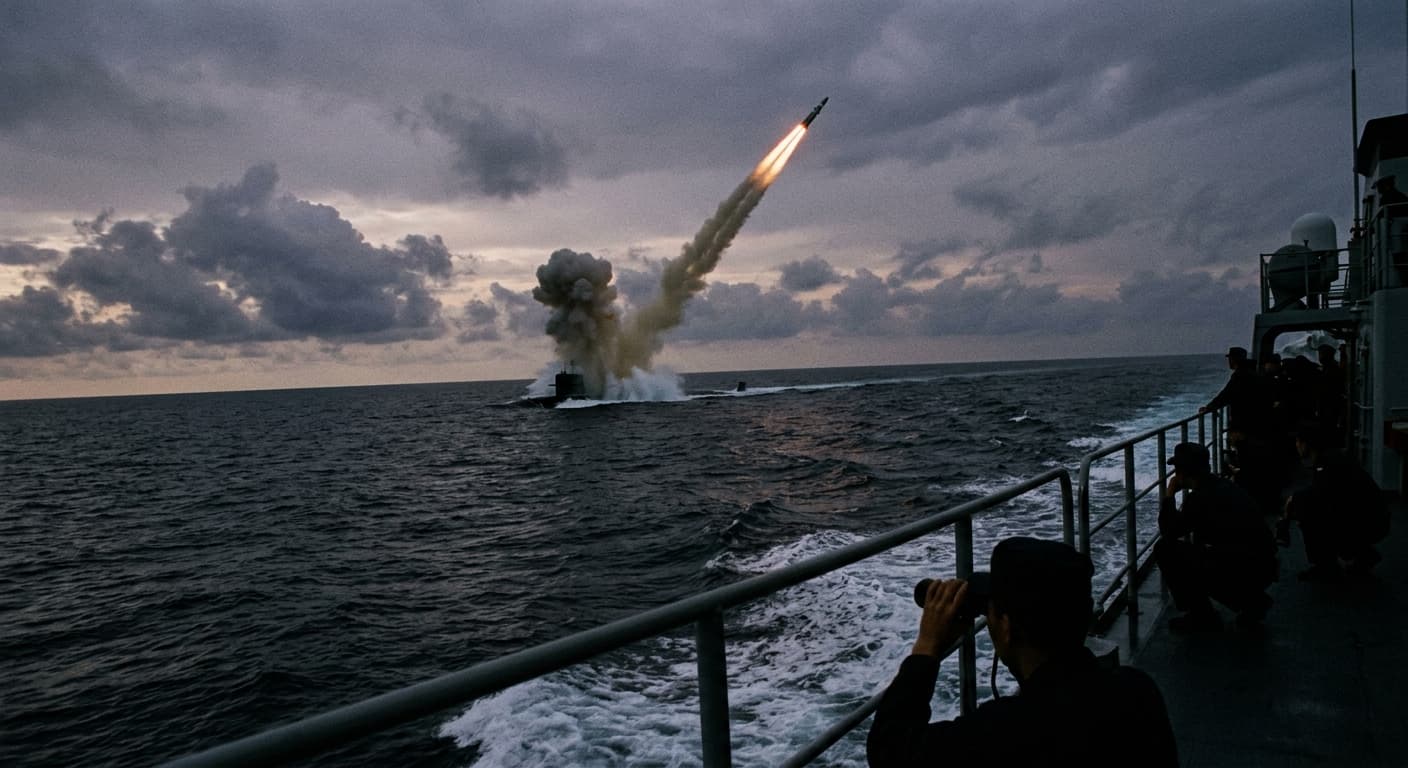
China's July 6, 2026 submarine missile launch into the Pacific signals a maturing sea-based nuclear force — and accelerates Australia's and Japan's pivot to hard containment.
The submarine-launched ballistic missile the People's Liberation Army fired into the South Pacific at 12:01 p.m. Beijing time on July 6, 2026 is not a warning to Australia or Fiji — it is a signal to Washington that China's sea-based nuclear deterrent is now credible enough to be paraded, and Beijing timed the demonstration to land the same morning Anthony Albanese sealed a treaty-level defence pact with Fiji. That coincidence is the story. The test converts what had been a landward Chinese nuclear posture into a mobile, at-sea one, and it forces every Indo-Pacific capital — Tokyo, Canberra, Wellington, Manila, Seoul, Taipei — to recalculate whether their existing hedges against Beijing are still sized correctly.
What actually happened
According to Al Jazeera, citing Xinhua, the PLA Navy launched a long-range ballistic missile with a dummy warhead from a nuclear-powered submarine into "designated waters" in the South Pacific, describing the test as a "routine arrangement" of annual training. Australian Foreign Minister Penny Wong, speaking in Suva, confirmed Beijing had notified Canberra in advance but called the test "destabilising… lacking in the transparency and reassurance as to intent that the region expects." Japan's government said it received a July 5 coastguard notification about "falling space debris" that could enter its exclusive economic zone and urged Beijing to reconsider. New Zealand Foreign Minister Winston Peters told reporters Wellington had "no interest in China using the South Pacific as a testing site for missile capability."
That the test came from a submarine — not a land silo — is the operationally significant fact. China's last Pacific ICBM shot, on September 25, 2024, was a DF-31AG fired from Hainan, its first full-range ICBM test since 1980, as documented by the BBC and analysed in detail by
MP-IDSA. This one closes the loop on the sea leg of Beijing's triad. As the
International Institute for Strategic Studies documented in February 2026, satellite imagery of Chinese yards shows the PLA Navy launched a seventh Type-094 (Jin-class) SSBN in 2024 and an eighth in 2025 — outproducing the United States in submarine tonnage for the first time. The
Council on Foreign Relations summary of the U.S. Department of Defense's
2024 China Military Power Report confirmed China's SSBNs are now conducting at-sea deterrent patrols armed with missiles capable of reaching the continental United States.
What Beijing is signalling
The nuclear-signalling read is straightforward: China is telling Washington its Type-094 boats, armed with the longer-range JL-3, no longer need to leave protected "bastion" waters to hold U.S. targets at risk. The Center for Strategic and International Studies, in its analysis of Beijing's September 3, 2025 Victory Day parade, noted the JL-3 was displayed publicly for the first time with an estimated range "over 5,400 nautical miles" — enough to reach the continental U.S. from the South China Sea. The
Observer Research Foundation puts JL-3 range above 10,000 km. The Royal United Services Institute has argued that this reach lets the PLA Navy hold Hawaii, Alaska and much of the U.S. west coast at risk
without SSBNs leaving Chinese-controlled seas — dramatically shortening the geometry of any Taiwan crisis.
There is a second, quieter audience: Australia, whose AUKUS submarine bet is premised on tracking exactly these boats. The Pentagon's 2024 report puts China's operational nuclear warhead count above 600 in mid-2024, up from roughly 500 twelve months earlier, and projects more than 1,000 by 2030. That is the arms-race trajectory against which Canberra chose today, of all days, to lock Fiji in.
Albanese's counter-move in Suva
While Xinhua was pushing out its launch statement, Prime Minister Anthony Albanese and Fijian counterpart Sitiveni Rabuka were signing a bilateral defence alliance in Suva — a treaty-level upgrade of the "Vuvale Union" finalised in May 2026 and reported by the
BBC as Australia's second major Pacific defence win in a year. Fiji is the Pacific's most consequential middle power — headquarters of the Pacific Islands Forum, one of only three Pacific island states with a standing military — and, until recently, a hedger between Suva's Western partners and Beijing's port and policing offers.
The Fiji pact sits inside a lattice Canberra has been building at pace. Australia signed the Pukpuk mutual defence treaty with Papua New Guinea on October 6, 2025, and on
June 29, 2026 sealed a deal with Vanuatu blocking foreign military bases — an arrangement pointed unmistakably at Beijing's ambitions in the archipelago. Add in the May 2026
Quad Ports of the Future Partnership to develop Suva and Lautoka, and Canberra has effectively priced China out of Pacific security architecture in twelve months. Wong's choice of Suva — not Canberra — as the venue to condemn the missile test was not accidental.
Tokyo's harder line
The Japanese reaction reads sharper than the diplomatic script suggests. Defence Minister Shinjiro Koizumi, in office under Prime Minister Sanae Takaichi since October 2025, has already told the BBC that strengthening deterrence is "critical" to preventing war and, at Shangri-La in June, pointed to China's "huge arsenal of nuclear weapons and strategic bombers" in
rebutting Beijing's "new militarism" charge. Tokyo announced on February 24, 2026 that it will deploy surface-to-air missiles on
Yonaguni island, 110 km from Taiwan, by March 2031 — and Beijing retaliated with export controls on 20 Japanese firms.
Today's launch feeds directly into Takaichi's revision of Japan's key security documents, due by year-end. The pattern Tokyo will emphasise: Beijing announced the "space debris" warning to Japan's coastguard on July 5, one day before the launch, without characterising it as a missile test. Japan called this out publicly in 2024 and is doing so again. The credibility of Chinese arms-control assurances is being systematically eroded — and that erosion is now Koizumi's most useful argument for the largest peacetime defence build-up in Japan's postwar history.
Taiwan reads the tempo
Taipei's response was analytically the most revealing. A senior Taiwanese security official told Reuters that Taiwan is tracking an "upward trend" in PLA Navy movements during peak exercise season, including joint drills with Russia, and will analyse "any new tactics." That framing matters. The
American Enterprise Institute's July 2, 2026 update documents the PLA Navy carrier Liaoning returning to Qingdao on June 23 after a 40-plus-day West Pacific deployment — its longest to date — and Chinese coastguard and research vessels operating almost continuously east of Taiwan since June 1. CSIS's
Geometry of Coercion study logged a more-than-500-percent rise in daily China Coast Guard vessels in Taiwan's near waters between 2020 and December 2025.
Layer today's SLBM demonstration on top of that campaign and the message to Taipei is this: any Taiwan contingency will unfold under an at-sea Chinese nuclear umbrella that did not credibly exist five years ago. That changes the risk calculus of every U.S. carrier commander tasked with responding.
The non-obvious loser: Beijing's Pacific diplomacy
The tell is Fiji. In 2023, then-new prime minister Rabuka openly discussed Suva Port redevelopment with Beijing, and Chinese officials extracted an explicit quid pro quo: infrastructure aid for "firm support on issues concerning China's core interests" — the One China policy foremost. Three years later, Rabuka is signing a mutual defence alliance with Canberra the same day China's navy fires a ballistic missile into his neighbourhood. Beijing's coercive military signalling and its charm-offensive diplomacy are cannibalising each other. As the
Lowy Institute noted this morning, Australia's Pacific diplomacy is on a genuine hot streak — and China's missile test is one of the reasons.
The historical parallel worth naming is the 1996 Third Taiwan Strait Crisis, when Chinese missile firings over Taiwan pushed Japan into deeper alliance integration with Washington and accelerated regional balancing that constrained Beijing for two decades. The 2026 version — sea-based, longer-range, at higher warhead counts — risks producing an even more durable coalition.
Diplomat View
The reasonable read is that China's July 6 test is a controlled, deliberate escalation intended to normalise SSBN patrols beyond the first island chain before the U.S. Columbia-class replacement cycle and AUKUS Virginia transfers take effect in the early 2030s. Beijing is trading medium-term diplomatic goodwill in the South Pacific for a permanent structural shift in the strategic balance — and it will accept the Vuvale Union and the Pukpuk treaty as the price. The forecast: expect a second submarine-launched test within 18 months, likely paired with a JL-3-compatible Type-096 SSBN sea trial from Huludao. What would revise this call: an unexpected Beijing return to arms-control dialogue with Washington after the next U.S.-China leaders' meeting, or a Chinese pullback from Pacific naval demonstrations in exchange for concessions on Yonaguni missile deployments. Neither is likely on current evidence; both would be visible if they happened.
What to watch next
- September 3, 2026: One-year anniversary of Beijing's Victory Day parade — a natural window for the next Chinese strategic-weapons demonstration or JL-3 flight test disclosure.
- Late 2026: Japan's revised National Security Strategy and Defense Buildup Plan, expected by year-end; watch whether Tokyo formalises counter-SSBN missions and expands anti-submarine warfare aircraft procurement.
- December 2026: U.S. Department of Defense's next China Military Power Report — the first to score the July 6 test against the Pentagon's projected 2030 warhead trajectory of 1,000-plus.
The Bottom Line
China's July 6 submarine-launched missile test is the moment its sea-based nuclear deterrent stops being theoretical, and the moment Australia's Pacific containment architecture stops being aspirational. The two events shared a single Monday morning by design — Beijing signalling to Washington, Canberra signalling to Suva. If the pattern holds, the Indo-Pacific of 2030 will be defined less by trade decoupling than by two overlapping submarine games: AUKUS boats hunting Type-094s, and Chinese SSBNs holding U.S. cities at range from waters Beijing already controls.
Read today's full |
Discover more

US Politics
US Launches $166B Tariff Refund Portal
The US is launching a $166 billion tariff refund portal to aid importers hit by Trump-era tariffs, with major implications for trade and supply costs.

US Politics
White House Pressures Congress for Crypto Leg
The Trump administration's push for the CLARITY Act aims to reshape crypto regulation, impacting trillions in market value and the Trump family's wealth.

India
Congress Accuses Modi of Stalling Women's Law
Congress accuses Modi of stalling women's reservation law by linking it to delimitation, revealing a deeper electoral strategy.

Conflict & Security
Drone Warfare Killing Aid Workers at Unprec
Over 1,000 humanitarian workers killed in three years as cheap armed drones collapse legal protections. Gaza, Sudan, Ukraine, and DRC see deliberate targeting of aid convoys and hospitals with zero prosecutions.