China's Missile Test Accelerates Pacific Alli
Beijing's warning gap strengthens Indo-Pacific alliances.
Model Diplomat7 min readAsia-Pacific
China's Hours-Only Warning Turns a Missile Test Into a Pacific Alliance Accelerator
China gave Washington only hours' notice before its July 6, 2026 submarine ICBM test — a transparency gap that is hardening Indo-Pacific alignments faster than the launch itself.
Beijing's decision to give the United States only a few hours' warning before firing a nuclear-capable submarine-launched ballistic missile into the South Pacific on July 6, 2026 is not the story. The story is that Beijing did it anyway — knowing the diplomatic cost — and that the cost is now being paid in accelerated Indo-Pacific alignments. Within 24 hours of the launch, Australia signed its fourth-ever formal alliance, with Fiji; Japan's prime minister publicly opened the door to reviewing Tokyo's non-nuclear principles; and the US State Department on July 8 rebuked China for falling short of P5 nuclear-power norms. The launch bought China a working sea leg of its nuclear triad, but at the price of every fence-sitter in the region moving a step closer to Washington.
What the missile actually did
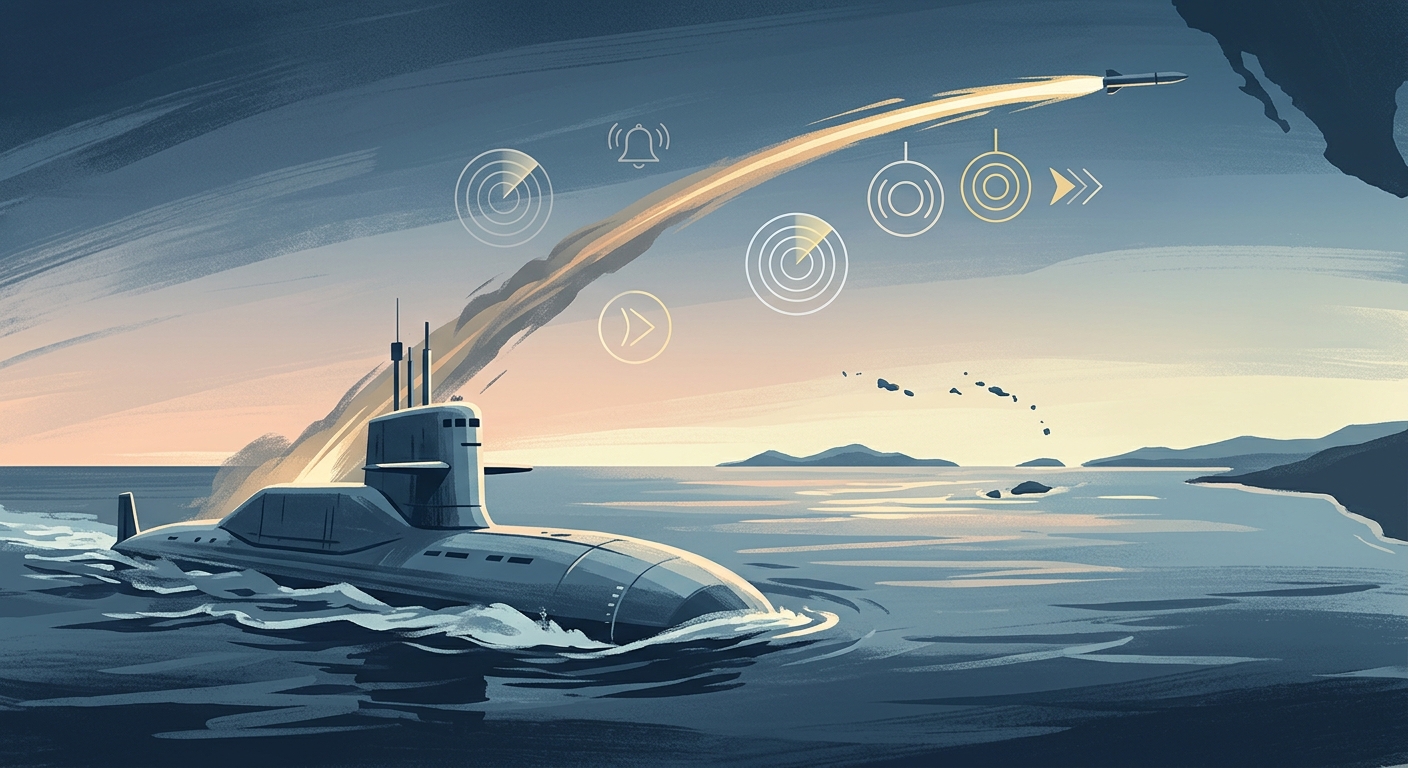
At 04:01 UTC on July 6, a Chinese Type-094 (Jin-class) ballistic missile submarine fired a JL-2 or JL-3 SLBM from the South China Sea across roughly 7,300 kilometres of the Pacific, likely overflying parts of the Philippines and landing inside the South Pacific Nuclear Free Zone. The reconstruction, based on navigation warnings and PLA imagery, comes from the Center for Strategic and International Studies, which called it the first time China has ever tested an SLBM into international open waters — and only its second ballistic-missile launch into international waters since 1980.
The dummy warhead's trajectory mattered as much as its range. The missile flew a realistic ballistic profile from a "bastion" area China's Navy uses to shelter its SSBNs, mirroring what an actual retaliatory strike from that patrol box would look like. Xinhua called the exercise "a routine part of China's annual military training programme," insisting "relevant countries had been notified in advance." The State Department disagreed. Spokesperson Tommy Pigott told the South China Morning Post the notice arrived "only hours before the launch" and "lacked key details expected among established nuclear powers," warning of Beijing's "rapid and opaque nuclear weapons build-up."
Japan received roughly 90 minutes' notice. Australia got about 23 hours. New Zealand's foreign minister, Winston Peters, called the launch "an unwelcome and concerning development." The Philippines — the country the missile most plausibly overflew — appears not to have received direct pre-launch notification at all, per the CSIS reconstruction.
The rulebook China refuses to sign
Every other nuclear-armed P5 state operates under a common transparency floor. The Hague Code of Conduct against Ballistic Missile Proliferation, adopted in 2002 and reaffirmed by UN General Assembly Resolution 79/29 in December 2024, commits its 145 subscribing states to pre-launch notifications no fewer than 24 hours in advance, with information on launch area, direction and missile class. China is the only major space-faring, ballistic-missile power that has never subscribed. That absence is not new — the US State Department's own compliance page notes that Beijing "is not a Party to the HCOC" and rests only on a bilateral November 2000 pledge to the United States — but its consequences are now visible in real time.
The July 6 pattern — ad hoc, discretionary, minimum viable — is Beijing's preferred substitute. Chinese diplomats have leveraged even token notifications: at the 2026 Nuclear Non-Proliferation Treaty Review Conference, China's national report cited its 2024 Pacific ICBM advance notice as evidence of "strategic risk reduction." The July 6 test undercut that framing within a single news cycle. Nine months earlier, the Pentagon's
2024 China Military Power Report had already assessed that China surpassed 600 operational nuclear warheads by mid-2024, on track to top 1,000 by 2030, and was moving toward a "launch on warning" posture. Against that arc, "hours" of notice reads less like transparency than test data.
Beijing's calculus — and why it backfired within 48 hours
The PLA had rational reasons to shoot. Chinese commentators quoted in Carnegie's Proliferation News speculate the missile was the JL-3, unveiled at the September 2025 Victory Day parade and now needing a near-full-range flight to validate reliability. A successful open-ocean shot from the South China Sea proves the JL-3 can reach the continental United States from waters the PLA Navy can defend, closing the credibility gap on China's undersea deterrent that
IISS analysts have long flagged. The Global Times boasted that "the Liberation Army's sea-based nuclear force is capable of carrying out stable, reliable strategic counterstrikes from anywhere in the vast open seas of the Pacific Ocean" — hyperbolic, but strategically pointed.
The timing was the political mistake. Prime Minister Anthony Albanese and Foreign Minister Penny Wong were in Suva finalising the Australia–Fiji "Ocean of Peace" alliance when the missile landed, according to the BBC. That treaty — Fiji's first formal alliance, Australia's fourth after the US, New Zealand and Papua New Guinea — is backed by more than A$1 billion of Australian spending over a decade. USSC chief executive Michael Green told
The Australian the launch was a clear attempt "to intimidate Pacific island nations and Australia, and to demonstrate there will be punishment" when such agreements are signed. Whether or not intimidation was the intent, the effect was the opposite: Albanese used the incident to justify the pact, and continued on to Honiara to negotiate a further treaty with Solomon Islands.
The Lowy Institute, no China hawk, called the episode "Beijing's own goal in the Pacific". That verdict tracks the second-order data: Chinese warships circumnavigated Australia in a February 2026 live-fire exercise; Beijing has registered 26 new coastguard vessels for high-seas boarding in the Pacific; and in May 2026 the Quad announced a "Ports of the Future" partnership starting with Suva and Lautoka, per
Al Jazeera. Every one of those data points hardens the Australia–US–PNG–Fiji quadrant China's launch was supposed to unsettle.
The Japan variable
The single most consequential response may not be Australian at all. It came from Tokyo. Two days after the launch, Prime Minister Sanae Takaichi told the Diet's Settlement and Administrative Oversight Committee she would "certainly bring all issues to the table for discussion" in the year-end revision of Japan's three security documents — explicitly including the Three Non-Nuclear Principles that have anchored Japanese policy since 1967. The exchange was reported by the Nikkei and summarised in Carnegie's Proliferation News.
Even a rhetorical opening of the "no possess, no manufacture, no introduction" trinity is a strategic tremor. Japan has received "hours" of notice on both the September 2024 and July 2026 Chinese launches into the Pacific. The next-nearest US ally to a Chinese SSBN bastion, and the one most exposed to a JL-3 flight profile out of the Bohai Sea, is now openly canvassing a nuclear-posture review. That is the price of Beijing's chosen notification model.
The Philippines, quietly, is the tell
The most under-covered detail is the missile's likely overflight of Philippine territory. As CSIS notes, Beijing had drawn navigation warnings suggesting two possible corridors on July 6 — a northern one over Japan, and a southern one over the Philippines — and chose the latter. The Philippine Coast Guard is the first foreign coastguard ever to participate in this year's US-led Rim of the Pacific exercise. In 2024 Manila became the first foreign host of the US Typhon mid-range missile system, a deployment the Indian analyst
MP-IDSA links directly to China's decision to resume full-range ICBM testing over open ocean. The trajectory is not a coincidence; it is signalling.
The problem for Beijing is that signalling by trajectory only works if the target's political system flinches. The Marcos government has done the opposite — deeper access agreements with the US, tighter coast-guard cooperation with Japan and Australia, and increasingly public documentation of Chinese grey-zone activity at Second Thomas Shoal and Sabina Shoal. A missile that "possibly crossed over Philippine territory," in the CSIS phrase, is not a deterrent; it is a recruiting poster for the US-Japan-Philippines trilateral.
Diplomat View
The forecast is this: the July 6 launch has locked in a two-track Indo-Pacific for the rest of the decade — a hardening Australia–Japan–Philippines–US quadrant that treats Chinese nuclear opacity as a fixed planning assumption, and a shrinking Beijing-aligned group (Solomon Islands, Kiribati, Cook Islands) whose value to China is now more symbolic than strategic. Expect the JL-3 to be declared operational by 2027 and Chinese SSBN patrols into the Philippine Sea to become routine, precisely because Beijing has calculated that the diplomatic cost is now sunk. What would falsify this call: a Chinese decision, in the next 12 months, to subscribe to the HCOC or to negotiate a bilateral pre-launch notification agreement with the US along the lines of the 1988 US-Soviet accord. Absent that — and Beijing has refused for a quarter-century — the working assumption in every regional defence ministry should be that "hours of notice" is now the ceiling, not the floor.
What to watch
- September 8–12, 2026 — 55th Pacific Islands Forum Leaders' Meeting in the Solomon Islands: whether the "Ocean of Peace" framework absorbs a formal condemnation of unnotified ballistic-missile tests.
- Late 2026 — Japan's National Security Strategy revision: whether Takaichi's Diet remarks on the Three Non-Nuclear Principles harden into a formal review clause.
- December 2026 — 2025 US DoD China Military Power Report (typical release window): the first official post-test assessment of China's operational SSBN patrol posture and JL-3 status.
- 2026 UN First Committee session: whether the US, France and the UK use HCOC's annual resolution to name China directly, breaking two decades of restraint.
Discover more

US Politics
US Launches $166B Tariff Refund Portal
The US is launching a $166 billion tariff refund portal to aid importers hit by Trump-era tariffs, with major implications for trade and supply costs.

US Politics
SNAP Food Assistance Faces Legal Challenges
In 2026, SNAP faces stricter eligibility rules and mounting legal challenges, threatening food assistance for the millions of Americans who rely on the program.

US Politics
White House Pressures Congress for Crypto Leg
The Trump administration's push for the CLARITY Act aims to reshape crypto regulation, impacting trillions in market value and the Trump family's wealth.

Conflict & Security
Drone Warfare Killing Aid Workers at Unprec
Over 1,000 humanitarian workers killed in three years as cheap armed drones collapse legal protections. Gaza, Sudan, Ukraine, and DRC see deliberate targeting of aid convoys and hospitals with zero prosecutions.