China's Maritime Gambit: 110 Ships Shift Tide
Beijing's naval expansion challenges Indo-Pacific stability
Model Diplomat9 min readAsia
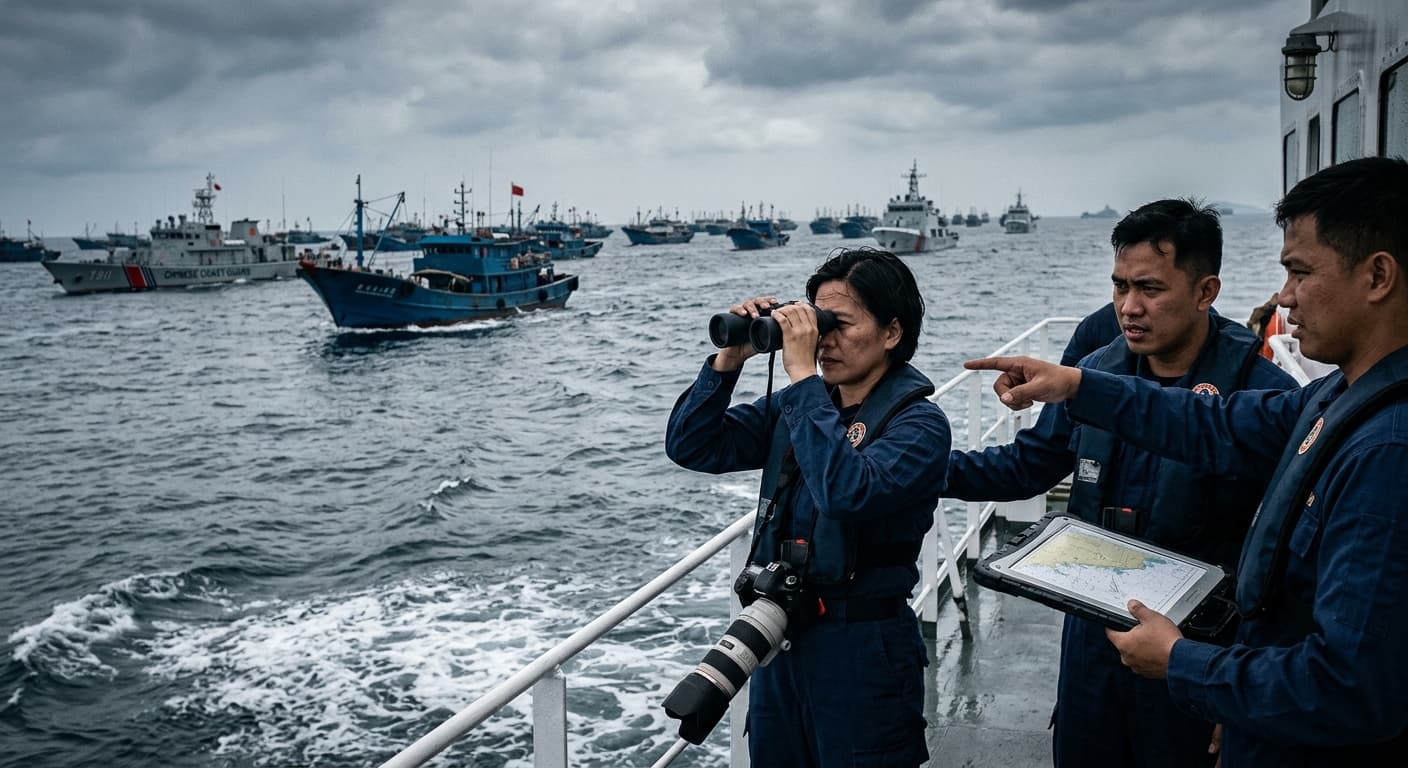
China's maritime gambit: 110 ships redraw the First Island Chain
Beijing exploited the Trump-Xi truce to push more than 110 warships and coast-guard vessels along the First Island Chain — and the Pentagon is quietly narrowing its Indo-Pacific defense to match.
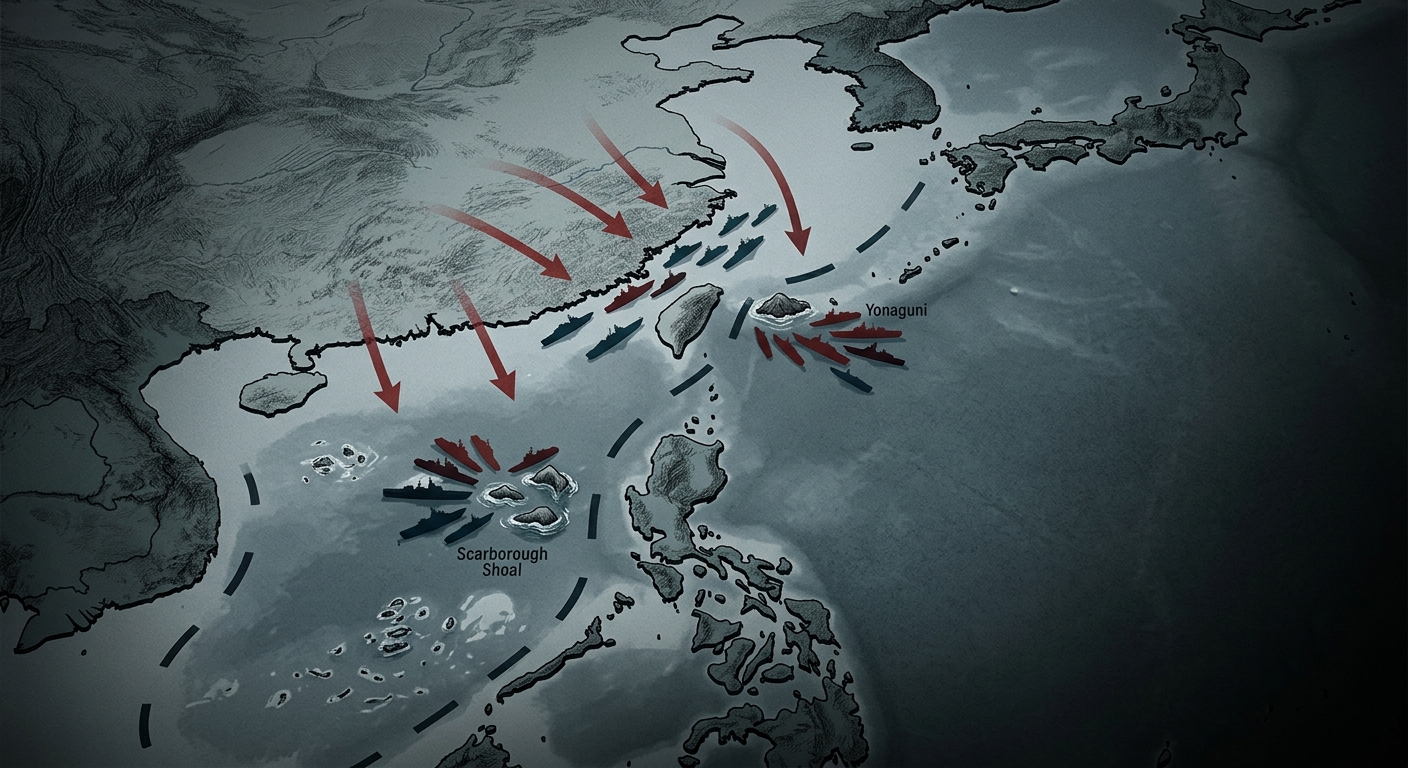
Between June 1 and July 5, 2026, China arrayed more than 110 military and coast-guard vessels along the First Island Chain — a record deployment that stretched from South Korea through the Ryukyus and Taiwan down to Scarborough Shoal, and which Taiwan's National Security Council Secretary-General Joseph Wu (吳釗燮) documented in a map posted July 5. The maritime gambit is not a prelude to invasion; it is a bid to rewrite the Indo-Pacific status quo while Washington is preoccupied with a trade truce. Beijing has read US President Donald Trump's May 14 pledge of "strategic stability" with Xi Jinping as tacit acquiescence — and is racing to lock in gains at sea before the next US election cycle can reverse them. Washington's response, as US Army Pacific commander General Ronald Clark confirmed on June 23 at the Balikatan 2026 drills, is to compress its defense perimeter to the First Island Chain itself.
The gambit: coercion under the cover of stability
The Trump-Xi summit in Beijing on May 14 produced what the Council on Foreign Relations called "a mutually useful ambiguity" — Washington sold the deliverables (Boeing orders, rare-earth flows, agricultural purchases); Beijing sold the doctrine. Xi told Trump that Taiwan was the "most important issue" in the relationship, warning that mishandling it could "lead to clashes and even conflicts," according to the
CSIS readout. The White House fact sheet omitted Taiwan entirely.
Within two weeks, the pressure resumed. On June 1, the China Coast Guard's Mount Tai flotilla appeared roughly 52 nautical miles southeast of Taiwan's Lanyu island — the first Chinese claim to "law enforcement" jurisdiction in Pacific waters east of Taiwan, BBC Chinese reported. Between June 6 and June 10, China's Ministry of Transport dispatched four large public vessels — including the 10,000-ton Haixun 09 — to sweep 1,030 nautical miles east of Taiwan, inspecting 198 ships. Beijing framed the operation as a response to Japan-Philippines exclusive economic zone talks that would delimit boundaries around the Sakishima chain without Taiwan at the table.
The Taipei Times editorial published July 10 reads the sequence bluntly: "China interprets the US pursuit of 'strategic stability' as a form of 'acquiescence' that allows Beijing to escalate pressure." That reading is consistent with the July 8 assessment by Ocean Affairs Council Minister Kuan Bi-ling (管碧玲), who told the Taiwan International Ocean Forum that Taiwan, Japan and the Philippines are facing "the same pattern of actions" that are "deliberately controlled to remain below the threshold of conventional warfare."
The numbers: a maritime campaign that dwarfs 2024
The scale of Beijing's mobilization is measurable, not rhetorical. The CSIS ChinaPower Project's annual tally recorded a monthly average of 221 PLA Navy vessels around Taiwan from May 2024 onward, a 42 percent jump from the pre-Lai baseline. In early December 2025, the PLA staged a single show-of-force involving more than 100 naval and coast guard vessels across the Yellow Sea, East China Sea, Taiwan Strait, and South China Sea simultaneously — a rehearsal, in retrospect, for the June 2026 deployment.
The Philippine flashpoint is starker. According to a July 2026 Asia Maritime Transparency Initiative analysis, China Coast Guard patrols at Scarborough Shoal totaled 933 ship-days in the first half of 2026 — nearly the entire 2025 annual figure of 1,099 ship-days, which had itself doubled from 516 in 2024. Monthly CCG presence peaked at 216 ship-days in May 2026. Philippine and Chinese vessels interacted on 112 separate days in the six-month window, averaging 19 days per month of near-misses, water-cannon exchanges and hull-to-hull maneuvering. On May 25, a Chinese "temporary research structure" appeared inside the shoal's lagoon — the first fixed platform Beijing has installed there.
The pattern at Pratas Island tells the same story in miniature. Chinese law enforcement patrols around Pratas rose from zero in 2021 to 60 recorded days in 2025, and AMTI documented a PLA drone incursion into Pratas airspace in January 2026 — the first of its kind. Around Kinmen and Matsu, China Coast Guard vessels logged 679 unauthorized transits of restricted waters in 2024 alone, according to Taiwan's 2025 National Ocean Policy White Paper cited by
CSIS.
Taiwan's Ministry of National Defense now publishes daily PLA activity bulletins that read like weather reports — 11 aircraft sorties, six PLAN ships, three "official" vessels around Taiwan in a routine 24-hour cycle on June 10 alone. This is the "normalization" that Kuan warned about: individually below the threshold of crisis, cumulatively a fait accompli.
Washington's answer: shrink the perimeter, harden the chain
The US response is not to push back at every flashpoint. It is to redraw its own defense line. The Trump administration's 2026 National Defense Strategy, released in late January and analyzed by Al Jazeera, declared that Washington will "erect a strong denial defense along the First Island Chain" and demand that regional allies "shoulder their fair share." The strategy relegated China from "pacing challenge" to one of four priorities, with the homeland and Western Hemisphere on top.
That framing is echoed in the operational data. General Clark told CSIS in June 2025 — and repeated to NPR from the Balikatan 2026 drills in the Philippines in May — that the Army has fielded Typhon mid-range missile systems on Luzon capable of striking targets on the Chinese mainland. "It's not about escalation. It's really about deterrence," Clark told
NPR. The "Operation Pathways" framework now links more than 50 multinational exercises across the Indo-Pacific, and the US has established Army Prepositioned Stocks in South Korea, Japan, the Philippines and Australia.
The Pentagon's reported rebranding of US Indo-Pacific Command as US Pacific Command — described in the July 10 Taipei Times editorial — carries the same signal. Quincy Institute Global South director Sarang Shidore reads it as a "narrower, militarized line of defense, specifically the First Island Chain." Foreign Affairs' Zack Cooper argued in a February 2026 essay that retrenchment to the First Island Chain "is the most likely outcome in the years ahead" — a thin defensive line that keeps Japan, Taiwan and the Philippines inside the US perimeter but effectively concedes the Asian mainland.
The Pentagon's own 2025 China Military Power Report, released in December, states plainly that the PLA "must be able to achieve 'strategic decisive victory' over Taiwan" by the end of 2027 and that Beijing is now pursuing "coerced progress toward unification on Beijing's terms" — a documented shift from deterring independence to compelling capitulation. The 2025 Annual Threat Assessment from the Director of National Intelligence
reached the same conclusion: Beijing is "intensifying the scope, size, and pace of operations around Taiwan."
The weak link: logistics, not politics
Here is what the wire coverage misses. The First Island Chain strategy hinges less on missiles and more on beans, bullets and fuel. A May 2025 RAND study for USARPAC found that "existing Army logistics and sustainment efforts in the Indo-Pacific face substantial challenges that cannot be overcome" without ally support — and that "the legal and contractual basis for multilateral logistics and sustainment support in this region remains weak." A separate RAND assessment concluded that of the three treaty allies most relevant to a Taiwan contingency — Japan, the Republic of Korea, and the Philippines — only Japan is likely to grant meaningful access "if Japan itself is not attacked," and even that support "is likely to take time."
That is the vulnerability Beijing is exploiting. Every additional day of gray-zone pressure without a Western response widens the political gap between what US planners assume they can do from allied territory and what those allies will actually authorize. It is why Manila's shift from internal-security posture to territorial defense — noted by Lieutenant General Aristotle Gonzalez at Balikatan 2026 — matters more than the missile hardware. It is also why Kuan Bi-ling warned this week that shipping routes may already be adjusting and "insurance companies recalculating risk." Once Lloyd's of London re-rates the Bashi Channel and the Miyako Strait, the coercion becomes self-executing.
Beijing's asymmetric advantage on the water is stark. The China Coast Guard is the world's largest, and its 2021 Coast Guard Law authorizes force against foreign vessels in "waters under Chinese jurisdiction" — a term the statute pointedly leaves undefined, as CSIS's Bonny Lin documented. Taiwan's coast guard, though scheduled to reach 141 hulls by 2027, is outnumbered and outsized. Japan's coast guard fields roughly 100 large- and medium-sized patrol vessels, but only about 20 are based in Okinawa. The Philippines has fewer still.
Who benefits, who loses
The winners of this maritime campaign are not obvious. Beijing is extracting a rewrite of the East Asian legal order without firing a shot — but it is also driving Manila, Tokyo and Taipei into a level of operational coordination that would have been politically impossible in 2020. The June Marcos-Takaichi announcement in Tokyo elevating the Japan-Philippines relationship to a "comprehensive strategic partnership," coupled with formal EEZ delimitation talks in the Sakishima chain, is a direct product of Chinese overreach. Taiwan, excluded from those talks, is nevertheless the strategic beneficiary: for the first time, two US treaty allies are drawing lines that structurally require Taiwan's cooperation.
The losers are Southeast Asian claimants that lack a US treaty. Vietnam, Malaysia and Indonesia have watched CCG patrols encroach deeper into their EEZs — AMTI recorded 261 calendar days of Chinese patrol activity in Malaysia's northeastern EEZ in 2025 alone. Washington's First Island Chain retrenchment offers them nothing.
The second-order loser is US extended deterrence itself. If Trump treats Taiwan arms sales as a bargaining chip in trade negotiations — the $14 billion package that Al Jazeera reports remains in limbo since the Beijing summit — then every Chinese incursion that goes unanswered becomes a data point for allies calculating whether US commitments still bind. That is the calculation Kuan was making when she told the forum that "the international community, through repeated judgements that each incident is 'not yet a crisis,' might gradually become accustomed to things that should never be regarded as normal."
What to watch next
- September 24, 2026: Xi Jinping's scheduled state visit to Washington, invited by Trump at the May state dinner. Any pre-visit CCG surge — or restraint — will signal whether Beijing views the second summit as leverage or as a ceiling.
- November 2026: APEC Leaders Meeting in Shenzhen. First multilateral test of whether the "strategic stability" framework survives contact with allied concerns.
- Late 2026: Pentagon decision on the $14 billion Taiwan arms package. Approval would validate Hegseth's Shangri-La commitments; delay would confirm Beijing's read of the Trump-Xi bargain.
- Fiscal 2027 defense budget: Trump has floated a $1.5 trillion topline. Congress has signaled it will not fund a 50 percent hike. The gap between First Island Chain rhetoric and appropriations will define whether "denial defense" is doctrine or slogan.
Diplomat View
The forecast: Beijing will convert its July 2026 deployment into a permanent baseline before the September Xi-Trump meeting, on the theory that Trump will pocket the summit optics rather than escalate over vessels. Expect a formal Chinese "administrative order" for the waters east of Taiwan within 90 days — the logical next salami slice after June's "law enforcement" patrols. What would revise this call: a Trump-authorized arms release to Taiwan before September, a Japanese Self-Defense Force intercept of a CCG vessel inside Yonaguni's territorial sea, or a Philippine invocation of Article IV of the US Mutual Defense Treaty following a Scarborough incident. Absent one of those triggers, the "new status quo" that Kuan Bi-ling described this week is not a warning — it is the outcome. The First Island Chain is being fortified and encircled at the same time, and the encirclement is winning on tempo.
The Bottom Line
Beijing is not preparing to invade Taiwan in 2026 — it is preparing to make invasion unnecessary by fait accompli, using coast guard hulls and administrative orders to convert international waters into internal ones while Washington negotiates trade. The 110-vessel deployment along the First Island Chain is the operational face of that bet, and the Pentagon's quiet retrenchment to the same line is the tell that the bet is working.
Discover more

US Politics
US Launches $166B Tariff Refund Portal
The US is launching a $166 billion tariff refund portal to aid importers hit by Trump-era tariffs, with major implications for trade and supply costs.

US Politics
White House Pressures Congress for Crypto Leg
The Trump administration's push for the CLARITY Act aims to reshape crypto regulation, impacting trillions in market value and the Trump family's wealth.
US Politics
Virginia's Redistricting Referendum
Virginia's redistricting referendum is drawing a flood of dark money, shaping future elections and the fight for congressional control amid party stakes.

Conflict & Security
Drone Warfare Killing Aid Workers at Unprec
Over 1,000 humanitarian workers killed in three years as cheap armed drones collapse legal protections. Gaza, Sudan, Ukraine, and DRC see deliberate targeting of aid convoys and hospitals with zero prosecutions.