China's Batanes Claim: A Legal Probe
Beijing's strategy to challenge Japan-Philippines EEZ talks
Model Diplomat5 min readAsia
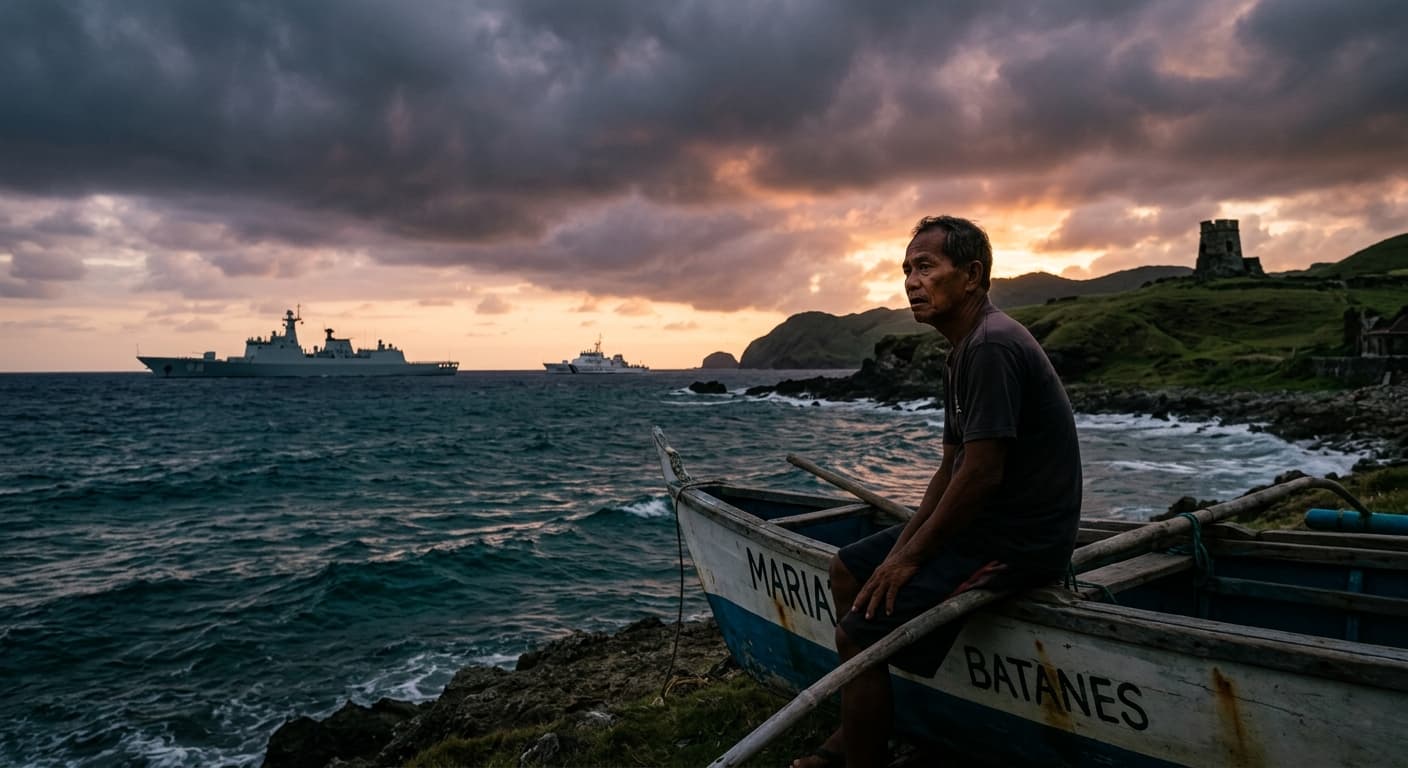
The Japan Institute of International Affairs reported in June 2026 that Chinese marine survey ship Zhong Shan Da Xue had left an "unusual crescent-shaped track pattern" through the Bashi Channel in late 2025, which the Institute for the Study of War assessed was either seabed mapping for submarine warfare or reconnaissance for placing devices to target US anti-ship systems on Batanes. Philippine Defense Secretary Gilberto Teodoro Jr. on July 3 called Chinese scholars' claim that Batanes belongs to China "baseless and ludicrous" — and warned it signals Beijing's intent to dominate the Pacific. The Japan Institute of International Affairs reported in June 2026 that Chinese marine survey ship Zhong Shan Da Xue had left an "unusual crescent-shaped track pattern" through the Bashi Channel in late 2025, which the Institute for the Study of War assessed was either seabed mapping for submarine warfare or reconnaissance for placing devices to target US anti-ship systems on Batanes. Read against the July 2 GDToday report on the Jinan University symposium, the sequence is a familiar Chinese playbook: quiet mapping, followed by a scholarly claim, followed by coast-guard patrols dressed as law enforcement.
The lawfare precedent — and why it matters legally
The scholars' argument fits what University of the Philippines maritime law director Jay Batongbacal has called China's post-2016 turn to "particularistic" historic-rights claims after the Permanent Court of Arbitration in The Hague rejected the nine-dash line under UNCLOS. That approach — asserting maritime and territorial entitlements through academic proxies and unilateral legal declarations rather than treaty or judgment — is documented in ISEAS-Yusof Ishak scholarship as China's core "lawfare" method since 2016.
The Batanes gambit extends that model in a specific direction. If sovereignty over Batanes is contestable "through Taiwan," then the Japan–Philippines EEZ delimitation between Yaeyama and the Batanes overlaps China's own claim by proxy — the exact argument Beijing has already made to declare the June talks "completely illegal and invalid" and to justify China Coast Guard patrols 96 kilometres southeast of Taiwan's Orchid Island. The National Maritime Council's
statement accompanying RA 12064 emphasises Manila's UNCLOS-based approach — the polar opposite of Beijing's history-based method.
Manila's counter-lawfare runs on three tracks. First, RA 12064 and the companion Archipelagic Sea Lanes Act give the Philippines a codified UNCLOS position on all its baselines, including Batanes. Second, the Japan–Philippines EEZ delimitation, once concluded, sets a treaty-based boundary that a third party cannot legally erase. Third, the Comprehensive Archipelagic Defense Concept, unveiled by Teodoro in January 2024, explicitly links the South China Sea and Taiwan contingencies as one strategic theatre with Batanes as its northern hinge.
Who benefits, who loses
The immediate winners are Washington and Tokyo. Beijing has just handed the Marcos administration a domestic political gift — a claim so implausible it collapses the pro-Duterte critique that Manila's US tilt is "provocative." As the Hudson Institute's Patrick Cronin argued, the Pentagon's 2025 National Defense Strategy makes credibility in the first island chain depend on whether Manila can politically sustain forward missile infrastructure under Chinese pressure. A "ludicrous" claim on a Philippine province with a 240-year administrative record — floated by scholars, not diplomats — makes that political sustainment easier, not harder.
Beijing's calculated loser here may be Taipei itself. As Hudson's Satoru Nagao told BBC Chinese in June, the Japan–Philippines EEZ overlap with Taiwan's claimed eastern EEZ leaves Taipei "sandwiched" — needing US-Japan-Philippines security cover while unable to formally join a delimitation that touches Taiwan's own claims. If the scholars' argument is accepted anywhere, it strengthens Beijing's proxy claim over waters Taipei also asserts — a subtle way of narrowing Taiwan's international space through academic maps.
The domestic Chinese audience matters too. GDToday and CASS-linked scholars have been used to seed narratives that Beijing later "adopts" once diplomatic timing suits — the South China Sea nine-dash line followed exactly this trajectory before 2016. That the June 30 event was hosted by Jinan University — not a Beijing-based defence institute — provides deniability. Foreign Ministry spokesperson Mao Ning has, so far, said nothing about Batanes; contrast that with China's swift June 2026 sanctions on Teodoro himself, barring him and his family from entering China for what Beijing called "erroneous remarks."
The evidence on Batanes' actual status
The scholars' historical claim collapses on inspection. Peer-reviewed archaeology in Antiquity — including the Bellwood-Dizon Batanes project, the field's primary excavation record — establishes that Batanes and Taiwan share prehistoric Austronesian settlement dating to roughly 2000 BC. Neither is descended from Han Chinese state formations; both were settled by seafaring populations that later populated the Pacific. Retired Philippine Supreme Court Justice Antonio Carpio
demonstrated in 2020, using Ming and Qing dynasty maps, that China's own imperial records place its southernmost territory at Hainan, not anywhere near the Bashi Channel.
The Permanent Court of Arbitration's 2016 award settled the legal frame: UNCLOS-based entitlements displace historic-rights claims where the two conflict. That ruling covered the South China Sea, but its principle applies with equal force to any Bashi Channel claim through Taiwan.
Diplomat View
The Batanes claim is not a serious sovereignty argument; it is a stress test. Beijing is measuring how far academic-proxy claims can travel before Manila's alliance architecture pushes back, and how much legal fog it can generate around Japan-Philippines EEZ talks that would, if concluded, treaty-lock the northern end of the first island chain against Chinese revision. The forecast: a second scholarly symposium, likely at CASS or a naval-linked institute, within 90 days; China Coast Guard "sovereignty patrols" through the Bashi Channel justified with reference to these academic conclusions before year-end. The forecast changes if Mao Ning or a Foreign Ministry statement explicitly disavows the Jinan claim (unlikely), or if Beijing accepts the Japan-Philippines EEZ line running through waters it now disputes (extremely unlikely). Absent either, Manila's answer is the correct one: treat the claim as coercion by other means, and let RA 12064 and the Japan delimitation do the legal work Beijing refuses to accept.
What to watch next
- Q3 2026: Second round of Japan–Philippines EEZ delimitation talks, expected in Tokyo. Beijing's reaction — and whether it deploys the Jinan University language in a formal démarche — is the leading indicator.
- September–October 2026: KAMANDAG and Sama-Sama exercises. Watch for whether NMESIS or Japan's Type 88 systems return to Batanes; if they do, expect a matching Chinese survey-ship or coast-guard incursion in the Bashi Channel.
- November 7, 2026: Two-year anniversary of RA 12064; Manila is expected to complete IMO submission of archipelagic sea-lane coordinates, giving the Batanes baselines a further layer of international legal endorsement.
The Bottom Line
The Batanes claim is not about Batanes. It is Beijing's opening lawfare probe against the Japan-Philippines EEZ delimitation and the US anti-ship missiles now sitting 160 kilometres from Taiwan — a plausibly-deniable academic argument designed to muddy the legal ground under the northern hinge of America's first-island-chain missile network. Manila's rebuke, backed by RA 12064 and a treaty-based Japanese delimitation, is the right answer: treat the scholarship as coercion by other means, and let UNCLOS do the work Beijing refuses to accept.
Discover more

US Politics
US Launches $166B Tariff Refund Portal
The US is launching a $166 billion tariff refund portal to aid importers hit by Trump-era tariffs, with major implications for trade and supply costs.

US Politics
White House Pressures Congress for Crypto Leg
The Trump administration's push for the CLARITY Act aims to reshape crypto regulation, impacting trillions in market value and the Trump family's wealth.

India
Women's Reservation Bill 2026: A Political Sh
India's Lok Sabha rejected the Women's Reservation Bill, exposing a political maneuver to redraw electoral maps favoring the north over the south.

Economics
Fed's Amex AML order puts correspondent banking on notice
Federal Reserve's Amex AML order requires board-level controls and a 90-day plan; OCC fined the bank $350 million over enterprise-wide deficiencies.