Children Demand a Seat at South Sudan's Table
Youth push for influence in upcoming elections
Model Diplomat8 min readAfrica
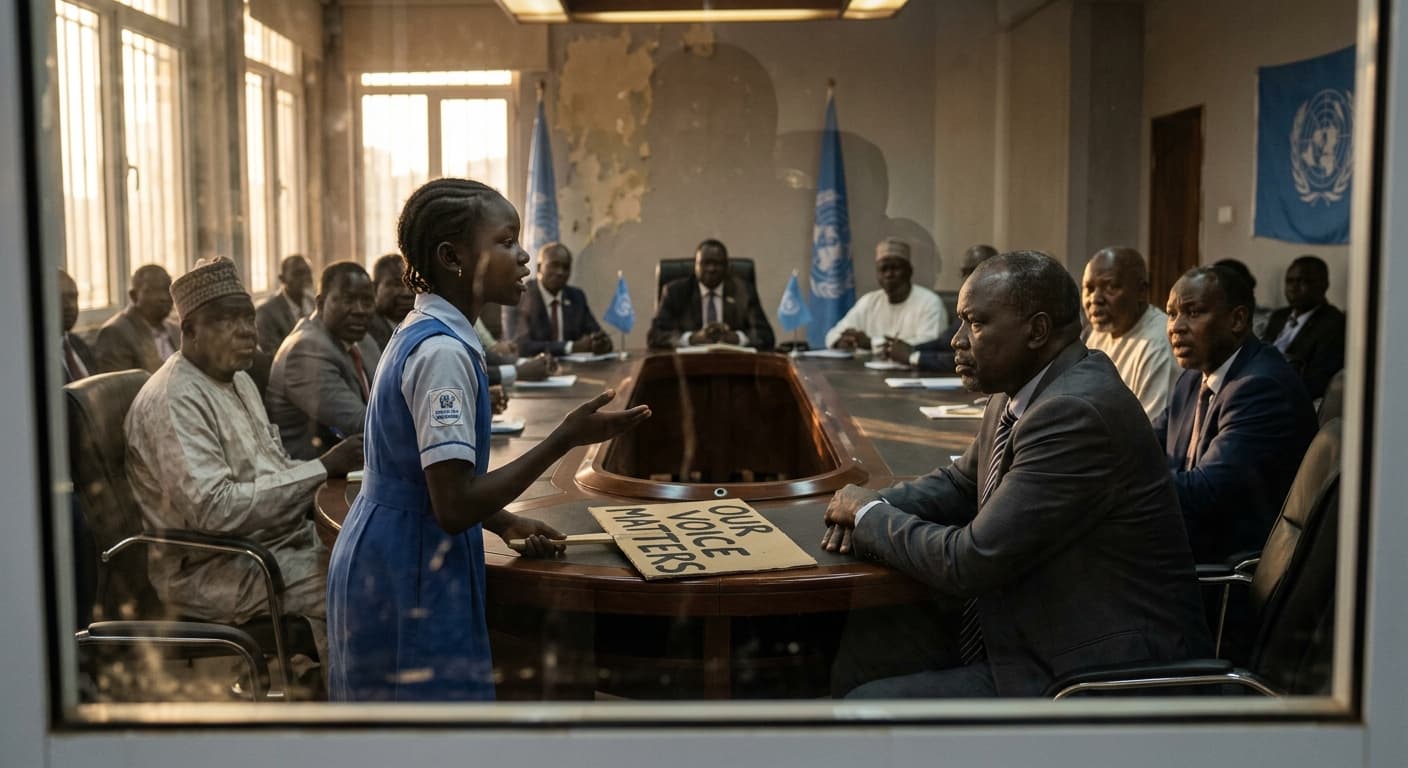
Children Demand a Seat at South Sudan's Table at 15
As South Sudan turns 15 on July 9, 2026, a generation born into the state is forcing its way into an election politics has tried to postpone — with UN-backed leverage the elite did not see coming.
On July 9, 2026, South Sudan will mark 15 years of independence with a first-ever national vote scheduled for December 22 — a poll its transitional leaders have already delayed four times and its youngest citizens have never once influenced. The angle worth watching this anniversary is not the fraying Kiir–Machar pact. It is that a UN-financed youth infrastructure — 312 trained "peace champions," a legally recognised network of State-level Youth Peace Fora, and a national strategy adopted in May 2025 — has quietly given a generation raised entirely inside the state its first codified point of leverage over the men who founded it. Whether that leverage survives the December election is the real test of South Sudan's second decade.
Roughly seven in ten South Sudanese are under 30, and more than 40% are under 15, according to United Nations population data cited in the ISS Africa analysis of the transition. This is a country whose median citizen has no memory of Sudan, only of the war of 2013–2018, the fragile Revitalised Agreement of 2018, and the transitional government that has ruled without a ballot ever since. The political class negotiating South Sudan's future is, in almost every meaningful sense, negotiating with someone else's children.
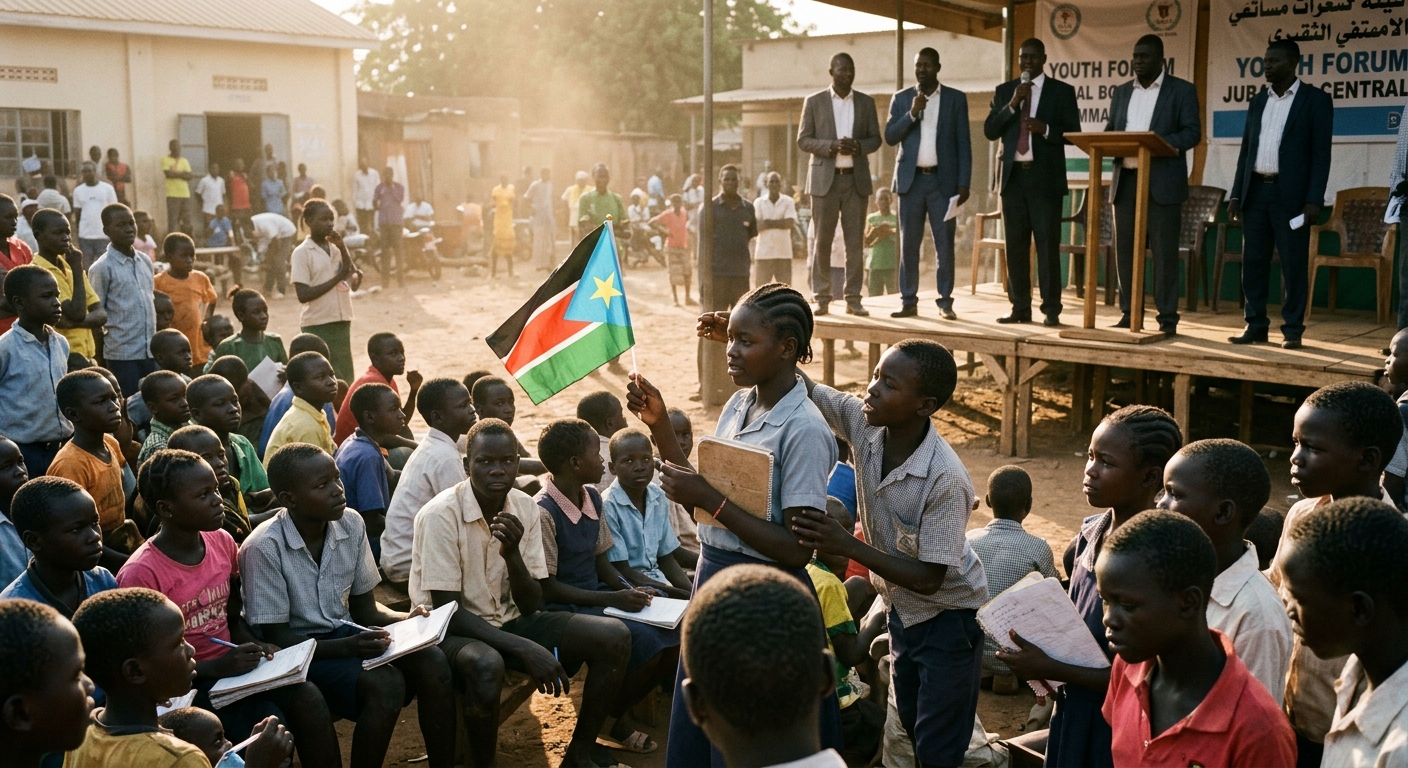
The state failed the child, then the child organised
The primary record on how the state has treated its children in the last year is unforgiving. The June 2026 report of the UN Secretary-General on children and armed conflict, document S/2026/357, verifies 555 grave violations against 383 South Sudanese children in 2025 alone. Of those, 147 children were recruited into armed forces — 107 by the government's own South Sudan People's Defence Forces (SSPDF), and 38 by the opposition SPLM/A-IO. Government forces were also identified as the largest single perpetrator of the killing and maiming of children, of attacks on schools and hospitals, and of documented sexual violence against girls.
The 2024 report of the UN Commission on Human Rights in South Sudan set the frame plainly, stating in A/HRC/55/26:
"Children suffer disproportionately from precarious health and humanitarian conditions, and constitute most of the population requiring assistance. One in 10 children under five dies, and 1.65 million experience acute malnutrition, mostly in areas affected by conflict."
The Commission's February 2026 follow-up went further, warning the country risked "a return to full-scale war" after the March 2025 house arrest and September 2025 treason indictment of First Vice-President Riek Machar, according to Al Jazeera's reporting on the report. UNICEF, cited in the same coverage, said more than 450,000 children were at risk of acute malnutrition in Jonglei alone after fighting displaced 235,000 people from late December 2025.
Against that record, the political interest in postponing elections — for a fifth time if December slips — is not abstract. Every extension prolongs a transitional cabinet in which, as the Chatham House expert brief on the Kiir–Machar breakdown argues, President Salva Kiir has used the time to sideline opposition governors, remove two of five vice-presidents in February 2025, and promote businessman Benjamin Bol Mel as his likely successor.
The quiet institutional shift: youth written into law
What is new — and what makes this anniversary different from the anguished tenth, when President Kiir told the country he would "not return you back to war again" per Al Jazeera — is that youth advocacy is no longer purely rhetorical. It now has a budget line, a legal footprint, and a monitoring mechanism.
In May 2025, South Sudan's Minister of Peacebuilding launched the National Youth, Peace and Security Strategy with a three-year, US$700,000 implementation plan. According to the UN Peacebuilding Support Office, the strategy gives legal recognition to State-level Youth Peace Fora as advisory bodies to state governors — the first time young people hold a codified seat above the informal County Peace Committee level. A network of 312 trained peace champions, nearly half of them young women, has resolved close to 20 documented local disputes since January 2025, from land quarrels to market-day clashes in Western Equatoria and the Greater Pibor Administrative Area.
The material footprint is small but tangible. By the end of June 2025, three pilot states — Western Bahr el Ghazal, Upper Nile, and Western Equatoria — had realigned their peacebuilding budgets to earmark a combined US$840,000 for youth-led conflict prevention, according to the same UN Peacebuilding brief. The country brief published by the UN's Peacebuilding Fund in September 2025 confirms the Fund also helped shape a "Youth Charter on the Constitution-Making Process" alongside the National Constitutional Review Commission, which now includes 33% female representation.
A perception survey conducted in April 2025 by the same UN partners found that 74% of surveyed youth — and 70% of young women — reported feeling "included or very included" in peacebuilding, up from 48% in 2023. The numbers are self-reported and confined to pilot geographies, but the shift is real enough that the Ministry of Peacebuilding has instructed all state ministries to appoint youth focal points for strategy rollout, with a joint monitoring mechanism co-chaired by a young woman peace champion.
Why this leverage is fragile
The counter-case is straightforward: institutional youth participation on paper has coexisted with escalating violence against actual children on the ground. The Human Rights Watch submission ahead of the 91st session of the UN Committee on the Rights of the Child, hosted at Pachodo, documents detention, torture, and denial of education alongside a hybrid war-crimes court that has not been established more than seven years after the peace deal required it.
The wider system built to protect children is also thinning. The Secretary-General's June 2026 report notes globally that "the drawdown of United Nations peace operations" and reduced child-protection funding "significantly reduced the United Nations' capacity to verify" grave violations. In South Sudan, where the UN Mission (UNMISS) has been the backbone of civilian protection since 2011, that matters. The Stimson Center is convening a July 16, 2026 panel — titled "A Nation at 15: South Sudan, Peacekeeping, and the UN Funding Crisis" — on precisely this concern, arguing that UN liquidity shortfalls and international attention absorbed by Sudan, Ukraine, and the Middle East risk leaving South Sudan under-monitored at exactly the moment it heads to a contested vote.
The other constraint is political. The SPLM-IO's acting chairperson Nathaniel Pierino warned in a Facebook post cited by the BBC that "anyone coming to register voters and campaign in territories controlled by the mighty SPLM-IO, you will be a prisoner of war." That is not an environment in which a youth peace forum in Yambio can meaningfully protect a first-time voter in Nasir.
Delivering the UK statement to the UN Human Rights Council's 62nd session in Geneva on July 3, 2026, Human Rights Ambassador Eleanor Sanders framed the choice in unusually blunt terms for a diplomatic text, according to the FCDO transcript:
"South Sudan's leaders now face a clear choice: translate commitments into action, or risk further instability and suffering for civilians."
The demographic argument no one at the table is making
The strategic point almost lost inside the human-rights conversation is demographic. If Kiir, 73 and reportedly in declining health per Chatham House, and Machar, indicted and confined, are the two poles of the 2018 peace agreement, then the constituency that has to live with the outcome of the December 22 vote is a constituency that has never held a national ID card issued under free-and-fair conditions. The 2023 Sudd Institute analysis, referenced by ISS Africa, argued the technical prerequisites for a credible 2026 election — a new constitution, a census, unified Necessary Unified Forces — cannot realistically be met in time.
That analytical gap is where child and youth advocacy is starting to matter. The 800-strong consultation that produced the National Youth, Peace and Security Strategy — documented by the UN Sustainable Development Group — is the only nationally aggregated exercise in preference-gathering the country has completed since independence. In a state without a census, that is not a small artefact.
Analyst Daniel Akech, quoted by ISS Africa, put the elite problem simply: "South Sudan doesn't have one commander-in-chief. There are about six." Youth mediation networks cannot substitute for command unification, but they are the only civilian counterweight actively operating in Jonglei, Upper Nile, and Greater Pibor — the exact states the UN's February 2026 alert identifies as the flashpoints of a possible war restart.
The unexpected beneficiary of this shift is not obvious. It is not the SPLM-IO, whose armed wing has itself recruited 38 children in the past year per the UN Secretary-General's data. It is not the international donors, whose budgets are contracting. It is the network of civil society groups — Ana-Taban, Community Empowerment for Progress Organisation, Search for Common Ground, and the more than 30 youth signatories on the civil-society letter to the Human Rights Council — that will still be organising in Wau and Malakal after the December vote, regardless of who wins.
The bottom line
South Sudan's 15th anniversary is not primarily a story about Kiir and Machar. It is the moment a generation raised entirely inside the state acquired — through UN-financed institutions the political elite tolerated because they were cheap — the first codified handhold to influence a future the two founding rivals have spent 15 years postponing. That handhold is narrow, under-resourced, and vulnerable to a war restart. It is also the only channel through which the roughly 70% of the population under 30 will register a preference before the December 22 vote.
What to watch
- December 22, 2026 — the scheduled first-ever national election. Electoral chief Abednego Akok Kacuol has told the BBC funding gaps and unresolved legal amendments could force a "realistic electoral timeline" adjustment; a fifth postponement would be the strongest signal yet that the transitional elite intends to outlast the anniversary generation.
- July 16, 2026 — the Stimson Center's "A Nation at 15" panel in Washington on UN peacekeeping funding and South Sudan, a bellwether for whether donor governments will resource UNMISS through an election year.
- 60th session of the UN Human Rights Council (autumn 2026) — expected renewal debate on the mandate of the Commission on Human Rights in South Sudan, whose reporting has anchored every credible atrocity claim of the past two years.
- Kikwete mediation track — former Tanzanian president Jakaya Kikwete, appointed AU High Representative for the Horn of Africa on March 24, 2026, is under pressure per ISS Africa to release political prisoners and produce a funded election roadmap. A first credible deliverable before September would keep the December date alive; nothing by then and postponement is the base case.
Read more country context on South Sudan and regional conflict.
Discover more

US Politics
White House Pressures Congress for Crypto Leg
The Trump administration's push for the CLARITY Act aims to reshape crypto regulation, impacting trillions in market value and the Trump family's wealth.
US Politics
Washington's Scrutiny of Iran War Prediction
The Iran war prediction market scandal exposes political ties and regulatory challenges in Washington, as insider trading concerns rise.
India
Women's Reservation Bill 2026: A Political Sh
India's Lok Sabha rejected the Women's Reservation Bill, exposing a political maneuver to redraw electoral maps favoring the north over the south.

Economics
Fed's Amex AML order puts correspondent banking on notice
Federal Reserve's Amex AML order requires board-level controls and a 90-day plan; OCC fined the bank $350 million over enterprise-wide deficiencies.