Algeria's Constitutional Court Certifies Vote
Court's role in Algeria's election outcome explained
Model Diplomat7 min readAfrica
Algeria's Constitutional Court now owns the election — and the next government
After provisional results gave Tebboune's camp a comfortable majority on July 6, Algeria's Constitutional Court has 10 days to certify the vote and clear the path to a new government.
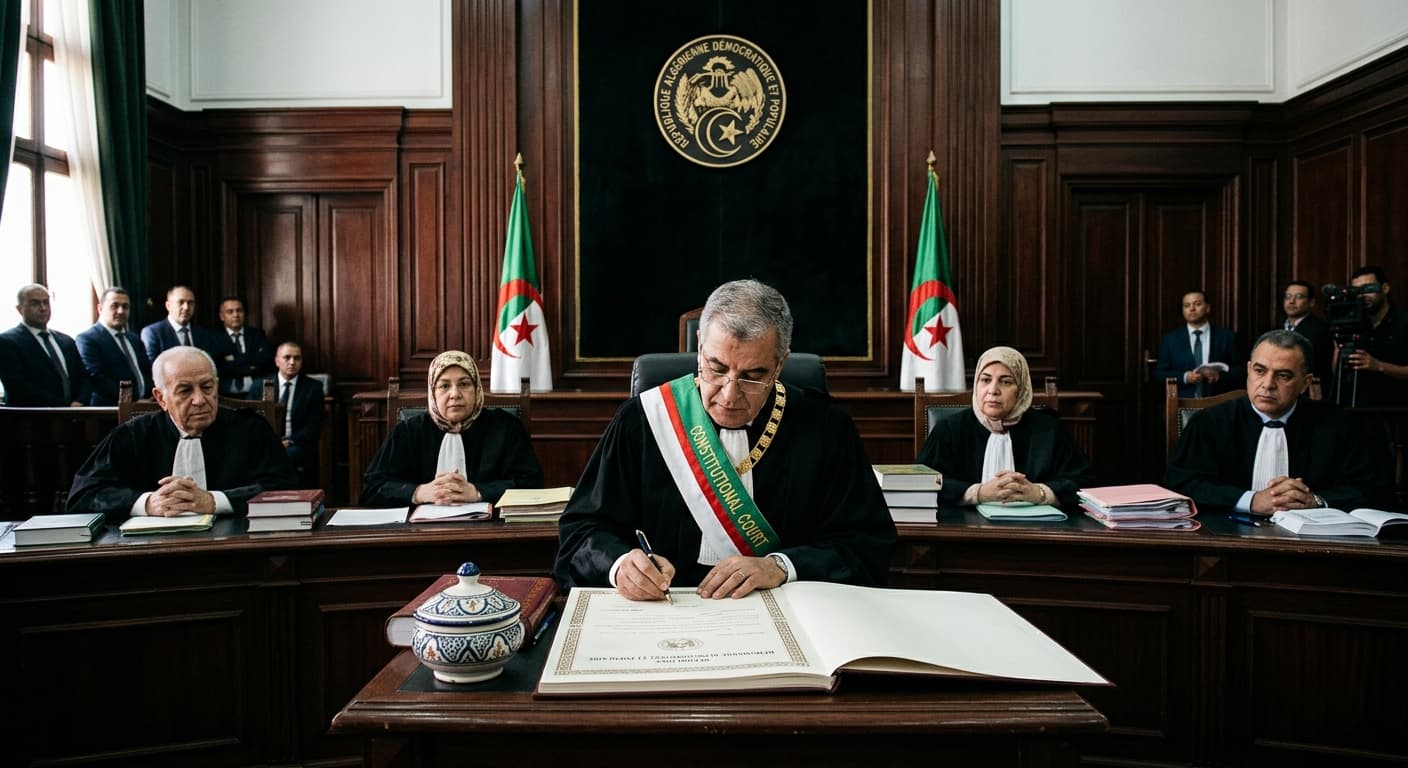
Algeria's July 2, 2026 legislative election has moved into a phase where the political stakes are not with the voters but with a nine-judge court: on July 8, the National Independent Election Authority (ANIE) handed the Constitutional Court the provisional records showing the National Liberation Front (FLN) leading with 90 of 407 seats, opening a 48-hour window for appeals and a 10-day statutory clock to certify final results. The real story is not the seat totals — it is that certification, not the ballot, is now the mechanism that ratifies President Abdelmadjid Tebboune's parliamentary majority, on a turnout of just 21.24% that his opponents will use to contest the new legislature's legitimacy long after the court has signed off. What happens over the next 10 days determines who forms the government, on what mandate, and how vulnerable that government is to a legitimacy challenge from a mostly absent electorate.
What the Constitutional Court actually does now
Under Article 211 of the electoral law, the Constitutional Court must certify final results within 10 days of receiving the provisional records. Anadolu Agency reports that ANIE acting president Karim Khelfan formally transferred those records on July 8 to Constitutional Court President Leïla Aslaoui, alongside vote-counting and tabulation minutes needed to adjudicate any challenges.
The 48-hour appeal window runs from the announcement of provisional results. Parties, candidate lists and individual candidates may file written challenges; the court receives written responses, then rules within statutory deadlines. Where an appeal is upheld, the court can annul a constituency's vote or amend the tally and declare the "legally elected" candidate — a power it used explicitly in September 2024, when it redistributed hundreds of thousands of votes between Tebboune and his two rivals before certifying his re-election, according to Al Jazeera.
This is not ceremonial. A 2024 study in the Directory of Open Access Journals notes that the 2020 constitutional revision converted Algeria's Constitutional Council into a court with "comprehensive powers" over legislative-election appeals, replacing what had been political oversight with formal judicial review. On paper, that is a strengthening of the rule of law. In practice, the court's independence is contested: Caterina Roggero of the Italian Institute for International Political Studies (ISPI)
writes that the March 2026 constitutional amendment reduced the High Council of the Judiciary and made its members "in effect, appointed solely by the government," while narrowing ANIE's role to supervision and shifting registration authority to the interior and foreign ministries.
Aslaoui herself gave a signal of the court's disposition in May 2026. Speaking about the outgoing parliament, she said, as quoted in ISPI's analysis by Massensen Cherbi:
"In other countries, Members of Parliament push and fight one another. Here, thank God, we do not have that; it simply does not exist. Members have spent five years in Parliament, and we have heard nothing of the sort about them. So be aware, be patriotic. One must love this country."
The seat map — and what it forces Tebboune to do
The provisional numbers were read out on July 6 at the Algiers International Conference Center. DZWatch reported that the FLN took 90 seats (85 domestic, 5 from the diaspora), the National Democratic Rally (RND) 73, and the Future Front 59. The Movement of Society for Peace (MSP), the only opposition bloc in the outgoing parliament, secured 43 seats; the National Construction Movement 38; independents 32, down sharply from 84 in 2021. The Socialist Forces Front, returning after boycotting the 2021 vote, won 12. The Rally for Culture and Democracy won four; the Workers' Party three.
No single party comes near the 204 seats needed for a majority in the 407-seat People's National Assembly. That matters constitutionally. Under Article 103 of the Algerian Constitution, if the vote produces a presidential majority, the president appoints a prime minister to form a government and prepare an action plan based on the presidential program. If a parliamentary majority emerges independent of the president, Article 105 requires him to appoint a "head of government" from that majority, whose program must go before the assembly; failure within 30 days triggers a second attempt.
The FLN, RND, Future Front and El-Bina — all considered part of the presidential camp or aligned with it — together control roughly 260 seats before independents. That gives Tebboune a comfortable presidential majority and, under Article 105, obliges him to name a prime minister, not a head of government. Anadolu noted that provisional results already showed "parties supporting President Abdelmadjid Tebboune securing a majority of seats." The government's action plan will therefore not need to negotiate a coalition manifesto; it will implement the president's.
Turnout is the fight the court cannot arbitrate
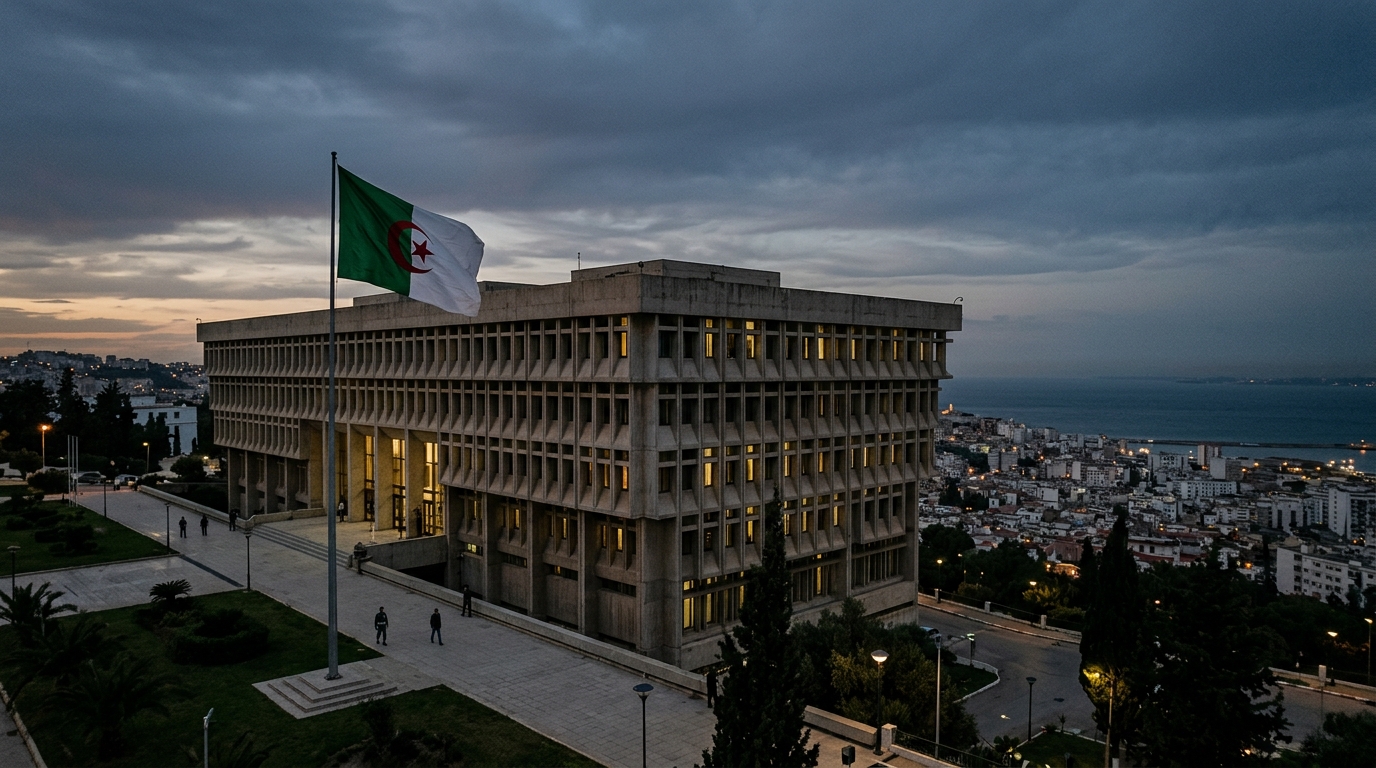
The result the Constitutional Court is preparing to certify sits on the thinnest base of legitimacy in Algerian legislative history. BBC Arabic reported that ANIE put turnout at 21.24% — below the 23.03% floor set in 2021, itself the lowest since independence. Out of 24,727,041 registered voters, most did not vote. In the Kabyle regions, participation has historically collapsed to under 1%: 0.42% in Béjaïa and 0.90% in Tizi Ouzou in 2021, according to ISPI's
analysis.
The regime has tried to build a legal moat around this problem rather than resolve it. In April 2026, Organic Law No. 26-08 on political parties — published in Journal Officiel de la République Algérienne No. 30 — made dissolution possible for any party that fails to contest two consecutive elections, halving the previous four-election threshold. ISPI's Louisa Dris-Aït Hamadouche describes the effect bluntly: boycott is no longer a viable protest strategy for legally recognised parties, because non-participation now threatens their institutional survival.
Second, ANIE's screening of candidates was extensive. Al Jazeera reported that more than 3,700 prospective candidates were barred, with only some 10,000 approved. ISPI counted 2,250 candidacies rejected out of the field, of which 1,762 were dismissed on the basis of "presumed links with circles of dubious money and business" under Article 200(7) of the 2021 electoral ordinance — a clause the Constitutional Court itself has
conceded "lacks clarity" and "may result in violations of citizens' rights." Only 120 of 2,370 administrative appeals succeeded.
The consequence is a legislature whose composition was largely determined before polling day. Nouri Dris, a sociology professor at the University of Sétif, told Al Jazeera that "the ruling establishment might give the lion's share of parliament seats back to the FLN" — a prediction the provisional totals validate — and that the composition of the new parliament "is unlikely to significantly alter the political balance" before Tebboune's second term ends in 2029.
Why this vote is really about 2029
Under the current constitution, Tebboune cannot run for a third term in the presidential election of December 2029. That is the deadline the machinery of state is quietly reorganising around.
Cherbi's ISPI analysis argues that the 2026 pre-selection of candidates reflects "the authorities' determination to produce an even more compliant Parliament, free from confrontation or controversy" — not only excluding radical opposition but purging the presidential majority of potential dissenters. Karim Tabbou, president of the unrecognised Democratic and Social Union, told ISPI's researchers that "the regime wants an Assembly that functions 100% without the slightest criticism." In his reading, the political sanitisation is a precondition for a further constitutional amendment permitting a third term — an amendment that would require a docile legislature to pass.
The March 2026 constitutional revision, published without a referendum in JORA No. 22, already strengthened presidential prerogatives, particularly over the judiciary. Almost half of the outgoing 250 MPs who unanimously supported that revision, according to Cherbi, then had their own candidacies rejected by ANIE. The incoming parliament is being built by a different logic than the outgoing one.
The outgoing assembly's own record shows how narrow the room for parliamentary initiative has become. Of 90 texts adopted during the 2021–2026 legislature, only two originated with MPs: one on stripping Algerian nationality (adopted February 17, 2026), the other criminalising colonisation (May 12, 2026). The rest were executive drafts.
What to watch
- By July 18, 2026 — Constitutional Court certification of final results under Article 211 of the electoral law. Watch whether any constituency results are annulled or amended; the court's 2024 revision of the presidential tally is the precedent.
- Publication in the Official Gazette — the moment the results become legally binding and MPs' mandates begin. This triggers the convening of the new People's National Assembly to elect a speaker.
- Tebboune's prime-ministerial appointment — expected within weeks of the APN's first session. Incumbent Nadir Larbaoui was named in November 2023 as an untraditional, non-partisan pick; whether he stays or is replaced by a party figure from the FLN or RND will signal whether the presidency plans coalition management or continued technocratic centralisation.
- Local elections, autumn 2026 — the second test of the anti-boycott law. Any recognised party that skips both this vote and the legislative may face dissolution proceedings under Organic Law No. 26-08.
The Bottom Line
Algeria's Constitutional Court is not adjudicating a contested election; it is closing out a managed one. The next 10 days will produce a certified legislature dominated by the FLN, the RND and their allies, but built on a turnout that fewer than one in four voters bothered to register — which is the vulnerability Tebboune's next government inherits, and the legitimacy fight the court cannot resolve on his behalf.
Discover more
India
Rajnath Singh's Durga Squad for 2026 Polls
Rajnath Singh's Durga Squad promised women's safety in Bengal but has since disappeared from the agenda, revealing BJP's true priorities.
US Politics
Congress Targets AI Chatbot Access for Terror
The House passed the Generative AI Terrorism Risk Assessment Act, focusing on AI's role in terrorism and potential surveillance implications.

India
India-South Korea $50B Trade Expansion Plan
India and South Korea target $50 billion in bilateral trade by 2030, focusing on industrial cooperation and strategic alignment amid US pressures.

Economics
Fed's Amex AML order puts correspondent banking on notice
Federal Reserve's Amex AML order requires board-level controls and a 90-day plan; OCC fined the bank $350 million over enterprise-wide deficiencies.