Aruba's Mike Eman Returns as PM in 2024
Elections reshape Aruba's fiscal future with the Netherlands.
Model Diplomat3 min readamericas
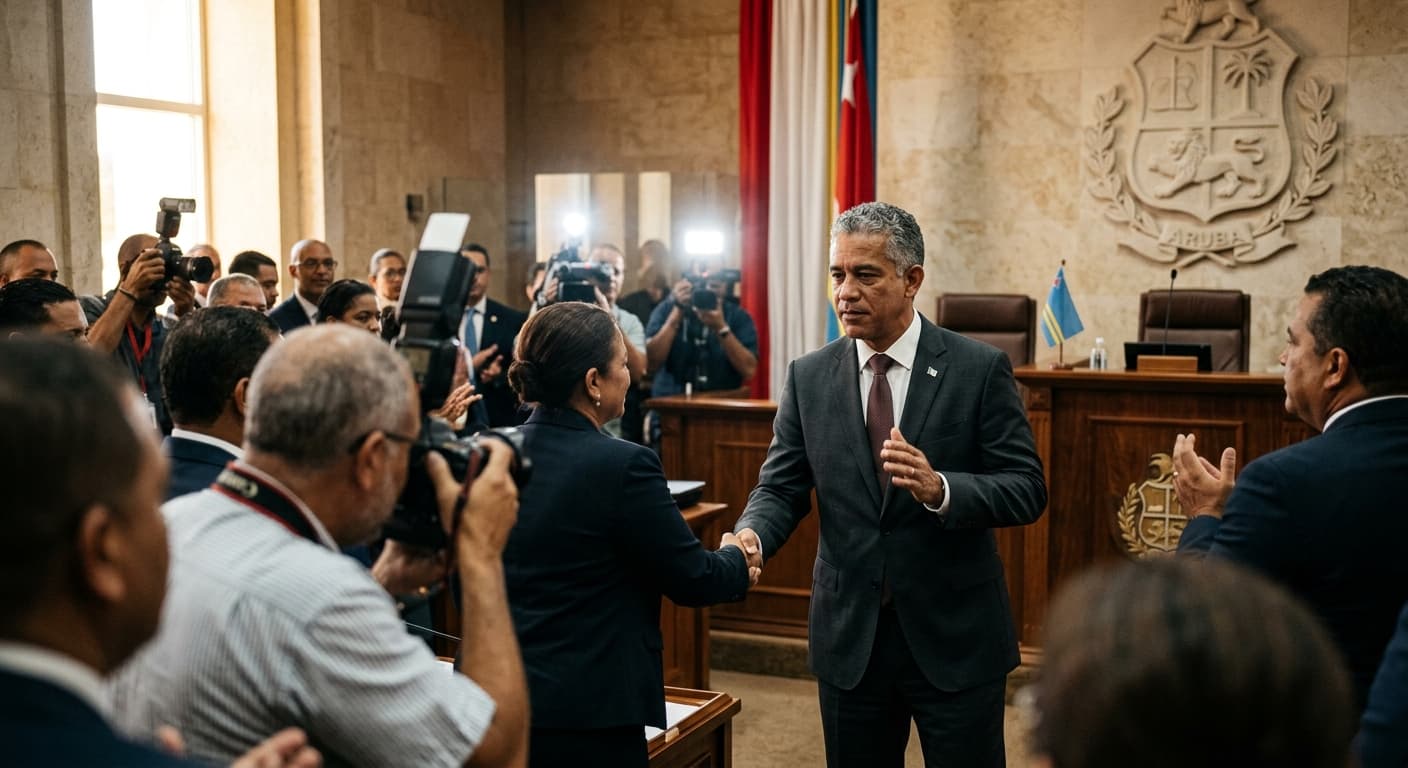
Aruba Swings Right: Mike Eman Returns as PM After December Election
Aruba's December 2024 parliamentary election returned the centre-right AVP and Mike Eman to power, ending Evelyn Wever-Croes's eight-year tenure and reshaping the island's fiscal trajectory with the Netherlands.
Mike Eman was sworn in as Prime Minister of Aruba on March 28, 2025, after his Aruban People's Party (AVP) won the December 6, 2024 parliamentary election, according to
CountryReports. The
BBC now lists Eman as prime minister, confirming the transition. The result ends the centre-left MEP's two-term hold on government and marks Eman's third stint as premier, having previously led the island from 2009 to 2017.
Exact seat totals from the December vote remain sparsely reported in English-language outlets, but the outcome is unambiguous: Eman's AVP assembled a governing majority in the 21-seat Staten, displacing Evelyn Wever-Croes's coalition of the People's Electoral Movement (MEP) and RAIZ. Wever-Croes, Aruba's first female prime minister, had governed since 2017, surviving the 2021 election with nine MEP seats to the AVP's seven, then forming a coalition with RAIZ to secure a majority, as documented in the IMF's 2023 Article IV report.
The power shift matters because of what it means for Aruba's fiscal relationship with the Netherlands. Under Wever-Croes, the government negotiated a landmark consensus Kingdom Act (known as HOFA) in June 2024, aimed at locking in sustainable public finances and reducing interest rates on Dutch pandemic loans. The IMF's 2025 Article IV mission, which met with Eman in Oranjestad in September-October 2025, confirmed that the draft HOFA was sent to the Kingdom Council of Ministers on August 29, 2025 — now under Eman's watch. The IMF Staff Report notes the act introduces escape clauses, a correction mechanism, and a contingency reserve for fiscal shocks, while streamlining Aruba's fiscal rules toward a debt anchor of 50% of GDP.
The Eman government inherits a fiscal picture that is genuinely improved. Public debt has fallen from 116.3% of GDP in 2020 to 68.6% by end-2024, and the central government posted its first surplus since 2008. But the IMF also flagged that the 2026 budget implies a "slightly expansionary" stance and recommended additional savings of 0.3% of GDP. Eman's AVP has historically been the more business-friendly, pro-tourism-development party — the question is whether his government will maintain Wever-Croes's fiscal discipline or loosen spending.
The Governor-General, Alfonso Boekhoudt, representing King Willem-Alexander, remains in post since 2017, providing institutional continuity within the Kingdom structure. Defense and foreign affairs remain under The Hague's authority regardless of who sits in Oranjestad.
Who Gains, Who Loses
Mike Eman and the AVP are the clear winners — a political dynasty restored. Eman's grandfather, Henny Eman, was Aruba's first prime minister in 1986. The AVP now controls both the premiership and the fiscal agenda.
Evelyn Wever-Croes and the MEP lose after eight years in office, despite presiding over a strong post-pandemic economic recovery. The MEP's coalition with smaller parties proved insufficient against an AVP that likely capitalized on cost-of-living concerns — the IMF notes the outgoing government prioritized boosting purchasing power and cutting the lowest income tax bracket to zero.
The Netherlands gains a negotiating partner in Eman whose party has historically been less inclined toward the MEP's occasional independence rhetoric, though full independence has been indefinitely postponed since 1994. The HOFA negotiations will test whether the AVP embraces the fiscal constraints or seeks to renegotiate.
What to Watch
The HOFA Kingdom Act's passage through the Dutch parliamentary process is the next decision point. If enacted, it locks Aruba into binding fiscal rules with Dutch oversight — and reduces pandemic loan interest rates. The IMF has recommended a 2035 target date for reaching the 50% debt anchor. Whether Eman accepts or pushes back on that timeline will signal his government's fiscal posture for the remainder of his term, with the next election due by December 2028.
Discover more

India
Vijay's Political Rise vs Silent Tamil Nadu
Actor Vijay's popularity surges across Tamil Nadu even as campus student politics fades, raising fresh questions about youth engagement and future power.

US Politics
Virginia GOP Rallies Rural Voters Against Red
Virginia Republicans are mobilizing rural voters against a Democratic-led redistricting referendum, a fight seen as pivotal to control in the 2026 midterms.

Global Politics
U.S. Naval Blockade Heightens Iran Tensions
The U.S. naval blockade of Iran collapsed oil exports, creating a new maritime regime in Hormuz that favors Tehran.

Economics
Fed's Amex AML order puts correspondent banking on notice
Federal Reserve's Amex AML order requires board-level controls and a 90-day plan; OCC fined the bank $350 million over enterprise-wide deficiencies.