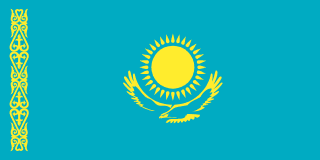
Inside Kazakhstan’s foreign policy.
Republic of Kazakhstan
Asia · UN voting record, treaty positions, and alliances — every claim primary-sourced.
In short
Kazakhstan is a presidential state trying to lock in strategic autonomy between Russia, China, and the West while keeping domestic politics tightly managed under President Kassym-Jomart Tokayev The Diplomat…
Capital
AstanaGovernment
Presidential republicKazakhstan's government & politics
Leadership, governance, and democratic trajectory.


Kazakhstan's UN voting record
How Kazakhstan votes at the UN General Assembly — ideological trajectory, voting partners, topic patterns, and key recent roll calls.
Ideological trajectory
Top voting partners
Topic-level voting
Source: Erik Voeten, “United Nations General Assembly Voting Data”, Harvard Dataverse (CC0). Aggregated by Model Diplomat. Last refresh tracked in profile freshness.
Kazakhstan's foreign policy
Bilateral posture, key relationships, and live diplomatic statements.
Foreign Policy
Kazakhstan’s foreign policy is built around strategic autonomy, not alliance loyalty. President Kassym-Jomart Tokayev frames this as a “balanced, constructive and pragmatic” course focused on sovereignty, territorial integrity, economic modernization, and a stable external environment for investment Official website of the President of the Republic of Kazakhstan. The operative decision-maker is the presidency: Kazakhstan’s constitution gives the president the central role in foreign policy, and Tokayev has used that authority since the 2022 crisis and subsequent constitutional changes to tighten control over the state’s external line Constitution of the Republic of Kazakhstan, BTI 2026 Kazakhstan Country Report. The state’s interests rank clearly. Survival means protecting independence between Russia and China and preventing spillover from regional instability; regime security means preserving elite control after the January 2022 unrest; economic interest means keeping hydrocarbons, uranium, transit, and foreign capital flowing; status means presenting Kazakhstan as Central Asia’s most credible middle power and mediator The Diplomat, Congressional Research Service.
That hierarchy explains Kazakhstan’s bilateral relationships. Russia remains indispensable in security, trade, and logistics: Kazakhstan is a member of both the CSTO and the Eurasian Economic Union, and a large share of its oil exports still depends on the Caspian Pipeline Consortium route through Russian territory CSTO, Eurasian Economic Commission, U.S. Energy Information Administration. But Astana has refused political subordination. Tokayev publicly declined to recognize Russia-backed separatist entities in eastern Ukraine at the 2022 St. Petersburg forum, citing the UN Charter and territorial integrity President of Russia, Reuters. China is the counterweight and growth engine: Beijing is a top trade partner, a major investor, and a core transit partner through Belt and Road corridors, while Kazakhstan values Chinese demand and infrastructure finance without wanting strategic dependence Ministry of Foreign Affairs of the People’s Republic of China, World Bank. Relations with Uzbekistan and the other Central Asian states have become more important because regional coordination gives Kazakhstan more room to maneuver vis-à-vis Moscow and Beijing The Diplomat. Turkey matters more for political symbolism, transport connectivity, and Turkic diplomacy than for hard security, especially through the Organisation of Turkic States Organisation of Turkic States.
Multilateralism is one of Kazakhstan’s main instruments of status and hedging. It stays active in the UN, SCO, CSTO, EAEU, OIC, and the Organisation of Turkic States simultaneously, because overlapping memberships reduce dependence on any single patron United Nations Digital Library, Shanghai Cooperation Organisation, Organisation of Islamic Cooperation, Organisation of Turkic States. Its diplomatic brand remains tied to nuclear non-proliferation, mediation, and procedural legitimacy: Kazakhstan highlights its closure of the Semipalatinsk test site, support for a world free of nuclear weapons, and its earlier role as a non-permanent UN Security Council member for 2017–2018 Permanent Mission of Kazakhstan to the United Nations, United Nations Security Council. This is not idealism for its own sake. It is a status strategy that also serves survival by making Kazakhstan more valuable to multiple major powers at once.
In UN voting and official diplomacy, Kazakhstan usually aligns with sovereignty-first positions and avoids direct confrontation with Russia or China, but it is more cautious than either power wants. The clearest divergence came after Russia’s full-scale invasion of Ukraine: Kazakhstan did not recognize the annexation of Ukrainian territory and has repeatedly affirmed the principles of territorial integrity and the UN Charter even while avoiding an openly anti-Russian posture Reuters, United Nations Charter. Kazakhstan abstained on some Ukraine-related UN General Assembly votes rather than joining Russia outright, reflecting a hedge between legal principle and geographic constraint United Nations Digital Library. It has also moved to demonstrate compliance with Western sanctions regimes in formal terms, saying it will not allow its territory to be used to circumvent restrictions, even as trade data and re-export concerns have kept external scrutiny high Reuters, Congressional Research Service. That gap between rhetoric and enforcement capacity is typical of Kazakhstan’s diplomacy: it signals independence, but calibrates implementation to avoid retaliation.
The most useful reading, then, is that Kazakhstan is not drifting out of the Russian orbit so much as widening the space inside it. Its bloc memberships suggest alignment with Moscow, yet its actual behavior shows consistent resistance to recognition politics, annexation claims, and any precedent that could legitimize pressure on Kazakhstan’s own sovereignty, given its long border with Russia and substantial ethnic Russian population in the north CSTO, Congressional Research Service, BTI 2026 Kazakhstan Country Report


Kazakhstan's treaties & memberships
UN multilateral treaty positions and IGO memberships.
International Organizations
Society & economy
Macro-economic snapshot and demographic context.
GDP (nominal)
$291.5B
#48/250GDP per capita
$14,154.632
#84/250Currency
—
HDI
0.81
#57/250GDP (nominal USD)
GDP per capita (USD)
Top trading partners


In the news
Stories surfacing across Kazakhstan’s authoritative outlets, plus headline events and the diplomatic calendar.
Headlines
Kazakhstan Is Betting on Predictability in an Unpredictable Region – The Diplomat
Kazakhstan is pursuing greater predictability to bolster foreign policy, diplomacy, elections, economy, and security. Key points from Tokayev’s Kurultai address and proposed constitutional reforms: - Governance and transitions: Proposes clear, rule-bound succession (presidential power termination: extraordinary elections within two months) and creation of a presidentially appointed, but parliamentarily consented, vice presidency with defined functions. Aims to curb informal,
Speech by Head of State Kassym-Jomart Tokayev at a solemn event on the occasion of Republic Day — Official website of the President of the Republic of Kazakhstan
Summary: - Domestic and constitutional reforms: Nationwide referendum expanded Parliament’s powers, created a Constitutional Court, granted constitutional status to the Ombudsman, and introduced direct elections for akims (local mayors). Moving toward a unicameral Parliament elected largely by party lists, with local maslikhat elections preserving a majoritarian local system. - Economy and modernization: Sustained dynamic growth with 16% economy growth since 2019; economy rea
Kazakhstan Country Report 2026 - BTI Transformation Index
Summary: - Political framework and power dynamics: - The central government maintains control with a broad security and law-enforcement apparatus. - 2023–2025 saw President Tokayev consolidating power after January 2022 unrest linked to Nazarbayev and his circle. - Nazarbayev exited key positions and political influence; Amanat (formerly Nur Otan) remains the ruling party. - 2022 constitutional reforms extended Tokayev’s term to seven years; 2023 snap parliamentary e
Diplomatic calendar
Upcoming key dates
- Apr 22, 2027Electionin 7mo
51st UEFA Ordinary Congress
Explore Kazakhstan in depth
Frequently asked questions about Kazakhstan
Quick answers to the most common questions about Kazakhstan.
What type of government does Kazakhstan have?
Kazakhstan is governed as a presidential republic, with its capital at Astana.
Who is the head of state of Kazakhstan?
Kassym-Jomart Tokayev is the head of state of Kazakhstan, in office since 2019-03-20.
Who leads the government of Kazakhstan?
Olzhas Bektenov serves as the head of government of Kazakhstan, since 2024-02-06.
What is the population of Kazakhstan?
Kazakhstan has a population of approximately 20.6 million people, making it the 64th most populous country.
What is the economy of Kazakhstan like?
Kazakhstan has a nominal GDP of about $291 billion, or roughly $14,155 per capita.
What languages are spoken in Kazakhstan?
The official languages of Kazakhstan are Kazakh and Russian.
When did Kazakhstan join the United Nations?
Kazakhstan has been a member of the United Nations since 1992.
Who are Kazakhstan's closest allies?
Kazakhstan's key allies include Russia, China, Türkiye, and Uzbekistan.
More about Kazakhstan
Kazakhstan is a presidential state trying to lock in strategic autonomy between Russia, China, and the West while keeping domestic politics tightly managed under President Kassym-Jomart Tokayev [The Diplomat](https://thediplomat.com/2026/06/kazakhstan-is-betting-on-predictability-in-an-unpredictable-region/) [President of the Republic of Kazakhstan](https://www.akorda.kz/en/speech-by-head-of-state-kassym-jomart-tokayev-at-a-solemn-event-on-the-occasion-of-republic-day-3052814). Formally, it is a presidential republic; in practice, foreign policy and the main lines of state strategy are set from the presidency, with the government executing rather than independently shaping the file [BTI Transformation Index 2026: Kazakhstan Country Report](https://bti-project.org/en/reports/country-report/KAZ) [President of the Republic of Kazakhstan](https://www.akorda.kz/en/president). After the 2023 parliamentary election, the ruling Amanat party retained dominance in the Mazhilis, and Tokayev has continued to pair selective political reform with strong presidential control [OSCE/ODIHR Election Observation Mission Final Report, Early Parliamentary Elections, 19 March 2023](https://www.osce.org/odihr/elections/kazakhstan/553113) [Inter-Parliamentary Union: Kazakhstan, Chamber of Deputies](https://data.ipu.org/node/85/parliament/election?chamber_id=13485). The current government is headed by Prime Minister Olzhas Bektenov, who was appointed in February 2024, replacing Älihan Smaiylov; any profile that still lists Smaiylov as current is out of date [President of the Republic of Kazakhstan, Decree on appointment of Olzhas Bektenov](https://www.akorda.kz/en/by-the-decree-of-the-head-of-state-olzhas-bektenov-was-appointed-prime-minister-of-the-republic-of-kazakhstan-60244) [Britannica](https://www.britannica.com/place/Kazakhstan/Daily-life-and-social-customs). Tokayev remains the decisive political actor after constitutional and institutional changes that redistributed some formal powers but did not create a competitive parliamentary system in the usual sense [BTI Transformation Index 2026: Kazakhstan Country Report](https://bti-project.org/en/reports/country-report/KAZ) [Freedom House, Freedom in the World 2025: Kazakhstan](https://freedomhouse.org/country/kazakhstan/freedom-world/2025). That structure matters for diplomacy: Kazakhstan can move quickly and speak coherently abroad because the presidency arbitrates between the foreign ministry, security organs, and economic ministries [Congressional Research Service, Kazakhstan: Background and Issues for Congress](https://crsreports.congress.gov/product/details?prodcode=R47557). Kazakhstan’s place in the world is larger than its population suggests because it sits at the junction of Russian, Chinese, Central Asian, Caspian, and trans-Corridor politics [Congressional Research Service, Kazakhstan: Background and Issues for Congress](https://crsreports.congress.gov/product/details?prodcode=R47557) [The Diplomat](https://thediplomat.com/2026/06/kazakhstan-is-betting-on-predictability-in-an-unpredictable-region/). It is in the CSTO and EAEU with Russia, in the SCO with China, active in the Organisation of Turkic States, and careful to preserve working ties with the EU and United States rather than align exclusively with any one camp [Ministry of Foreign Affairs of the Republic of Kazakhstan](https://www.gov.kz/memleket/entities/mfa?lang=en) [Congressional Research Service, Kazakhstan: Background and Issues for Congress](https://crsreports.congress.gov/product/details?prodcode=R47557). Since Russia’s full-scale invasion of Ukraine, Astana has sharpened this “multi-vector” line: it has not recognized Russian annexations, has stressed the principles of sovereignty and territorial integrity, and has tried to avoid secondary sanctions exposure while keeping essential economic links with Moscow intact [Reuters](https://www.reuters.com/world/asia-pacific/kazakh-president-says-country-will-not-recognise-quasi-state-territories-2022-06-17/) [U.S. Department of the Treasury](https://home.treasury.gov/news/press-releases) [The Diplomat](https://thediplomat.com/2026/06/kazakhstan-is-betting-on-predictability-in-an-unpredictable-region/). Economically, Kazakhstan is an upper-middle-income, resource-heavy economy whose external weight comes from oil, uranium, metals, and transit geography [World Bank country overview: Kazakhstan](https://www.worldbank.org/en/country/kazakhstan/overview) [International Trade Administration, Kazakhstan Country Commercial Guide](https://www.trade.gov/country-commercial-guides/kazakhstan-market-overview). The World Bank estimated GDP at about $288 billion in 2024, and hydrocarbons remain central to exports, fiscal revenues, and elite bargaining despite years of official diversification rhetoric [World Bank Data: GDP (current US$), Kazakhstan](https://data.worldbank.org/indicator/NY.GDP.MKTP.CD?locations=KZ) [International Energy Agency: Kazakhstan](https://www.iea.org/countries/kazakhstan). Uranium is another strategic asset: Kazakhstan remained the world’s largest producer, accounting for about 43% of global primary uranium production in 2022 according to the World Nuclear Association, which gives it influence well beyond Central Asia in energy-security discussions [World Nuclear Association, Uranium in Kazakhstan](https://world-nuclear.org/information-library/country-profiles/countries-g-n/kazakhstan). The constraint is structural: much of its oil export system still depends on routes vulnerable to Russian pressure, which is why Astana keeps pushing the Trans-Caspian or “Middle Corridor” as both a commercial and geopolitical hedge [Congressional Research Service, Kazakhstan: Background and Issues for Congress](https://crsreports.congress.gov/product/details?prodcode=R47557) [European Bank for Reconstruction and Development](https://www.ebrd.com/news/2023/sustainable-transport-connections-between-europe-and-central-asia.html). Three issues define Kazakhstan’s current trajectory. First is regime-managed reform after the January 2022 unrest: Tokayev has advanced constitutional and administrative changes, but outside monitors still describe the system as centralized and only partly liberalized, so the operative question is state renovation, not democratization [BTI Transformation Index 2026: Kazakhstan Country Report](https://