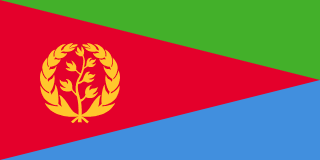
Inside Eritrea’s foreign policy.
State of Eritrea
Africa · UN voting record, treaty positions, and alliances — every claim primary-sourced.
In short
Eritrea is a highly centralized presidential state whose foreign policy is set by President Isaias Afwerki and executed with minimal institutional constraint; that concentration of power makes regime security the first filter for nearly every external decision…
Capital
AsmaraGovernment
Unitary one-party presidential republicEritrea's government & politics
Leadership, governance, and democratic trajectory.

Head of state & government
Isaias Afwerki
Head of State
Eritrea's UN voting record
How Eritrea votes at the UN General Assembly — ideological trajectory, voting partners, topic patterns, and key recent roll calls.
Ideological trajectory
Top voting partners
Topic-level voting
Source: Erik Voeten, “United Nations General Assembly Voting Data”, Harvard Dataverse (CC0). Aggregated by Model Diplomat. Last refresh tracked in profile freshness.
Eritrea's foreign policy
Bilateral posture, key relationships, and live diplomatic statements.
Foreign Policy
Eritrea’s foreign policy is controlled almost entirely by President Isaias Afwerki, who has served as both head of state and head of government since independence and remains the decisive actor over security, diplomacy, and regional strategy CIA World Factbook, Britannica. The state presents its line as one of sovereign self-reliance, anti-external interference, and resistance to what officials describe as a hegemonic regional and international order, a theme Isaias repeated in his 35th independence address in May 2026 Eritrea Ministry of Information. In practice, Eritrea’s interests pyramid is unusually clear: regime security comes first, then territorial and military security, then economic survival and access, with status expressed through a deliberate image of defiance rather than broad coalition-building International Crisis Group, Institute for Foreign Affairs. That hierarchy explains why Asmara accepts isolation costs that most low-income states would avoid.
Its bilateral relationships are transactional and threat-driven, not ideological. Ethiopia has been the central reference point in Eritrean strategy for decades; the 2018 peace declaration ended the formal state of war, but subsequent cooperation with Addis Ababa during the Tigray war did not produce durable trust, and current analysis of Eritrean behavior still treats Ethiopian fragmentation and any revival of armed pressure near the border as top-tier security concerns Peace Agreement between Eritrea and Ethiopia, 9 July 2018, Human Rights Watch, Institute for Foreign Affairs. Relations with Djibouti remain poor because of the unresolved border dispute and the issue of missing Djiboutian prisoners of war, which the UN Secretary-General has continued to track UN Security Council, Encyclopaedia Britannica. By contrast, ties with the United Arab Emirates and Saudi Arabia improved through Red Sea security cooperation, while Egypt has gained weight as a partner because both Cairo and Asmara are wary of shifts in the Nile-Horn balance and of Ethiopian regional ambitions Ahram Online, Carnegie Endowment for International Peace. Eritrea’s deepening engagement with Russia and China is also less about alignment on doctrine than about diplomatic cover, arms and infrastructure access, and support from permanent Security Council members less likely to press governance conditions UN Digital Library, China Global South Project.
Multilaterally, Eritrea is a member of the United Nations, African Union, Intergovernmental Authority on Development, and Group of 77, but it uses these forums defensively rather than as platforms for institutional leadership United Nations Member States, African Union, IGAD, Group of 77. Its record in regional bodies is defined by selective participation: Eritrea suspended or downgraded engagement with IGAD in the past over Ethiopia-related disputes and has often preferred ad hoc bilateral channels over rules-based regional mechanisms Reuters, IGAD. That pattern matters because Eritrea is geographically central to the Red Sea-Horn corridor but institutionally semi-detached from the regional organizations that would normally convert geography into influence. Its leverage comes from location, military mobilization, and spoiler capacity, not from agenda-setting inside multilateral bodies International Crisis Group, CIA World Factbook.
At the UN, Eritrea usually aligns with sovereignty-maximizing positions and resists country-specific scrutiny on human rights, sanctions, and intervention questions UN Digital Library, OHCHR. The clearest public pattern is its opposition to resolutions seen as legitimizing pressure campaigns or Western-led coercive diplomacy, including on Ukraine. In March 2022, Eritrea was one of only five states to vote against the General Assembly resolution demanding that Russia reverse its invasion of Ukraine, breaking sharply not only from most African states but also from the more hedged abstention strategy used by many governments that wanted to preserve ties with both Moscow and Western partners UN General Assembly, ES-11/1 voting record, UN News. It repeated that hard line in subsequent Ukraine-related votes, placing itself closer to Russia, Belarus, North Korea, and Syria than to the median African or Non-Aligned position UN Digital Library, Al Jazeera. That is the analytically useful divergence: Eritrea is not merely “non-aligned”; it often chooses visible minority opposition when abstention would carry lower diplomatic cost.
That break from its nominal blocs reflects regime logic more than bloc logic. Many African Union and G77 members balance sovereignty rhetoric with pragmatic hedging to protect aid, trade, and diplomatic flexibility; Eritrea instead treats resistance to pressure as a political asset in itself


Eritrea's treaties & memberships
UN multilateral treaty positions and IGO memberships.
International Organizations
Society & economy
Macro-economic snapshot and demographic context.
GDP (nominal)
$2.1B
#187/250GDP per capita
$688.682
#201/250Currency
—
HDI
0.49
#175/250GDP (nominal USD)
GDP per capita (USD)
Top trading partners


In the news
Stories surfacing across Eritrea’s authoritative outlets, plus headline events and the diplomatic calendar.
Headlines
Keynote Address by President Isaias Afwerki on the Occasion of the 35th Independence Anniversary Asmara, 24 May 2026 – Eritrea Ministry Of Information
Summary: - The keynote address from Eritrea’s President Isaias Afwerki marks the 35th Independence Anniversary (Asmara, 24 May 2026) and outlines the country’s evolving foreign policy, diplomacy, and security stance. - Core themes include regional/security cooperation in the Horn of Africa and Nile Basin, advocacy for a collective security framework among neighboring states, and reduction of external intervention by regional powers and outsiders. - Economic vision described
El-Sisi, Eritrea's Afwerki to hold Cairo talks on bilateral ties, regional issues - Foreign Affairs - Egypt - Ahram Online
Summary: - Egypt and Eritrea (President El-Sisi and President Afwerki) plan formal talks in Cairo to deepen bilateral relations and discuss regional and international issues of mutual interest. - The discussions are expected to cover expanded cooperation across multiple sectors and joint perspectives on Horn of Africa developments, Red Sea security, and regional stability. - The two countries have stepped up political, security, and diplomatic coordination over the past years
U.S. Seeks to Reset Ties With Reclusive but Strategically Vital African State - tovima.com
Summary: The Trump administration was pursuing a potential reset of U.S. relations with Eritrea, aiming to begin lifting some sanctions and restart high-level dialogue after years of sanctions and limited engagement. This push, led by Africa envoy Massad Boulos and aided by Egypt, reflects a strategic calculation: Eritrea sits on the Red Sea near critical maritime chokepoints and against broader regional tensions involving Iran and the Gaza conflict. Eritrea’s autocratic regi
Explore Eritrea in depth
Frequently asked questions about Eritrea
Quick answers to the most common questions about Eritrea.
What type of government does Eritrea have?
Eritrea is governed as a unitary one-party presidential republic, with its capital at Asmara.
Who is the head of state of Eritrea?
Isaias Afwerki is the head of state of Eritrea, in office since 1993-01-01.
What is the population of Eritrea?
Eritrea has a population of approximately 3.5 million people, making it the 132nd most populous country.
What is the economy of Eritrea like?
Eritrea has a nominal GDP of about $2 billion, or roughly $689 per capita.
What languages are spoken in Eritrea?
The official languages of Eritrea are Arabic, English, and Tigrinya.
When did Eritrea join the United Nations?
Eritrea has been a member of the United Nations since 1993.
Who are Eritrea's closest allies?
Eritrea's key allies include China, Russia, United Arab Emirates, and Saudi Arabia.
More about Eritrea
Eritrea is a highly centralized presidential state whose foreign policy is set by President Isaias Afwerki and executed with minimal institutional constraint; that concentration of power makes regime security the first filter for nearly every external decision [CIA World Factbook](https://www.cia.gov/the-world-factbook/countries/eritrea/), [Bertelsmann Stiftung BTI 2024 Eritrea Country Report](https://bti-project.org/en/reports/country-report/ERI). Isaias Afwerki remains both head of state and head of government, and the only legal political organization is the People’s Front for Democracy and Justice, which the government describes as the country’s sole political movement rather than one party among many [Eritrean Ministry of Information](https://shabait.com/), [CIA World Factbook](https://www.cia.gov/the-world-factbook/countries/eritrea/). There have been no national elections since independence, the 1997 constitution has not been implemented, and the presidency, security apparatus, and party structure dominate decision-making over any formal cabinet or legislature [U.S. Department of State 2024 Human Rights Report: Eritrea](https://www.state.gov/reports/2024-country-reports-on-human-rights-practices/eritrea/), [BTI 2024 Eritrea Country Report](https://bti-project.org/en/reports/country-report/ERI). In the international system, Eritrea matters less for economic weight than for location and strategic access. It sits on the Red Sea opposite the Arabian Peninsula, belongs to the African Union, IGAD, the UN, and the G77, and has used that geography to keep channels open with Gulf states, Egypt, China, and more recently Russia, even while remaining politically isolated from many Western partners [United Nations Member States: Eritrea](https://www.un.org/en/about-us/member-states/eritrea), [African Union Member States](https://au.int/en/member_states), [IGAD Member States](https://igad.int/member-states/), [Chatham House: Eritrea’s regional role and foreign relations](https://www.chathamhouse.org/). Its behavior is deliberately non-aligned in rhetoric but selective in practice: Asmara rejects what it calls external interference, resisted UN criticism for years, and has built ties with states willing to engage on security and infrastructure without demanding domestic liberalization [UN Human Rights Council Special Rapporteur on Eritrea](https://www.ohchr.org/en/special-procedures/sr-eritrea), [Eritrean Ministry of Information](https://shabait.com/). The result is a state that is diplomatically small, strategically noticed, and often judged in foreign capitals through the lens of Red Sea competition and the Horn of Africa security balance rather than trade or development metrics alone [International Crisis Group: Eritrea and the Tigray conflict](https://www.crisisgroup.org/africa/horn-africa/eritrea), [International Institute for Strategic Studies](https://www.iiss.org/). Economically, Eritrea is poor, narrow-based, and unusually shaped by state control, national service, and mineral exports. The World Bank estimated GDP at roughly $2.1 billion in current US dollars in 2023, while population estimates cluster around 3.5 million, making the domestic market small and limiting fiscal room [World Bank Data: GDP current US$ Eritrea](https://data.worldbank.org/indicator/NY.GDP.MKTP.CD?locations=ER), [World Bank Data: Population total Eritrea](https://data.worldbank.org/indicator/SP.POP.TOTL?locations=ER). Gold remains the dominant export earner, with mining central to foreign-exchange generation, while agriculture employs much of the population but is constrained by aridity, weak infrastructure, and periodic food insecurity [U.S. International Trade Administration: Eritrea Country Commercial Guide](https://www.trade.gov/country-commercial-guides/eritrea-country-commercial-guide), [FAO Eritrea Overview](https://www.fao.org/eritrea/en/). The IMF has also pointed to persistent structural weaknesses, including limited private-sector development, weak data transparency, and external vulnerability tied to commodity dependence and regional shocks [IMF Article IV Consultation—Eritrea](https://www.imf.org/en/Countries/ERI). In practice, the economy serves regime continuity before growth maximization: compulsory and open-ended national service supplies labor and control, but it also suppresses private enterprise and drives emigration [Human Rights Watch: World Report Eritrea](https://www.hrw.org/world-report/2025/country-chapters/eritrea), [U.S. Department of State 2024 Human Rights Report: Eritrea](https://www.state.gov/reports/2024-country-reports-on-human-rights-practices/eritrea/). Three issues define Eritrea’s current trajectory. First is regime security, which shapes both domestic repression and foreign policy caution; the government treats external pressure on human rights, military reform, or political opening as a threat to state survival, not a compartmentalized governance issue [OHCHR Special Rapporteur on Eritrea](https://www.ohchr.org/en/special-procedures/sr-eritrea), [BTI 2024 Eritrea Country Report](https://bti-project.org/en/reports/country-report/ERI). Second is the aftershock of the Ethiopia-Tigray war. Eritrean forces intervened decisively in that conflict, and the legacy is a mix of unresolved border-security logic, damaged international standing, and deep mistrust between Asmara and parts of the Ethiopian political landscape despite the earlier Ethiopia-Eritrea rapprochement [UN Human Rights Council, Commission of Human Rights Experts on Ethiopia](https://www.ohchr.org/en/hr-bodies/hrc/ichre-ethiopia/index), [International Crisis Group: Eight Priorities for the African Union in 2024](https://www.crisisgroup.org/africa/horn-africa). Third is Red Sea geopolitics: tensions around Sudan, relations with Egypt, Gulf competition, and renewed great-power attention have increased Eritrea’s leverage without changing its basic governing model [Ahram Online](https://english.ahram.org.eg/), [Institute for Foreign Affairs: The Eritrea Misreading](https://www.ifa.de/en/), [Making Sense of Eritrea's Emerging Foreign Policy Approach](https://africacenter.org/). The country’s direction is therefore not liberalization but strategic hardening with selective diplomatic opening. President Isaias’s 2026 independence address again framed Eritrea’s line around sovereignty, self-reliance, and resistance to outside tutelage, signalling continuity rather than reform [Eritrean Ministry of