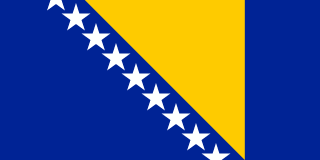
Inside Bosnia and Herzegovina’s foreign policy.
Europe · UN voting record, treaty positions, and alliances — every claim primary-sourced.
In short
Bosnia and Herzegovina is a weak-centered, internationally supervised state whose foreign policy and reform pace are constrained less by external threat than by internal veto points built into the Dayton system.
Capital
SarajevoGovernment
Federal parliamentary republicBosnia and Herzegovina's government & politics
Leadership, governance, and democratic trajectory.

Head of state
Denis Bećirović
Head of State

Head of government
Borjana Krišto
Head of Government
Bosnia and Herzegovina's UN voting record
How Bosnia and Herzegovina votes at the UN General Assembly — ideological trajectory, voting partners, topic patterns, and key recent roll calls.
Ideological trajectory
Top voting partners
Topic-level voting
Source: Erik Voeten, “United Nations General Assembly Voting Data”, Harvard Dataverse (CC0). Aggregated by Model Diplomat. Last refresh tracked in profile freshness.
Bosnia and Herzegovina's foreign policy
Bilateral posture, key relationships, and live diplomatic statements.
Foreign Policy
Bosnia and Herzegovina’s foreign policy is formally pro-EU, pro-NATO, and sovereignty-focused, but in practice it is constrained by a state structure that lets internal veto players pull external policy in different directions. The constitutional presidency sets foreign policy collectively, the Council of Ministers and Ministry of Foreign Affairs implement it, and entity-level leaders — especially from Republika Srpska — can obstruct or dilute positions even when the state line is clear in law Constitution of Bosnia and Herzegovina, Annex 4 of the Dayton Peace Agreement Presidency of Bosnia and Herzegovina Ministry of Foreign Affairs of Bosnia and Herzegovina. That decision structure matters more than any declaratory strategy document: BiH’s external posture is less about strategic ambition than about whether Sarajevo can produce a common line at all.
The state’s stated doctrine is Euro-Atlantic integration. Bosnia and Herzegovina was granted EU candidate status in December 2022 and the European Council decided in March 2024 to open accession negotiations, tying progress to reforms on rule of law, institutions, and constitutional functionality European Council European Council. On NATO, BiH joined the Partnership for Peace in 2006 and received a Membership Action Plan invitation in 2010, though activation and follow-through have been slowed by disputes over defense property and open resistance from Republika Srpska leaders NATO. Its core interests sit in a clear hierarchy: survival means preserving territorial integrity and blocking secessionist challenges to the Dayton order; regime-system security means keeping the constitutional state functional enough to retain international support and the Office of the High Representative framework; economic interest means using EU integration to attract investment, remittances, and market access, with the EU accounting for the dominant share of BiH trade European Commission World Bank.
Its most important bilateral relationships are with the EU’s leading member states, the United States, Croatia, Serbia, and Türkiye, but not all relationships serve the same tier of interest. The United States remains central to survival and constitutional security because it is a principal Dayton guarantor and has repeatedly sanctioned Republika Srpska President Milorad Dodik and related networks for undermining the peace agreement and state institutions U.S. Department of the Treasury U.S. Department of State. Germany is a leading economic and political partner through EU enlargement policy, while Croatia and Serbia are unavoidable neighbors with formal roles under Dayton but also direct links to Bosnian Croat and Bosnian Serb party networks, which often turns bilateral diplomacy into a contest over BiH’s internal balance rather than classic interstate bargaining Dayton Peace Agreement, General Framework Agreement European Commission. Türkiye carries status and political weight beyond its economic footprint, backing BiH’s sovereignty and cultivating ties especially with Bosniak leadership through frequent high-level engagement Republic of Türkiye Ministry of Foreign Affairs.
Regionally and multilaterally, Bosnia and Herzegovina is embedded in institutions designed to lock it into a rules-based orbit: the UN since 1992, the Council of Europe since 2002, the OSCE, the Central European Free Trade Agreement, and NATO’s Partnership for Peace United Nations Digital Library Council of Europe OSCE Mission to Bosnia and Herzegovina CEFTA. Its UN behavior broadly aligns with the Euro-Atlantic camp when a state position is actually adopted. Bosnia and Herzegovina voted in favor of the UN General Assembly resolution condemning Russia’s aggression against Ukraine in March 2022 and supported later General Assembly resolutions affirming Ukraine’s territorial integrity, placing the formal state line closer to the EU and U.S. than to Serbia’s more hedged posture UN General Assembly Resolution ES-11/1 UN General Assembly Resolution ES-11/4. That pattern fits Sarajevo’s sovereignty-first logic: a state threatened by internal partitionism has a structural reason to oppose forceful border revision abroad.
The key divergence is not that Bosnia and Herzegovina breaks from its bloc in New York; it is that it often breaks from itself. On sanctions against Russia, the country has politically backed EU positions and its foreign minister has publicly supported alignment with the EU’s Common Foreign and Security Policy, but domestic obstruction has repeatedly limited implementation and produced gaps between declared solidarity and enforceable state action European Commission Ministry of Foreign Affairs of Bosnia and Herzegovina. The European Commission’s enlargement reporting has consistently noted that BiH’s alignment with EU foreign policy positions is incomplete and vulnerable to internal contestation, even as the country seeks accession European Commission. That is the analytically useful point for MUN delegates: BiH’s default external preference is Western alignment, but the decisive question in any crisis is whether state institutions can overcome entity-level vetoes. When they can, Bosnia votes like a sovereignty-sensitive EU aspirant. When they


Bosnia and Herzegovina's treaties & memberships
UN multilateral treaty positions and IGO memberships.
International Organizations
Society & economy
Macro-economic snapshot and demographic context.
GDP (nominal)
$29.6B
#112/250GDP per capita
$9,358.788
#100/250Currency
—
HDI
0.78
#76/250GDP (nominal USD)
GDP per capita (USD)


In the news
Stories surfacing across Bosnia and Herzegovina’s authoritative outlets, plus headline events and the diplomatic calendar.
Headlines
Becirovic Meets with German Chancellor Merz: Calls for Increased German Investment in BiH - Sarajevo Times
Summary: Bosnia and Herzegovina’s Chair of the Presidency, Denis Bećirović, met German Chancellor Friedrich Merz to seek increased German investment in BiH, especially in renewable energy and the defense industry. Bećirović credited Germany as a major investor and trade partner and highlighted ongoing German support for BiH’s EU and NATO path, regional stability, and European integration. The discussion covered Germany’s role in the Peace Implementation Council, the High Repr
Can the Crisis Between the US and the EU Jeopardize the Functioning of the OHR? - Sarajevo Times
Summary: The article analyzes a growing US–EU diplomatic rift over appointing a new High Representative for Bosnia and Herzegovina (OHR). Key points: - The PIC (Peace Implementation Council) has not reached a consensus, with US-backed candidate Antonio Zanardi Landi not elected; this has triggered talk of a possible US reevaluation of its role in BiH. - The US criticized European indecision and signaled it may reassess its presence in BiH if consensus fails, while the EU urge
Interview with BiH FM: Dodik and Russia will not decide on a new HR, the Choice remains in the Hands of the PIC - Sarajevo Times
Bosnia and Herzegovina’s foreign policy and diplomacy, as discussed by FM Elmedin Konaković, center on preserving the Office of the High Representative (OHR) and ensuring the High Representative is chosen through the PIC rather than the UN Security Council. Key points: - Broad consensus within the PIC to maintain the OHR and its powers, while using Bonn powers as little as possible. - The new high representative must be elected via the PIC, not through Dodik/Russia’s preferre
Diplomatic calendar
Upcoming key dates
- Oct 4, 2026Electionin 10d
2026 Bosnian parliamentary election
- Oct 4, 2026Electionin 10d
2022 Bosnian presidential election
- Oct 4, 2026Electionin 10d
2026 Republika Srpska general election
- Oct 4, 2026Electionin 10d
2026 Federation of Bosnia and Herzegovina general election
- Oct 4, 2026Electionin 10d
2026 Bosnian general election
Explore Bosnia and Herzegovina in depth
Frequently asked questions about Bosnia and Herzegovina
Quick answers to the most common questions about Bosnia and Herzegovina.
What type of government does Bosnia and Herzegovina have?
Bosnia and Herzegovina is governed as a federal parliamentary republic, with its capital at Sarajevo.
Who is the head of state of Bosnia and Herzegovina?
Denis Bećirović is the head of state of Bosnia and Herzegovina, in office since 2022-11-16.
Who leads the government of Bosnia and Herzegovina?
Borjana Krišto serves as the head of government of Bosnia and Herzegovina, since 2022-12-28.
What is the population of Bosnia and Herzegovina?
Bosnia and Herzegovina has a population of approximately 3.2 million people, making it the 136th most populous country.
What is the economy of Bosnia and Herzegovina like?
Bosnia and Herzegovina has a nominal GDP of about $30 billion, or roughly $9,359 per capita.
What languages are spoken in Bosnia and Herzegovina?
The official languages of Bosnia and Herzegovina are Bosnian, Croatian, and Serbian.
When did Bosnia and Herzegovina join the United Nations?
Bosnia and Herzegovina has been a member of the United Nations since 1992.
Who are Bosnia and Herzegovina's closest allies?
Bosnia and Herzegovina's key allies include Türkiye, United States, Germany, and United Kingdom.
More about Bosnia and Herzegovina
Bosnia and Herzegovina is a weak-centered, internationally supervised state whose foreign policy and reform pace are constrained less by external threat than by internal veto points built into the Dayton system. It is a parliamentary democracy with a tripartite state presidency, a Council of Ministers led by Chair Borjana Krišto, and extensive entity-level power divided between the Federation of Bosnia and Herzegovina and Republika Srpska; the current state coalition was formed after the 2022 general election by parties including HDZ BiH, SNSD, and the “Trojka” bloc, while Denis Bećirović serves as the Bosniak member and current chair of the Presidency under its rotating system [Bosnia and Herzegovina Parliamentary Assembly](https://www.parlament.ba/), [Council of Ministers of Bosnia and Herzegovina](https://www.vijeceministara.gov.ba/), [Central Election Commission of Bosnia and Herzegovina](https://www.izbori.ba/), [Presidency of Bosnia and Herzegovina](http://www.predsjednistvobih.ba/). The state’s external orientation is clear even when its internal politics are not: Bosnia and Herzegovina is an EU candidate country, participates in NATO’s Partnership for Peace, and relies heavily on the EU, the United States, and the Office of the High Representative to stabilize its constitutional order and reform agenda [European Council](https://www.consilium.europa.eu/en/policies/enlargement/bosnia-and-herzegovina/), [NATO](https://www.nato.int/cps/en/natohq/topics_49127.htm), [Office of the High Representative](https://www.ohr.int/). The EU is by far its largest trading partner, accounting for the great majority of its goods trade, and the country’s strategic significance comes less from hard power than from whether it can be anchored inside Euro-Atlantic institutions before institutional drift, ethnic polarization, and Russian-backed obstruction deepen [European Commission](https://neighbourhood-enlargement.ec.europa.eu/bosnia-and-herzegovina-report-2024_en), [World Bank](https://www.worldbank.org/en/country/bosniaandherzegovina), [Delegation of the European Union to Bosnia and Herzegovina](https://www.eeas.europa.eu/delegations/bosnia-and-herzegovina_en). Economically, Bosnia and Herzegovina is small, service-led, export-dependent, and structurally fragile. The World Bank reported GDP of about $27 billion in current US dollars in 2023, with growth constrained by weak productivity, emigration, and political fragmentation, while unemployment and labor-market inactivity remain persistent structural problems even as remittances and external demand cushion household incomes [World Bank Data](https://data.worldbank.org/country/bosnia-and-herzegovina), [World Bank Bosnia and Herzegovina Overview](https://www.worldbank.org/en/country/bosniaandherzegovina/overview). Its export base is concentrated in metals, electricity, wood products, machinery components, and some automotive supply-chain production, leaving it highly exposed to EU demand, energy price shifts, and logistics bottlenecks in the wider Western Balkans market [Foreign Trade Chamber of Bosnia and Herzegovina](https://komorabih.ba/), [European Commission](https://neighbourhood-enlargement.ec.europa.eu/bosnia-and-herzegovina-report-2024_en). Public administration is expensive relative to state capacity because competences are split across multiple layers of government, which raises transaction costs for investors and slows implementation of even agreed reforms [OECD SIGMA](https://www.sigmaweb.org/publications/Monitoring-Report-2024-Bosnia-and-Herzegovina.pdf), [European Commission](https://neighbourhood-enlargement.ec.europa.eu/bosnia-and-herzegovina-report-2024_en). Three issues define its current trajectory. First is institutional paralysis driven by constitutional fragmentation and recurrent secessionist moves from Republika Srpska’s leadership, especially around the authority of state-level judicial, constitutional, and international oversight bodies [Office of the High Representative](https://www.ohr.int/), [European Commission](https://neighbourhood-enlargement.ec.europa.eu/bosnia-and-herzegovina-report-2024_en), [U.S. Department of State](https://www.state.gov/). Second is EU accession: the European Council decided in March 2024 to open accession negotiations with Bosnia and Herzegovina, but progress still depends on judiciary reform, anti-corruption measures, border management, and functional coordination across the state and entities [European Council](https://www.consilium.europa.eu/en/press/press-releases/2024/03/21/european-council-conclusions-21-march-2024/), [European Commission](https://neighbourhood-enlargement.ec.europa.eu/bosnia-and-herzegovina-report-2024_en). Third is demographic and economic depletion through outward migration, which strips the country of skilled labor, narrows the tax base, and turns reform delay into a long-term competitiveness problem rather than just a political one [World Bank Bosnia and Herzegovina Overview](https://www.worldbank.org/en/country/bosniaandherzegovina/overview), [UNDP Bosnia and Herzegovina](https://www.undp.org/bosnia-herzegovina). The current government’s basic line is pro-EU, fiscally constrained, and politically transactional. Krišto’s Council of Ministers depends on cooperation among actors with incompatible constitutional end-states: HDZ BiH prioritizes electoral and institutional guarantees for Croat representation, SNSD resists deeper state centralization and often contests Western intervention, and the Sarajevo-based “Trojka” parties push governance reform and closer Euro-Atlantic alignment [Council of Ministers of Bosnia and Herzegovina](https://www.vijeceministara.gov.ba/), [Central Election Commission of Bosnia and Herzegovina](https://www.izbori.ba/), [European Commission](https://neighbourhood-enlargement.ec.europa.eu/bosnia-and-herzegovina-report-2024_en). That makes Bosnia and Herzegovina’s immediate future less a question of grand strategy than of administrative capacity and political cohesion: if accession-related reforms produce visible gains, the state inches toward consolidation; if veto politics dominate, outside supervision through the OHR and external pressure from Brussels and Washington will remain central to keeping the system functional [Office of the High Representative](https://www.ohr.int/), [European Council](https://www.consilium.europa.eu/en/policies/enlargement/bosnia-and-herzegovina/), [U.S. Embassy in Bosnia and