Russia's Eroding Influence in the Sahel
Moscow's grip on the Sahel is weakening amid rising challenges.
Model Diplomat5 min readAfrica
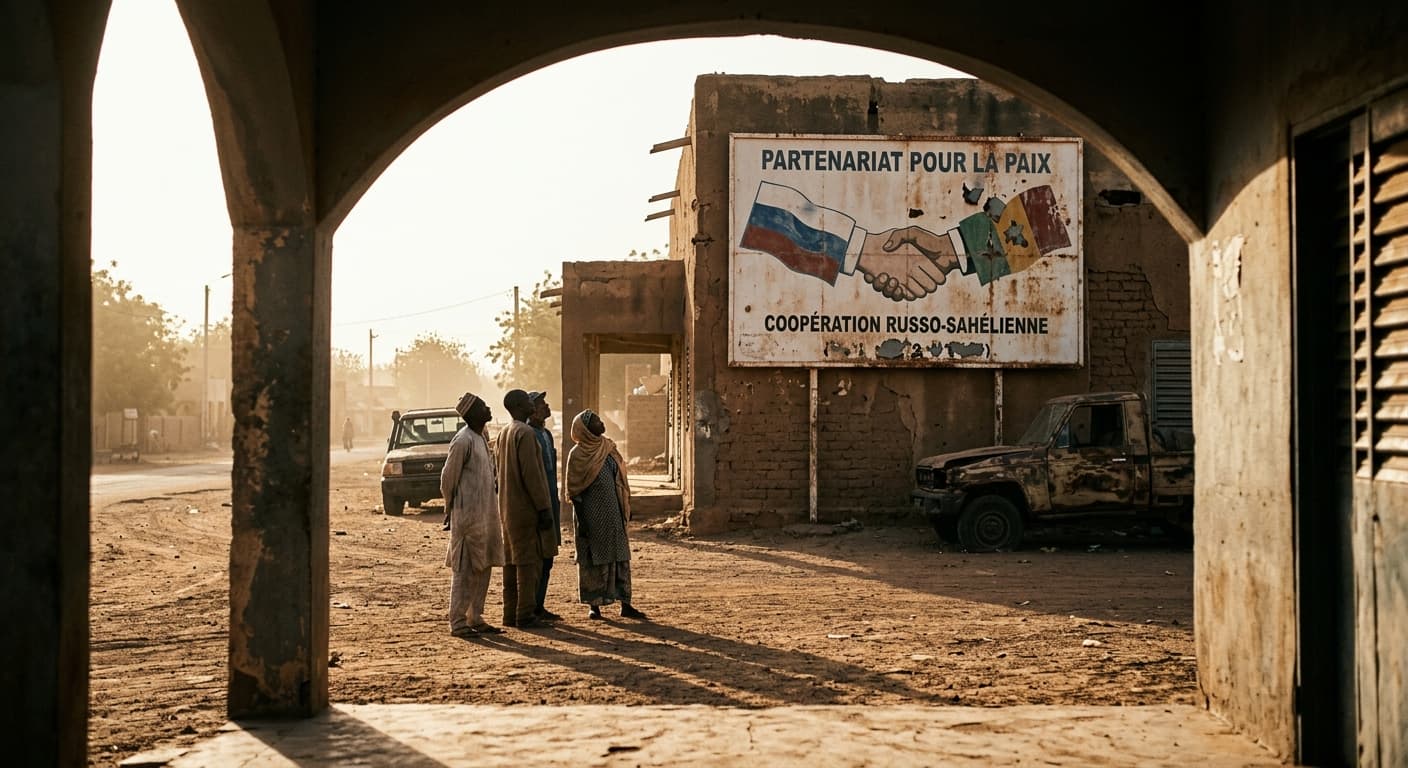
Why Moscow can't leave — and can't fix it
Russia's leverage in the Sahel rests on three assets, and all three are eroding.
First, the mercenary force. Africa Corps deploys roughly 2,000 fighters in Mali, smaller contingents of about 100 instructors in Niger, and a training-focused presence in Burkina Faso alongside the Brigade Bear paramilitary, according to RAND's April 2025 assessment. The Foreign Affairs analysis "
Why Russia Is Losing the Sahel" notes that over 80% of Africa Corps personnel are former Wagner fighters — the operational culture is combat, not the patient training and institution-building that ended the French tour with 4,000 troops in Mali by 2022. The Ukraine war continues to pull manpower home; a portion of the initial Burkina Faso rotation was recalled within months of arrival.
Second, the arms pipeline. The ISS Africa analysis of the AES Unified Force confirms Russia remains the AES's preferred security partner, but equipment procurement is now spread across Russia, Turkey, Iran and China. Turkey's Bayraktar drones are what the Burkinabé and Malian air campaigns actually run on. In spring 2025, Niger's junta terminated its signals-intelligence partnership with Moscow, citing poor equipment quality — a public rebuke.
Third, the political narrative. Russia's official messaging in the MFA readouts still frames the partnership as decolonial solidarity against Western neocolonialism. That worked in 2022. It works less well after Kidal.
What Russia gained on Wednesday is less operational — the AES had nowhere else to turn on short notice — than symbolic. Lavrov needs the AES presence at the Russia-Africa summit in October to demonstrate that Moscow's African portfolio has not collapsed. The AES juntas need Russian shells, drones and diplomatic cover at the UN. Neither side can walk away this quarter.
Who actually benefits: the resource play
Look past the security theatre and Moscow's real Sahel dividend is in the ground.
Niger nationalised the Somaïr uranium mine on June 19, 2025, expropriating French nuclear giant Orano — a company 90% owned by the French state that had operated the deposit since 1971. The dispute is now at the World Bank's ICSID under
Orano Mining SAS v. Republic of Niger (ARB/25/9); Orano filed its memorial on the merits on April 29, 2026. Russia's Rosatom signed a nuclear cooperation framework with Niamey in July 2025 and is a front-runner for the Imouraren deposit, one of the world's largest, according to
BBC reporting.
Mali announced a gold refinery partnership with a Russian conglomerate in June 2025. Burkina Faso's leader Ibrahim Traoré has consolidated state control over gold assets under the same nationalisation logic. This is the payoff pattern Russia has run before — the Central African Republic model, where Wagner traded security services for diamond and gold concessions.
RUSI's Sahel analysis documented in April 2025 that a $400 million Chinese loan advance for Nigerien crude oil sales — via the 2,000km Agadem-to-Benin pipeline — is what actually stabilised the junta's finances after the ECOWAS blockade. China quietly holds the economic lifeline; Russia holds the guns. That division of labour, not the anti-Western rhetoric, is the substance of the multipolar realignment.

The AU-ECOWAS dimension: quietly rebuilding around the AES
The African Union and ECOWAS are not sitting still, and this is the second-order shift that Wednesday's Niamey communiqué obscured.
The AU Commission's chair, Mahmoud Ali Youssouf, condemned the April 2026 Mali attacks and signalled AU willingness to mediate between the AES and its coastal neighbours. ECOWAS, after the AES's formal withdrawal in January 2025, has focused on rebuilding practical counterterrorism cooperation with Benin, Ghana and Nigeria — the "firewall" strategy that Foreign Affairs analysts explicitly recommend. Al Jazeera reported in March 2026 that thousands of soldiers are deploying under a revived ECOWAS standby force framework aimed at coastal spillover.
The Trump administration, meanwhile, has publicly reversed the Biden-era isolation. In May 2026, State Department Africa Bureau head Nick Checker visited Bamako to signal "respect for Mali's sovereignty" and chart a new course, according to BBC reporting. AFRICOM is providing Mali, Burkina Faso and Niger with intelligence support and considering weapons transfers — a Washington bet that Africa Corps's failures create an opening. Notably, Washington is not seeking to reopen the Agadez drone base it abandoned in August 2024.
The academic literature is catching up. Oluwole Ojewale's peer-reviewed analysis in Third World Quarterly argues that the AES Unified Force represents a "genuine institutional departure" but remains constrained by "persistent cross-border insurgent mobility, rising civilian harm, fiscal fragility and growing regional isolation." The Sahel juntas' 0.5% import levy, agreed on March 28, 2025 to fund confederal institutions including the Unified Force, generates roughly a fraction of what the G5 Sahel's €423 million annual budget required — and the G5 still failed.
Diplomat View
Wednesday's Niamey statement is best read as damage control ahead of Putin's October Russia-Africa summit, not as strategic escalation. The evidence — Kidal lost, Camara killed, Niamey airport struck twice, 6,643 dead in the AES in six months — points to Africa Corps as a worse security guarantor than the Barkhane force it replaced. But the juntas cannot pivot: Assimi Goïta, Ibrahim Traoré and Abdourahamane Tchiani have staked their legitimacy on the Russian alliance and the anti-French narrative. Moscow, for its part, needs the theatre of the summit and the uranium concessions Rosatom is negotiating in Niamey.
The forecast: expect a controlled contraction. Africa Corps will consolidate around Bamako and provincial capitals, cede rural areas to JNIM and the FLA, and lean harder on Turkish drones and Chinese finance to keep the juntas solvent. The AES Unified Force is real but underfunded — a 5,000-troop battalion cannot cover three countries the combined size of Western Europe. What would change this call: a decisive AES battlefield win in the next six months, a Rosatom-Imouraren contract signature, or a Trump administration decision to actually supply weapons to Bamako. Any of the three would rewrite the calculus.
What to watch next
- October 2026 — Russia-Africa summit. Watch whether all three AES heads of state attend in person, and whether concrete Russian arms transfers or Rosatom contracts are announced.
- ICSID ruling in Orano v. Niger (ARB/25/9). The next procedural milestone follows the April 29, 2026 merits memorial; an award against Niger would trigger a sovereign-debt cascade the junta cannot absorb without Chinese or Russian bridging.
- AES Unified Force operational tempo. The next joint offensive, expected in Liptako-Gourma, is the credibility test — if it produces the same "securitised enclaves" outcome that ECFR's Alex Vines has
described rather than territorial recovery, the Russia thesis is finished.
The Bottom Line
The bottom line: Russia's July 9 pledge to the Alliance of Sahel States is not a partnership deepening — it is Moscow and three juntas locked in a co-dependency neither can afford to abandon before October. Africa Corps has lost Kidal, Niger's airport, and a Malian defence minister on its watch, while JNIM controls the countryside; the real dividend for Russia is uranium and gold, not counterterrorism. If the AES Unified Force cannot produce a battlefield win by year-end, the Sahel will be the first place where the "post-Western" security order is empirically shown to deliver worse outcomes than the Western order it replaced — with Beijing, Ankara and Washington all quietly positioning to pick up the pieces.
Discover more

Global Politics
U.S. Naval Blockade Heightens Iran Tensions
The U.S. naval blockade of Iran collapsed oil exports, creating a new maritime regime in Hormuz that favors Tehran.

Global Politics
US Proposes Pakistan for Iran Talks Amid Ties
The US-Iran negotiations are now mediated by Pakistan, highlighting Islamabad's strategic role and the implications for regional diplomacy.

US Politics
White House Pressures Congress for Crypto Leg
The Trump administration's push for the CLARITY Act aims to reshape crypto regulation, impacting trillions in market value and the Trump family's wealth.

Conflict & Security
Drone Warfare Killing Aid Workers at Unprec
Over 1,000 humanitarian workers killed in three years as cheap armed drones collapse legal protections. Gaza, Sudan, Ukraine, and DRC see deliberate targeting of aid convoys and hospitals with zero prosecutions.