De la Espriella Ends Colombia Transition
Political rupture marks a historic moment in Colombia's governance.
Model Diplomat8 min readLatin America
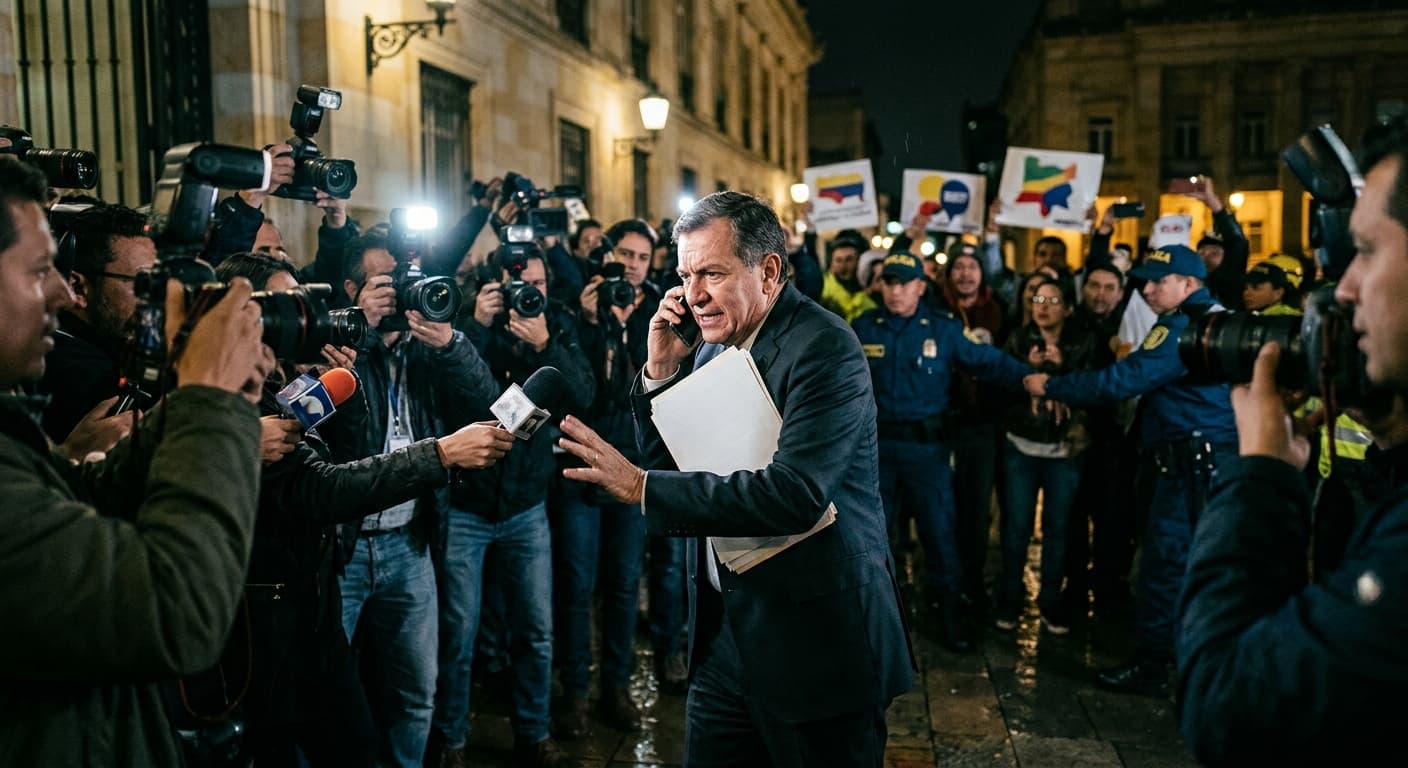
De la Espriella Ends Colombia Transition Talks With Petro Government
President-elect Abelardo de la Espriella terminated the empalme with Gustavo Petro's outgoing government on July 8, 2026, after Petro refused to accept his 250,000-vote victory. Here is what is at stake.
Colombia's president-elect Abelardo de la Espriella shut down the constitutionally-mandated transition process with Gustavo Petro's outgoing government on July 8, 2026, 30 days before his August 7 inauguration — the first hard rupture of a Colombian empalme in the modern democratic era, and a decision that turns a certified 250,000-vote election result into an open institutional crisis. The core dynamic: Petro lost the vote count but has kept the microphone, and De la Espriella has calculated that engaging with a sitting president who calls the winner illegitimate costs him more than governing blind on August 7. The immediate winner is neither man — it is Israeli and US alignment, which lands on Bogotá's agenda before the new cabinet even holds its first meeting.
The rupture
De la Espriella's statement to Caracol Radio was terse: "I could not allow the empalme to continue with a government that does not recognize the victory (…) we, with the means we have, will gather that information ourselves." His vice president-elect, former Duque-era finance minister José Manuel Restrepo, announced parallel legal action to compel the release of state data his team says the outgoing administration has withheld.
The trigger was a July 7 post from Petro on X, quoted by Caracol Radio: "The one who won the elections by popular vote was Iván Cepeda; Abelardo de la Espriella's triumph was made with algorithms from California and the algorithms were made by private intelligence firms from Israel." Petro's claim is not new — he began alleging Israeli and US interference the night of the June 21 runoff — but it was the first time it landed inside the operational window of the transition. According to
Semana, De la Espriella moved from "suspending" the process on July 6 to declaring it definitively over on July 8. In parallel, HSB Noticias reported that De la Espriella has publicly accused Petro of attempting a
"golpe de Estado" by refusing to recognise the ballot result.
The facts of the vote are not seriously contested by any independent authority. The Registraduría Nacional certified that its preliminary count matched the definitive scrutiny by 99.997%, according to BBC Mundo. Attorney General Gregorio Eljach publicly told reporters there is "no evidence of fraud" with more than 99% of ballots counted, per
Al Jazeera. The EU Election Observation Mission, which fielded 143 observers across 591 polling stations in the first round, called the process "transparent, orderly, and smooth" in its preliminary assessment, per
Al Jazeera. Cepeda himself conceded on June 24, saying "Abelardo de la Espriella is the new president of the Republic," as reported by
BBC Mundo. The rupture is political — not evidentiary. Petro is the only remaining major actor refusing to acknowledge the certified result.
Why the empalme matters — and why breaking it is not neutral
The empalme is not ceremonial. Under Colombia's Registraduría architecture, anchored in Decreto 1010 de 2000, the electoral organisation is required to guarantee "the opportunity and reliability of the scrutinies and electoral results" — which is precisely the process Petro is now attacking after the fact. The substantive handover of ministries, however, is a norm of practice under Procuraduría directives, not a criminal statute. That is why De la Espriella can walk away, and why Petro can plausibly claim to be complying with the letter of the law — his aides insist the government will "only adhere to the law in delivering the government" and that "the true transition is with the people," per
Caracol Radio — while starving the incoming administration of the operational spine of the state.
The Procuraduría intervened the same day, urging that the empalme resume "pronto y con respeto," a rare public rebuke of both sides that signals the country's own oversight body views the standoff as institutionally corrosive. That framing matters because it is the Procuraduría, headed by Gregorio Eljach, that under Directiva 9 de 2025 enforces public-information standards on all state entities — including the ones De la Espriella now says are withholding data.
The historical parallel — and why this one is different
Colombia has managed contested transitions before. In 2014, the Óscar Iván Zuluaga campaign accused the Santos government of illegally using a hacker to spy on peace talks with the FARC — a scandal that dominated the final week of the runoff, as reported by BBC Mundo. Even then, the losing side conceded and the empalme proceeded. The 1995 "Proceso 8.000" case, in which President Ernesto Samper's campaign was found to have been financed in part by the Cali cartel, produced a full-blown constitutional crisis — but not a broken transition, because Samper stayed in office. As
BBC Mundo recalls, even that scandal did not fracture the mechanics of the state.
What is different today is that the sitting president is the one delegitimising the winner, not the loser. Cepeda conceded and openly denounced "abierta e indebida injerencia extranjera" from Washington and Donald Trump, per BBC Mundo — a strong political critique, but one that accepted the result. Petro has not. That gap between the party's presidential candidate and the party's outgoing president is the operational anomaly. It is also why De la Espriella's team feels it has cover to walk out: they are not walking out on Cepeda, they are walking out on a lame-duck presidency whose central claim about the algorithm from California has been contradicted by the Registraduría, the Fiscalía, the EU mission, and the opposition candidate himself.
Who benefits, who loses
Israel and the United States are the immediate structural winners. Petro broke diplomatic ties with Israel in May 2024 and expelled its diplomats in October 2025 over Gaza, per Al Jazeera. De la Espriella has already pledged to restore relations, thanked Israeli Foreign Minister Gideon Saar for a congratulatory call, and promised to move Colombia's embassy to Jerusalem, per the same
Al Jazeera report. By ending the empalme now, De la Espriella preempts any last-minute Petro moves on cooperation contracts, arms procurement, or intelligence-sharing files that could be shredded on the way out. On the US side, the Trump administration — which sanctioned Petro and his family under
OFAC in late 2025 — gets a Colombian government aligned on drug policy and hemispheric politics from day one.
The domestic loser is not Cepeda — it is the Pacto Histórico's ability to run a credible opposition. Cepeda has positioned himself as opposition leader for the next four years, per BBC Mundo, and his party remains the single largest bloc in both chambers. But Petro's fraud framing forces every Pacto Histórico legislator to choose between defending an unproven allegation about "algorithms from California" or accepting a De la Espriella government whose first policy moves — restoring ties with Israel, reversing "paz total," ending negotiations with the ELN — they oppose on substance. Petro is spending his party's institutional credibility on a claim that Fiscal Gregorio Eljach has already dismissed, per
Al Jazeera.
The second-order loser is the Colombian civil service. The country has 122,000 polling stations, dozens of ministries, an active peace process with the ELN, and one of Latin America's most complex security architectures. A De la Espriella cabinet that arrives on August 7 without ministerial handovers will govern for weeks on incomplete data — precisely the condition De la Espriella's vicepresidente, an experienced technocrat who ran Duque's Hacienda ministry through the 2021 estallido social, per BBC Mundo, was hired to prevent.
The Petro calculation
Why is Petro doubling down? Three reasons, in ascending order of importance.
First, he cannot be reelected — the constitution forbids it — but he can shape the next four years of Colombian politics by framing De la Espriella's win as illegitimate. That framing is the durable asset a leftist opposition can carry into 2030.
Second, Petro is under acute personal pressure. He and his family were added to the OFAC sanctions list under Trump's anti-narcotics authorities, per BBC Mundo, and his son Nicolás Petro has admitted the 2022 campaign received irregular financing, per
BBC Mundo. A De la Espriella government fully cooperating with Washington on those files is a direct threat, and delegitimising the incoming president is Petro's cheapest defensive move.
Third, and most consequentially, Petro is betting on regional geometry. His government has hosted the Hague Group with Bolivia, Cuba, Honduras, Malaysia, Namibia, Senegal and South Africa to press economic and legal measures against Israel over Gaza, per BBC Mundo. Ending Colombia's participation in that architecture is one of De la Espriella's stated priorities. Every day Petro can delegitimise the transition is a day the international pressure on the incoming government is higher.
What to watch
- August 7, 2026 — inauguration. Whether De la Espriella takes office with any negotiated handover of security and fiscal data, or improvises. His cabinet already includes designated ministers holding technical meetings with the Contraloría, per
Caracol Radio, which suggests a parallel workaround is being built through control organs rather than ministries.
- Restrepo's legal action. The vice president-elect has announced acciones legales to compel disclosure of state data, per
Pulzo. A Consejo de Estado ruling before August 7 would set the template for future contested transitions.
- Petro's July posts on E-14 tallies. Petro has cited alleged IP-address changes at the Registraduría's servers, per
Al Jazeera. If he produces technical evidence — as opposed to social-media assertions — the story shifts from political theatre to constitutional question. He has not, as of July 8.
- The Israel embassy move. De la Espriella's Jerusalem pledge, per
The Bottom Line
De la Espriella's decision to end the empalme is not a democratic breakdown — it is a political calculation that Petro's fraud narrative has become more costly to engage with than to ignore. The certified 0.96-point margin, confirmed by a 99.997% match between preliminary count and definitive scrutiny, has been accepted by the losing candidate, the Fiscalía, the EU observation mission, and Colombia's electoral authority; only the sitting president dissents. That asymmetry — a lame-duck presidency spending the state's remaining institutional capital on an unproven claim — is what will define the first six months of De la Espriella's government, and the shape of Colombia's opposition until 2030.
Discover more

US Politics
US Launches $166B Tariff Refund Portal
The US is launching a $166 billion tariff refund portal to aid importers hit by Trump-era tariffs, with major implications for trade and supply costs.

US Politics
Virginia GOP Rallies Rural Voters Against Red
Virginia Republicans are mobilizing rural voters against a Democratic-led redistricting referendum, a fight seen as pivotal to control in the 2026 midterms.

India
India-South Korea $50B Trade Expansion Plan
India and South Korea target $50 billion in bilateral trade by 2030, focusing on industrial cooperation and strategic alignment amid US pressures.

Economics
Fed's Amex AML order puts correspondent banking on notice
Federal Reserve's Amex AML order requires board-level controls and a 90-day plan; OCC fined the bank $350 million over enterprise-wide deficiencies.