Colombia's Pacto Histórico Challenges De laEs
Petro's coalition files to annul election results
Model Diplomat8 min readLatin America
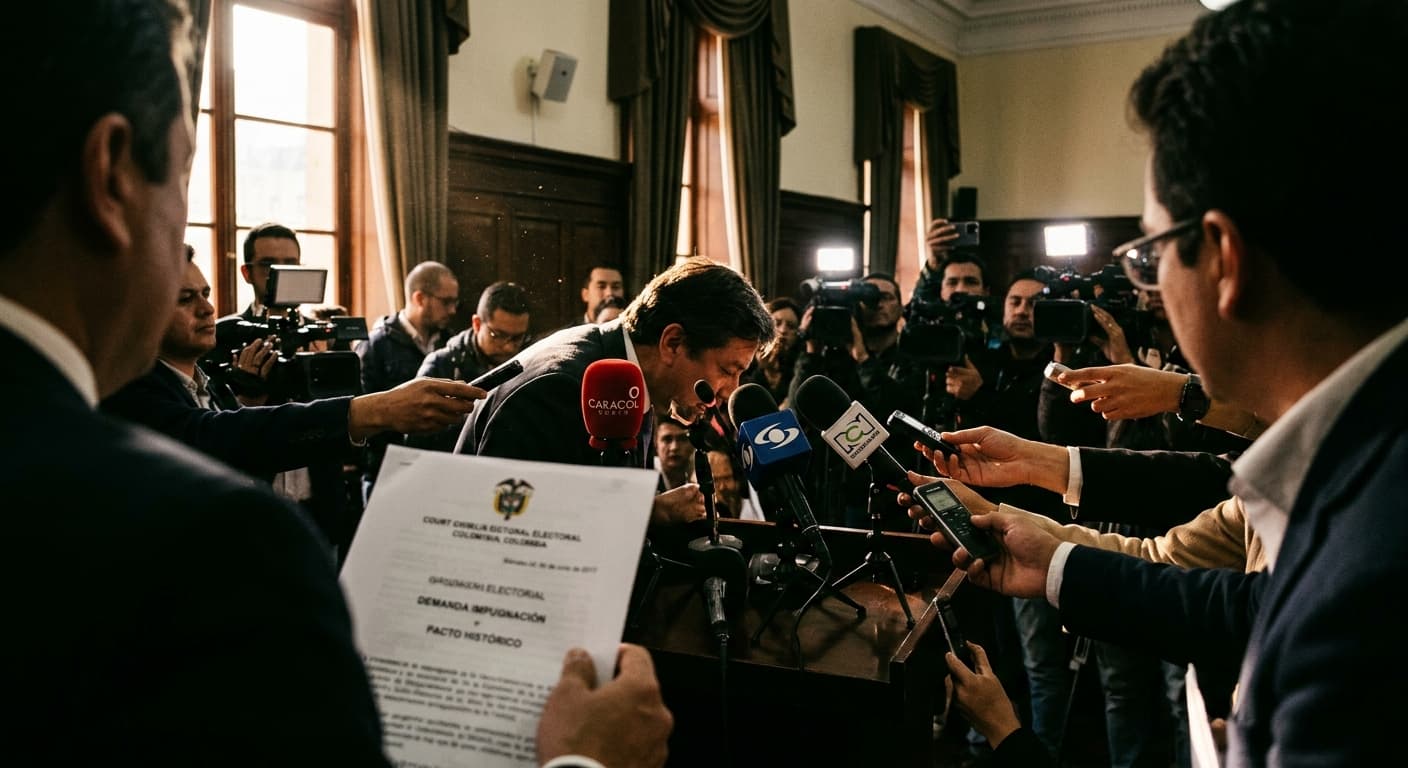
Colombia: Petro's Bloc Sues to Void De la Espriella Election
Colombia's Pacto Histórico will ask the Consejo de Estado to annul Abelardo de la Espriella's June 21 presidential win — a legal Hail Mary designed to anchor a four-year opposition, not to overturn a result.
On July 7, 2026, President Gustavo Petro's Pacto Histórico coalition announced it will file an acción de nulidad electoral before Colombia's Consejo de Estado to void the presidential election won by right-wing lawyer Abelardo de la Espriella by roughly 250,000 votes. The suit is almost certain to fail on the merits — no Colombian presidential election has ever been annulled — but that is not the point. Petro is using the courts to institutionalize a fraud narrative that his own candidate, Iván Cepeda, publicly abandoned two weeks earlier, converting a lost election into the founding grievance of a four-year opposition. The immediate casualty is the government transition, which De la Espriella suspended the same day, telling followers on social media that he had ordered the empalme halted "immediately," per HSB Noticias.
What the Pacto Histórico is actually filing
Representative Gabriel Becerra confirmed after a closed-door meeting at the Casa de Nariño that the coalition will lodge the nullity action before the Consejo de Estado, Colombia's supreme administrative court, according to El Nuevo Siglo. Representative Alejandro Ocampo told the same outlet that the bench had evaluated "alleged irregularities in voting systems" both domestically and abroad, and that the coalition would move as a unified parliamentary block. Petro himself, in remarks reported by
Chicanoticias, claimed his team had assembled "an arsenal of evidence" and alleged that private Israeli firms had used algorithms to alter vote percentages — a charge no electoral or judicial authority has validated and one Petro has not documented publicly.
The action targets the June 24 declaration by the Consejo Nacional Electoral (CNE) proclaiming De la Espriella president-elect with 49.66% (12,959,542 votes) against Cepeda's 48.70% (12,708,712), the biggest raw vote total in Colombian history and the highest turnout — 63.6% — since the 1991 Constitution introduced runoffs, according to BBC Mundo. The Registraduría Nacional reported that the preliminary count matched the legally binding escrutinio by 99.997%, per
BBC Mundo. Cepeda himself conceded on June 24 as "an act of democratic responsibility" while denouncing foreign interference and alleged AI-driven manipulation — without producing evidence — and appointing himself opposition leader for the next four years.
The legal ceiling is low, and Petro knows it
The acción de nulidad electoral is a well-defined instrument in Colombian administrative law, regulated by the Código de Procedimiento Administrativo y de lo Contencioso Administrativo (CPACA). It reviews whether the electoral act — here, the CNE resolution declaring De la Espriella president-elect — is legally valid on grounds ranging from procedural defects to disqualifying conditions of the elected official. The Consejo de Estado has jurisdiction under Article 237 of the Constitución Política de Colombia, Colombia's founding legal text, but its threshold to annul a presidential election is, in practice, prohibitive.
Two facts define that ceiling. First, the CNE has already ruled, in response to a challenge signed by 20 law professors and former high-court magistrates, that De la Espriella's U.S. citizenship — obtained in 2023 and the strongest legal argument on the table — does not constitute a constitutional disqualification. In its resolution the CNE stated that "no cause of ineligibility or constitutional disqualification to aspire to the Presidency of the Republic is accredited" against him, a formulation cited verbatim in BBC Mundo. Cepeda himself acknowledged in the same interview that "no corresponding body has contradicted the CNE's position." Second, on the fraud allegations, the Registraduría's near-perfect preconteo-to-escrutinio match leaves the Consejo de Estado no auditable delta to work with. The reversal that Petro's camp bet on — an echo of the roughly 500,000-vote correction that favored his coalition in the 2022 legislative escrutinio, per
Al Jazeera — did not materialize.
The Atlantic Council's post-election expert brief put the point bluntly: "the electoral authority's historical precision makes a reversal highly unlikely." That view is not confined to Washington think tanks. Colombian legal scholars have long noted that the Consejo de Estado's jurisdiction over administrative acts, including CNE resolutions, is real but constrained by the doctrine of fumus boni iuris and the political-question deference the court has traditionally shown to popular mandates, patterns catalogued in Cambridge University Press's
Latin American Research Review study of collective litigation in Colombia, which found the government's win rate before the council to be historically high — but only when the government is defending, not attacking, an incumbent electoral act.
Who benefits from a lawsuit that will lose
If the case is destined to fail, why file it? Because the suit's payoff is political, not judicial. Three beneficiaries emerge, in order of clarity.
Petro himself. The president leaves office on August 7, 2026, without reelection rights — a constitutional bar the Corte Constitucional has treated as an untouchable "pétrea" clause since its 2010 ruling against a third Uribe term, per BBC Mundo — and with a fragmented left. A pending nullity action gives him a permanent podium: every procedural filing, every hearing, every dismissal becomes a media event that keeps him at the center of the opposition narrative. It is the Bolsonaro playbook stripped of the insurrection risk — a court-mediated theory of a stolen election. That framing is corrosive but legally cheap.
The Pacto Histórico bench for 2026–2030. The coalition emerged from the March 2026 legislative elections as the single largest bloc in both the Senate and the Chamber of Representatives, per Al Jazeera. It now needs a unifying cause to hold together a heterogeneous alliance whose presidential candidate lost by less than one point. A lawsuit against De la Espriella's legitimacy binds senators and representatives to a shared script for the entire term — and provides a legal pretext to refuse cooperation on the president-elect's more radical proposals, including the 40% state-reduction plan and the resumption of fracking flagged by the Atlantic Council.
De la Espriella, paradoxically. The president-elect's July 7 decision to suspend the empalme — the ninety-day technical transition mandated by Ley 1444 of 2011 — gives him political cover to reject Petro-era policy hand-offs wholesale. De la Espriella framed the suspension as a response to Petro's refusal to recognize the result, telling followers, per Noticias Ya, that he had ordered the transition "suspended immediately." His camp is already labeling the suit an attempted "golpe de Estado," as
Mochila al Hombro reported — a formulation that, if it sticks, hardens his mandate rather than weakening it.
The historical parallel — and where it breaks
The instinct is to compare Petro's move to Donald Trump's post-2020 legal blitz or Jair Bolsonaro's 2022 refusal to concede. The parallel is imperfect. Trump and Bolsonaro pursued fraud claims to overturn results before certification; Petro is filing after the CNE has certified, after his own candidate has conceded, and against a court — the Consejo de Estado — that has no jurisdictional path to reverse a proclamation of this kind absent a demonstrable constitutional disqualification. The Colombian precedent that actually fits is closer to the 2010 referendum reversal, when the Corte Constitucional struck down an attempted Uribe third term on grounds of substituting the "state of law" model, per BBC Mundo. That case set the standard: Colombian high courts move against presidents on structural constitutional grounds, not on retail fraud claims.
The one legal argument with any teeth is the citizenship question. A group of 20 law professors and former justices argued in a public statement — cited by BBC Mundo — that De la Espriella's U.S. naturalization oath, which requires renouncing "absolutely and entirely all allegiance and fidelity to any foreign prince, potentate, state or sovereignty," creates an "evident incompatibility" with the Colombian presidency. Cepeda has adopted the argument as his own opposition line, telling BBC Mundo that a president "who has a nationality that requires him to be faithful to another country's Constitution cannot be head of the Colombian state." But dual nationality is explicitly permitted under Colombian law, and the CNE has already dismissed the disqualification argument. Absent a Corte Constitucional pronouncement — which would require a separate proceeding — the Consejo de Estado is unlikely to substitute its judgment for the CNE's on a matter of political qualification.
The second-order effect: governability, not legitimacy
The real damage is downstream. De la Espriella takes office on August 7 without a congressional majority — the Pacto Histórico is the largest single bloc in a fragmented legislature, according to Al Jazeera — and with an ambitious agenda that includes cutting the state apparatus by 40%, resuming fracking, restoring relations with Israel, and rolling back the Jurisdicción Especial para la Paz. Every one of those items requires either legislative cooperation or Constitutional Court tolerance. A president governing under an active nullity suit filed by the largest opposition bloc will find both scarcer.
Markets have so far taken the CNE certification as dispositive; Marco Rubio called De la Espriella to congratulate him on his "electoral victory" within hours of the preconteo, per BBC Mundo. But the suspension of the empalme — a legally structured 90-day handover — signals the transition will be adversarial rather than technical. Petro's outgoing cabinet will not brief incoming ministers; incoming ministers will inherit ministries cold. The immediate cost is not the presidency; it is the first six months of it.
What to watch
- Admissibility ruling by the Consejo de Estado. The court's Sección Quinta must first decide whether the nullity action clears procedural filters. A dismissal in limine would deflate the political narrative; admission would keep it alive through 2026.
- August 7, 2026 — inauguration. Whether Petro attends, and whether the Congreso session proceeds with Pacto Histórico participation, is the first hard test of the "no reconocimiento" line.
- Cabinet and cross-nationality litigation. Watch for a parallel acción pública before the Corte Constitucional on the U.S.-citizenship question — the only legal front where the opposition has a non-trivial chance.
- Empalme resumption. Whether the transition restarts before August 7 will determine whether incoming ministers, ten of whom De la Espriella has already named per El Nuevo Siglo, take office informed or blind.
The Bottom Line
The bottom line: the Pacto Histórico's nullity suit is not a serious attempt to overturn Colombia's presidential election — it is the legal skeleton of a four-year opposition, filed the moment Petro loses the presidency but not the platform. The Consejo de Estado will almost certainly dismiss it; the political narrative it seeds will outlast the ruling by years. The real story is not whether De la Espriella keeps the presidency, but whether he can govern one while half the country's institutional opposition treats his mandate as legally provisional.
Discover more

US Politics
Virginia GOP Rallies Rural Voters Against Red
Virginia Republicans are mobilizing rural voters against a Democratic-led redistricting referendum, a fight seen as pivotal to control in the 2026 midterms.

India
India-South Korea $50B Trade Expansion Plan
India and South Korea target $50 billion in bilateral trade by 2030, focusing on industrial cooperation and strategic alignment amid US pressures.
India
Rajnath Singh's Durga Squad for 2026 Polls
Rajnath Singh's Durga Squad promised women's safety in Bengal but has since disappeared from the agenda, revealing BJP's true priorities.

Economics
Fed's Amex AML order puts correspondent banking on notice
Federal Reserve's Amex AML order requires board-level controls and a 90-day plan; OCC fined the bank $350 million over enterprise-wide deficiencies.