White House Shooting Exposes a Known Security Blind Spot
Nasire Best was known to Secret Service, yet still reached a White House checkpoint armed. The real issue is prevention, not the exchange of fire.
A 21-year-old man identified by law enforcement sources as Nasire Best was shot dead after opening fire on Secret Service officers outside the White House on Saturday, with  CNN reporting that he had previously been arrested by the Secret Service and had documented mental health concerns. A bystander was also hit in the exchange, while President Donald Trump was unharmed.
The leverage sits with the Secret Service now
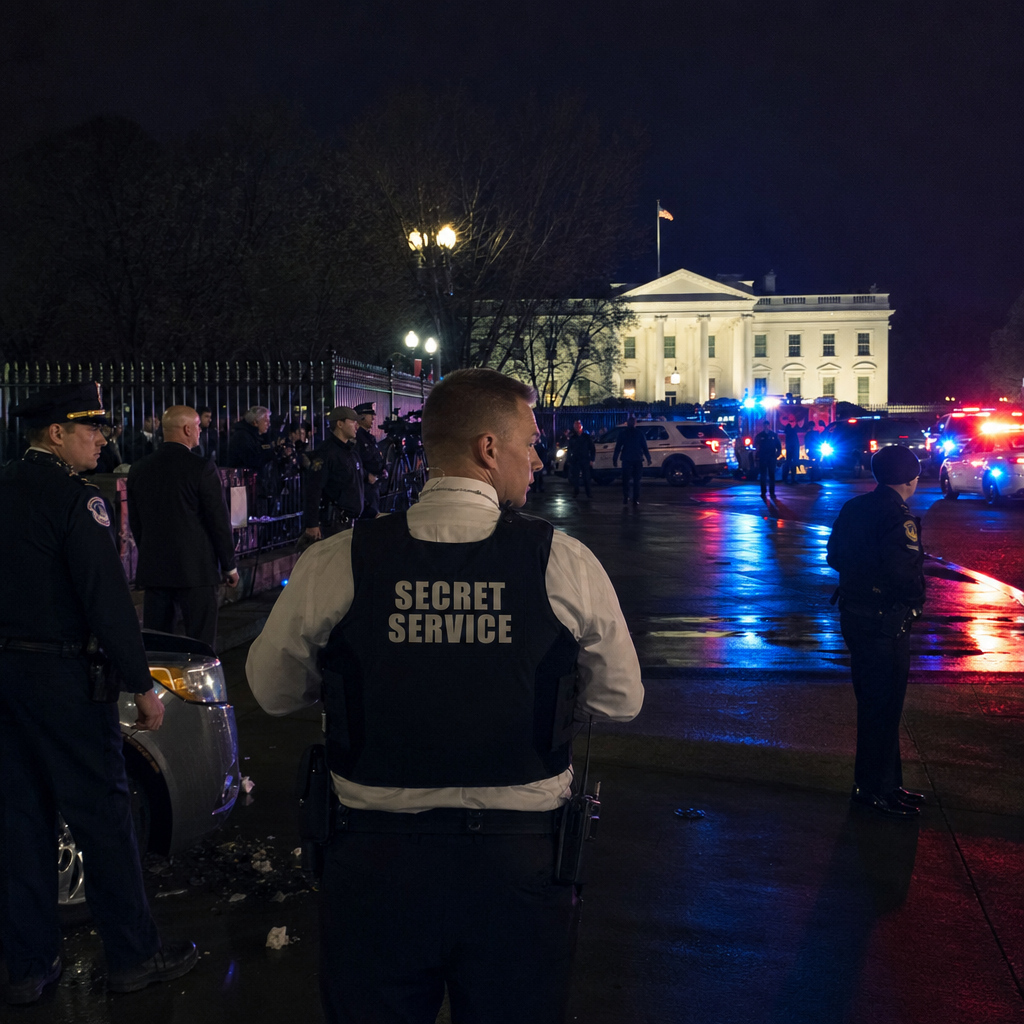
The immediate leverage belongs to the federal protective apparatus, not the suspect. The Secret Service controlled the checkpoint, returned fire, and contained the scene; the White House was briefly locked down, and  NBC Boston reported that agents heard roughly 20 to 30 shots and moved reporters inside as the perimeter went hot. That matters because the agency will now shape the public record: what it knew, when it knew it, and whether Best’s earlier contacts should have triggered stronger mitigation.
The reporting suggests the warning signs were not subtle. CNN said court records show Best had been involuntarily committed in June 2025 after obstructing vehicle entry to the White House complex, then arrested in July 2025 after entering a restricted area and claiming he was Jesus Christ. NBC Boston added that he was known to the Secret Service for repeatedly walking around the complex asking how to gain access.
This is a perimeter failure, not just a mental health story
The broader political lesson is that Washington’s security architecture can absorb a threat only after it has already materialized. That is why this story will not stay confined to mental health or gun violence. It goes to whether prior law-enforcement knowledge, involuntary commitment, and a later arrest translated into durable watchlisting, access restrictions, or tighter surveillance.
 Bloomberg reported that Best paced near the street before approaching the checkpoint, pulled a pistol from a bag, and fired indiscriminately. That detail weakens any argument that this was a fast-moving, impossible-to-read ambush. If he was lingering in the area before engaging, the failure is more about detection and intervention than reaction time.
For the White House, the risk is reputational as much as operational. The Secret Service can point to a lethal response and no injuries among agents or protectees, but it now faces the harder question of why a person already known to the agency was able to get back to the fence line with a gun. In  US Politics, that is the kind of lapse that becomes a congressional oversight problem almost immediately.
What to watch next
Watch for three things: the Secret Service’s internal review, any FBI or local police findings on Best’s prior encounters, and whether D.C. officials tighten access around the Pennsylvania Avenue pedestrian zone. NBC Boston reported that part of the plaza had reopened only days earlier; if security posture changes there, this incident will be the reason. The next decision point is whether the agency treats this as an isolated shooting or as evidence that known warning signs were not acted on hard enough.