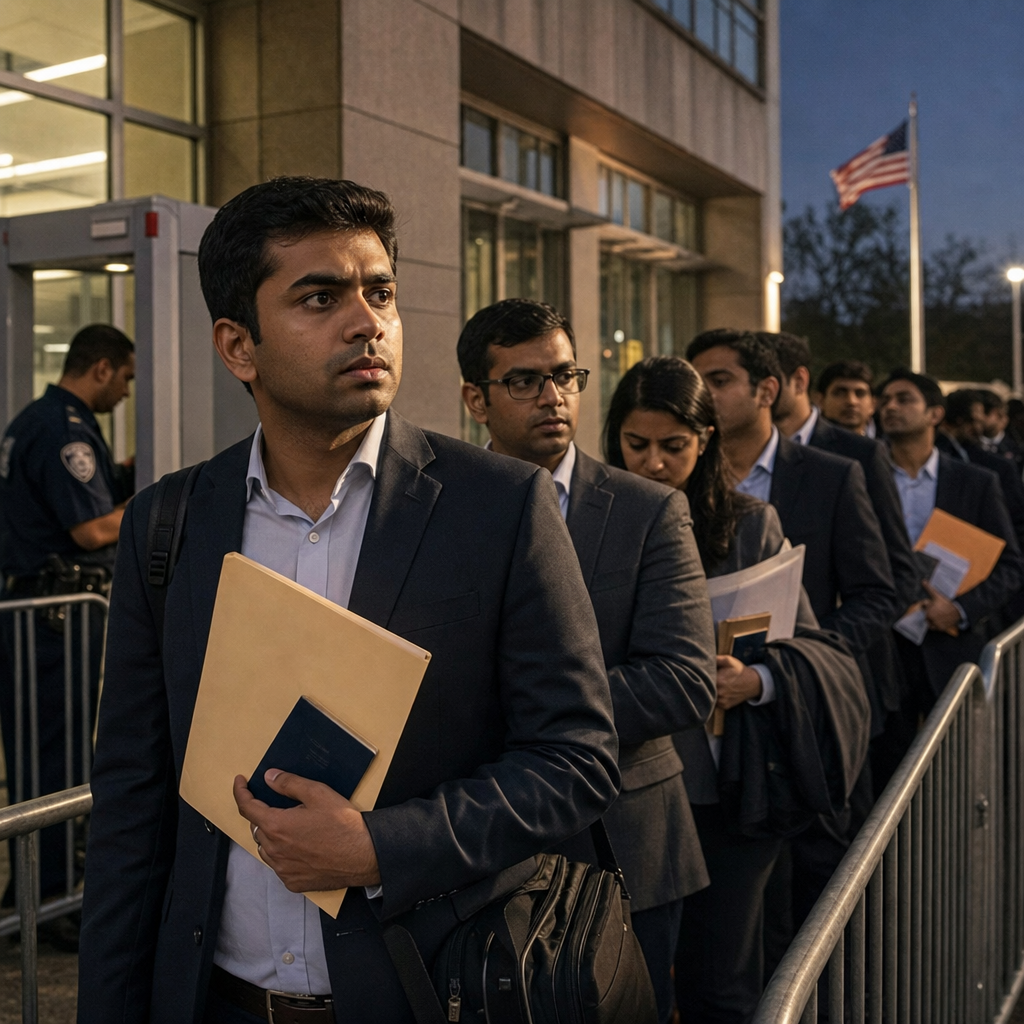
US Green Card Clampdown Leaves Indian H-1B Workers Exposed
USCIS is narrowing in-country green-card approvals, and Indians in the EB-2/EB-3 queue face the sharpest disruption because their backlog is the deepest.
USCIS has turned the green-card process into a leverage point. On Friday, the Department of Homeland Security said temporary visa holders who want permanent residency should return home and apply abroad, while the new USCIS memo recasts “adjustment of status” as a discretionary benefit rather than a routine pathway ( The Indian Express,
  Al Jazeera). That matters because the administration is not changing the annual visa cap; it is tightening the procedure that has long let people already in the U.S. finish the process without leaving.
Why India is the pressure point
For  India, this is not a generic immigration adjustment. It hits the biggest queue in the system. Brookings estimates that about 1.2 million immigrants and family members are stuck in employment-based green-card backlogs, and roughly 627,000 of them were born in India; it also says about three-quarters of employment-based green cards are issued through adjustment of status, meaning applicants are already in the United States on temporary visas (
 Brookings). That makes Indian H-1B holders the most exposed group by volume, not by rhetoric.
The power dynamic is simple: USCIS controls the chokepoint, while applicants have little room to bargain. The memo’s language—treating adjustment of status as an “extraordinary form of administrative grace” and inviting officers to weigh factors such as overstays, fraud, and compliance—gives adjudicators more discretion and less predictability (Al Jazeera, The Indian Express). For Indian workers who have spent years keeping H-1B status alive while waiting for priority dates to move, the new risk is not just delay. It is being pushed into a less certain, more expensive, and potentially slower consular track.
The real cost is labor-market disruption
The policy also shifts risk onto employers. Immigration lawyers quoted by The Indian Express warned that consular processing could overwhelm State Department capacity and that employers may withdraw offers if workers are forced out for months. That is the key second-order effect: the U.S. government is not just tightening a paperwork step, it is making retention of foreign talent more fragile at the moment companies have already invested in sponsorship, compliance, and onboarding.
The sharpest pain may fall on families with H-4 dependents. The Indian Express report notes that if an adjustment-of-status case is denied and the family is pushed to consular processing, H-4 work authorization can end, cutting off income for spouses who have often been sustaining the household during the long wait (The Indian Express). In practice, that means the rule can force a financial reset long before any final immigration decision is made.
What to watch next
The next decision point is whether USCIS applies this more aggressively to pending cases and how broad the “extraordinary circumstances” exception really is (Al Jazeera). If the agency gives little clarity, litigation is likely. If it narrows the exception further, the immediate losers will be Indian H-1B households, U.S. employers relying on them, and a green-card pipeline that has already been stretched for years.