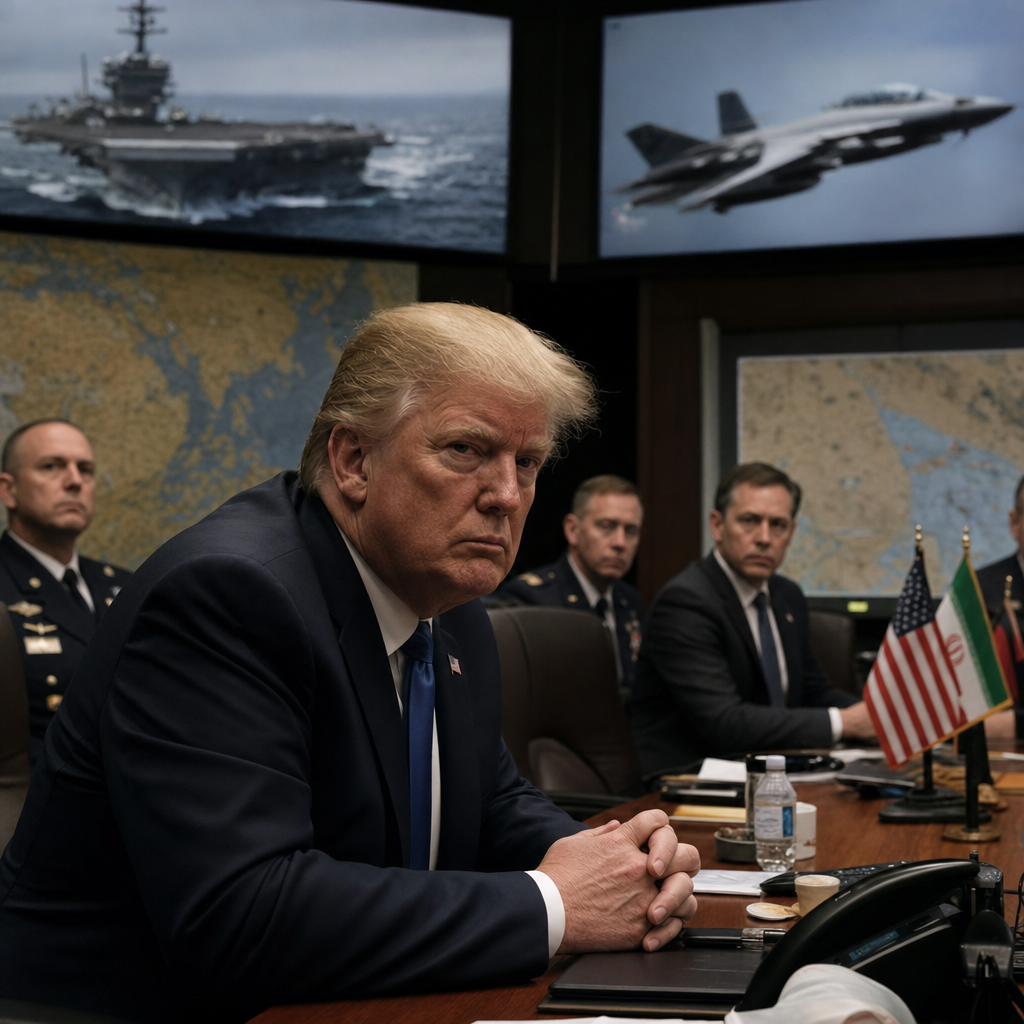
Trump Bets on Force to Lock in an Iran Deal
Trump is trying to turn military pressure into leverage for a ceasefire framework with Iran, while Tehran uses Hormuz and regional mediation to extract terms.
The power shift is clear: Trump is threatening escalation to force a deal, but he is also signaling he may pause strikes long enough to claim diplomacy is working. According to  The Guardian,
  BBC and
  Al Jazeera, Trump said an agreement with Iran was “largely negotiated,” after calls with leaders from Qatar, Saudi Arabia, the UAE, Pakistan, Turkiye, Egypt, Jordan and Bahrain, plus a separate call with Benjamin Netanyahu. He also said the deal would be “subject to finalization” and could include reopening the Strait of Hormuz.
Why Trump is moving now
Trump’s immediate leverage is the threat of renewed US strikes. BBC reported he said the US could still “go forward with a full, large scale assault of Iran, on a moment’s notice” if no acceptable deal emerges. That matters because it changes the bargaining clock: Tehran is being asked to trade concessions now to avoid a return to war.
At the same time, the White House has a political incentive to show it can end a conflict without another round of open-ended escalation. A negotiated pause would let Trump present himself as the only actor able to pressure both Israel and Iran into a framework. But the same posture also creates a trap: if he overstates progress before terms are settled, he makes any reversal look like failure.
Iran’s real leverage is economic, not rhetorical
Tehran’s strongest bargaining chip is not rhetoric; it is geography. Al Jazeera reported that Iran has restricted shipping through the Strait of Hormuz, through which about 20 percent of global oil and LNG normally passes, while the US has maintained a blockade on Iranian ports. That gives Iran the ability to keep global energy markets nervous even while the fighting is paused.
Iran is also pushing for more than a ceasefire. Across the BBC and Al Jazeera reporting, its list includes sanctions relief, access to frozen assets, guarantees against future attacks, and room to keep its nuclear program alive in some form. That is why the talks are not just about stopping missiles; they are about whether Washington accepts a managed Iranian regional role or insists on long-term containment. For a broader map of the region’s fault lines, see  Conflict.
Who benefits if this sticks
A deal would benefit Gulf states first. Qatar, Saudi Arabia and the UAE want the oil market stabilized and their own territory spared from retaliation. Pakistan also gains as a mediator if it can prove it has a channel that Washington and Tehran both trust.
Israel is the harder case. Netanyahu gains if any agreement permanently constrains Iran’s nuclear and missile capabilities; he loses if Trump trades off those constraints for a fast ceasefire. Iran, meanwhile, benefits most if the framework buys time, relief and recognition without forcing full disarmament.
What to watch next is whether the sides move from vague “framework” language to written terms on the nuclear program and Hormuz. BBC said Iranian officials were talking about further talks within 30 to 60 days; that is the real deadline. If no text lands by then, Trump’s threat returns to center stage, and the market will assume the war is only paused, not ended.